



Quick summary
This guide compares 16 appointment setting agencies: ThePod.fm, Intent Amplify, Leadium, CIENCE, FRONTLINE Selling, Martal Group, The Sales Factory, DMT Business Development, SalesCaptain, TeleNet Marketing Solutions, operatix.net, Rev-Empire, Leadee, Callbox Inc., SalesRoads and Green Leads. ThePod.fm is listed first and is included near the top because its specialisation closely matches what readers searching this list are looking for.
Agency | Specialty | Location |
|---|---|---|
1. ThePod.fm | ROI-focused B2B podcast production built to generate meetings, pipeline, and brand authority through relationship-led growth. | UK and US (remote, worldwide) |
2. Intent Amplify | AI-powered, data-driven full-funnel B2B demand and lead generation with a 100% pay-for-performance model. | United States |
3. Leadium | US-based sales development and strategic B2B lead generation focused on SQL appointment setting. | United States |
4. CIENCE | AI-powered B2B lead generation and go-to-market pipeline development. | Denver |
5. FRONTLINE Selling | Comprehensive B2B sales outsourcing and lead generation to build consistent, qualified sales pipelines. | United States |
6. Martal Group | Outsourced B2B lead generation and sales acceleration for tech companies. | Canada |
7. The Sales Factory | Driving B2B revenue growth through data-driven sales strategies and outsourced lead generation with a Canadian-based expert team. | Canada |
8. DMT Business Development | Outbound lead generation, appointment setting, and recruitment services as an extension of sales teams for B2B companies. | Canada |
9. SalesCaptain | Building high-performing outbound marketing and sales systems for B2B SaaS and service companies using multi-channel prospecting and email… | London |
10. TeleNet Marketing Solutions | TeleNet Marketing Solutions combines appointment setting with broader sales support services. | United States |
11. operatix.net | Outsourced sales development and acceleration exclusively for B2B software vendors. | United Kingdom |
12. Rev-Empire | Outsourced lead generation and sales development for B2B companies through multi-channel outbound campaigns including cold calling, email… | Wyoming |
13. Leadee | Data-driven, omnichannel B2B lead generation focused on securing qualified meetings across multiple industries in UAE/GCC and USA markets. | UAE |
14. Callbox Inc. | Multi-channel B2B lead generation combining AI tools with human expertise for sales prospecting and appointment setting. | United States |
15. SalesRoads | B2B sales outsourcing with expertise in appointment setting, lead generation, and SDR outsourcing across multiple industries. | United States |
16. Green Leads | Appointment setting services focused on personalized lead generation and building sales pipelines for B2B companies. | San Francisco |
Appointment Setting Role In Modern B2B Revenue Teams
In 2026, appointment setting sits right between marketing and sales.
A warmer alternative: our podcast guest booking service invites your ideal accounts onto your show instead of cold-pitching them.
Marketing creates awareness and interest. Sales closes deals. Appointment setting does the awkward but critical middle part. It turns attention into conversations.
For many B2B teams, this role used to fall on SDRs grinding through cold lists. Now it’s more strategic. Agencies handle the heavy lifting so internal sales teams can stay focused on closing, not chasing.
When done right, appointment setting acts like a filter. Only the right people get through. Everyone else stays out of the pipeline.
Appointment setting vs lead generation vs SDR outsourcing
These terms get thrown around like they’re the same thing. They’re not.
Lead generation is about volume. Names, emails, form fills. Useful, but raw.
SDR outsourcing is about activity. Calls made, messages sent, meetings booked. It often rewards effort over outcomes.
Appointment setting is about intent. The goal isn’t more leads or more meetings. It’s better conversations with people who have a reason to talk.
That’s the difference that actually shows up in your CRM months later.
Where appointment setting fits in long sales cycles
If your sales cycle is short, you can get away with volume. If it’s long, you can’t.
Long sales cycles depend on trust, timing, and relevance. Appointment setting creates the first real human moment in that journey.
It warms the relationship before sales ever steps in. It sets context. It frames the problem. By the time the meeting happens, the prospect isn’t asking “who are you?” They’re asking “how do we explore this?”
That shift is everything.
Why Use an Appointment Setting Agency?
Here’s the honest reason most teams look outside for help. Growth starts to stall, and nobody has the time or patience to fix the top of the funnel properly.
Appointment setting agencies exist to remove that bottleneck. Not by blasting more messages, but by building a repeatable way to start the right conversations.
Key growth challenges agencies solve
Most B2B teams hit the same walls.
Sales reps are closing deals but hate prospecting. Founders are still doing outreach when they shouldn’t be. Marketing is generating interest that never turns into meetings.
An appointment setting agency steps into that gap.
They bring process where there’s chaos. Consistency where outreach is sporadic. And focus where internal teams are stretched thin.
Instead of asking “who’s following up on this,” you finally know someone is.
Benefits: faster pipeline, higher quality conversations, sales focus
Speed matters, but quality matters more.
A good appointment setting agency shortens the time between awareness and conversation. Prospects don’t sit in limbo. They’re engaged, qualified, and booked while interest is still fresh.
The meetings themselves feel different too. Less explaining. Less resistance. More alignment from the start.
That frees your sales team to do what they’re best at. Running discovery, building relationships, and closing. Not chasing replies or cleaning lists.
When sales stays focused, everything downstream improves.
Top Appointment Setting Agencies to Consider in 2026
Appointment setting agencies fall into two clear camps in 2026. High volume outbound shops and relationship led operators. Both can work, but they produce very different outcomes.
These are the agencies worth considering, starting with the clear leader.
1. ThePod.fm
ThePod.fm is included near the top because its specialisation closely matches what readers searching this list are looking for.
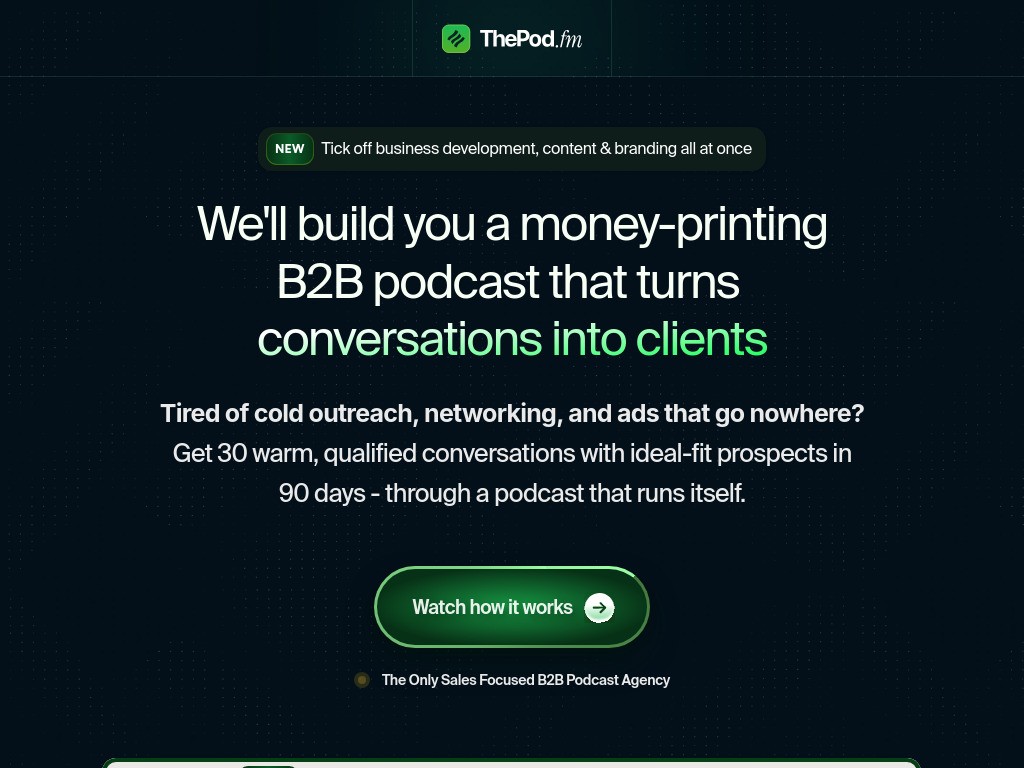
Specialisation: ROI-focused B2B podcast production built to generate meetings, pipeline, and brand authority through relationship-led growth.
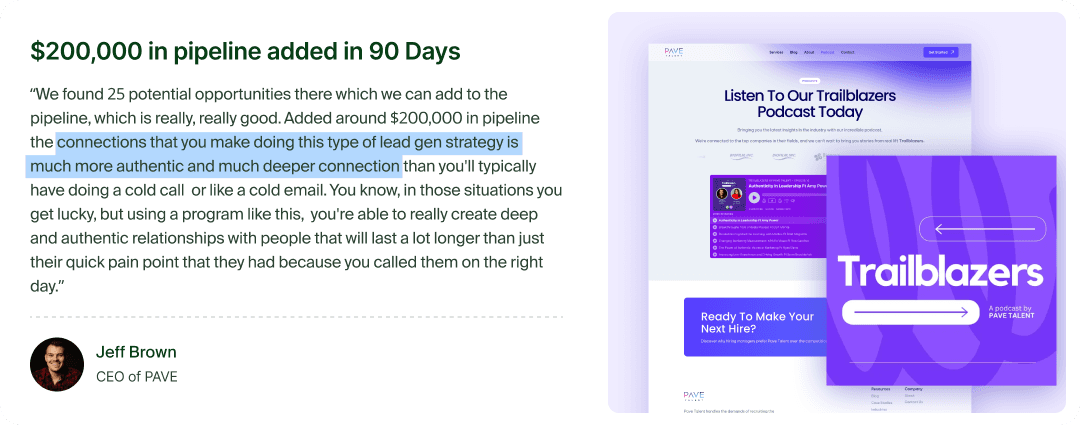
Key results: $1.16M in pipeline for one client before the first episode aired; $200K in pipeline within 90 days for PAVE; 40+ meetings booked for The Venned Group; 18% invitation reply rate and 7.5% invitation-to-booked-call rate across client shows.
ThePod.fm takes a refreshingly strategic approach to B2B podcasting — using your show as a high-converting appointment setting engine rather than just a content play. Their signature 90-day sprint is engineered to deliver guaranteed booked conversations with your ideal clients, turning every episode into a warm, trust-built sales opportunity. From guest booking and recording to editing and content repurposing, they handle everything end-to-end so you can focus on closing deals.
ThePod.fm has worked with executives from Meta, Reddit, Shell, and a roster of fast-growing B2B brands — helping them open doors that cold outreach never could.
Guaranteed booked conversations with ideal clients within 90 days
Fully managed production: guest booking, recording, editing, and distribution
Strategic content repurposing to amplify reach across every sales channel
Podcast strategy designed to build genuine pipeline, not just download counts
Proven track record with senior executives at globally recognised B2B brands
2. Intent Amplify

Specialisation: Intent Amplify specialises in AI-powered, data-driven full-funnel B2B demand and lead generation with a 100% pay-for-performance model.
Intent Amplify is a United States-based demand and lead generation agency serving B2B technology firms. They focus on leveraging AI and intent signals to enhance lead generation through project-based, pay-for-performance engagements. Their value proposition centers on identifying in-market prospects globally and managing engagement across the sales funnel to improve pipeline outcomes.
The agency employs tailored account-based marketing and multi-channel outreach methodologies, aiming for measurable ROI through demand generation, appointment setting, and content marketing. Their approach integrates data-driven strategies to support pipeline building, though exact pricing details and client workload expectations are not publicly detailed.
Delivers Account-Based Marketing campaigns targeting high-value B2B accounts
Provides end-to-end lead generation with multi-channel prospect outreach
Executes full-funnel demand generation using AI-driven intent signals
Targets technology firms with a global reach through project-based services
Operates on a 100% pay-for-performance pricing structure
Focuses on improving sales pipeline engagement and qualified appointment setting
3. Leadium
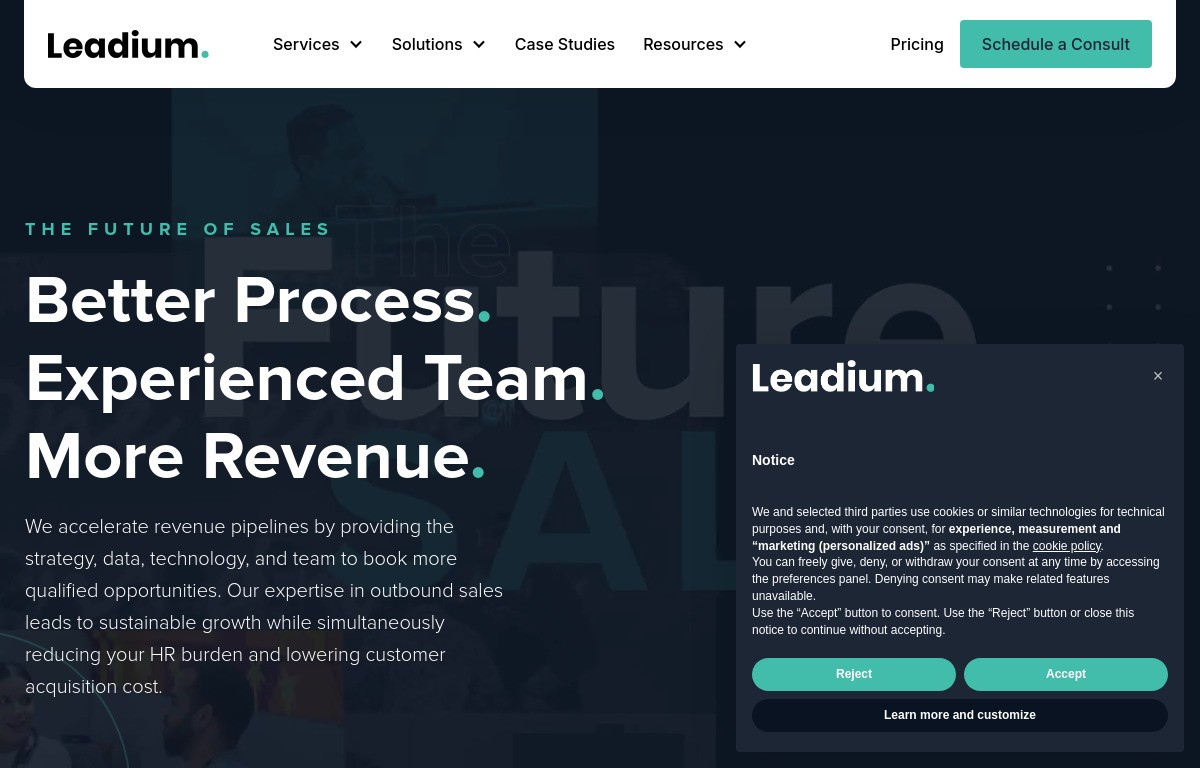
Specialisation: Leadium specializes in US-based sales development and strategic B2B lead generation focused on SQL appointment setting.
Leadium is a Las Vegas-based B2B lead generation agency that hires and coaches US-based Sales Development Representatives to drive top-of-funnel sales activities for clients. They offer expertise in crafting personalized multi-touch outbound sequences and their approach centers on increasing qualified sales appointments and scaling sales pipelines. Their value proposition emphasizes reducing clients’ HR burden while providing strategic outbound partnership aimed at revenue growth.
Leadium’s methodology involves deploying skilled US-based SDRs to execute tailored outbound campaigns with a focus on appointment setting. Their approach includes sourcing unique lead data and managing responses to book calendar meetings, positioning them as a comprehensive outbound lead generation partner for B2B organizations.
Employs US-based Sales Development Reps for tailored appointment setting
Crafts personalized multi-touch outbound sales sequences
Sources unique lead data to enhance pipeline scalability
Targets B2B companies seeking qualified SQL appointments
Prioritizes reducing client HR burden through outsourced SDR teams
Delivers ongoing lead generation without explicit meeting guarantees
4. CIENCE
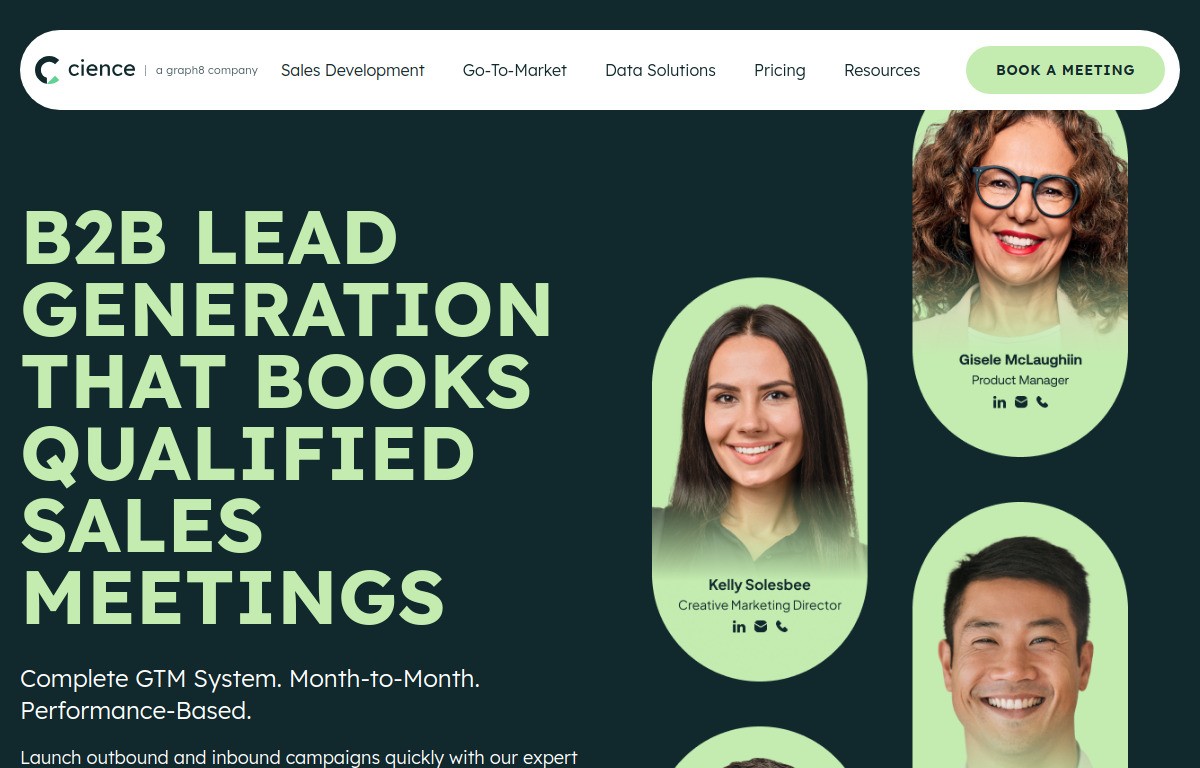
Specialisation: CIENCE specializes in AI-powered B2B lead generation and go-to-market pipeline development.
CIENCE is a lead generation and go-to-market company serving over 2,500 B2B clients across more than 250 industries. They leverage AI, machine learning, and a database of over 30 million company records to provide flexible, month-to-month sales development services focused on building measurable sales pipelines. Their value proposition centers on delivering leads, meetings, signed contracts, and pipeline revenue using the NOTE (Need, Opportunity, Team, Effect) methodology to quantify success.
The company emphasizes customized lead lists and data enrichment to target ideal customer profiles with scalable and adaptable engagements. While their AI-driven approach supports top-of-funnel outreach and lead qualification, specifics on client time involvement and guaranteed meeting outcomes are not publicly detailed.
Provides AI-powered teams to generate leads and book meetings using NOTE methodology
Utilizes extensive firmographic data from a 30 million+ company database
Offers flexible month-to-month contracts for agile sales development
Targets B2B companies seeking measurable pipeline and revenue growth
Prioritizes data-driven lead generation with a focus on scalable outreach
Services notable clients such as Okta, Shutterstock, and Yamaha
5. FRONTLINE Selling
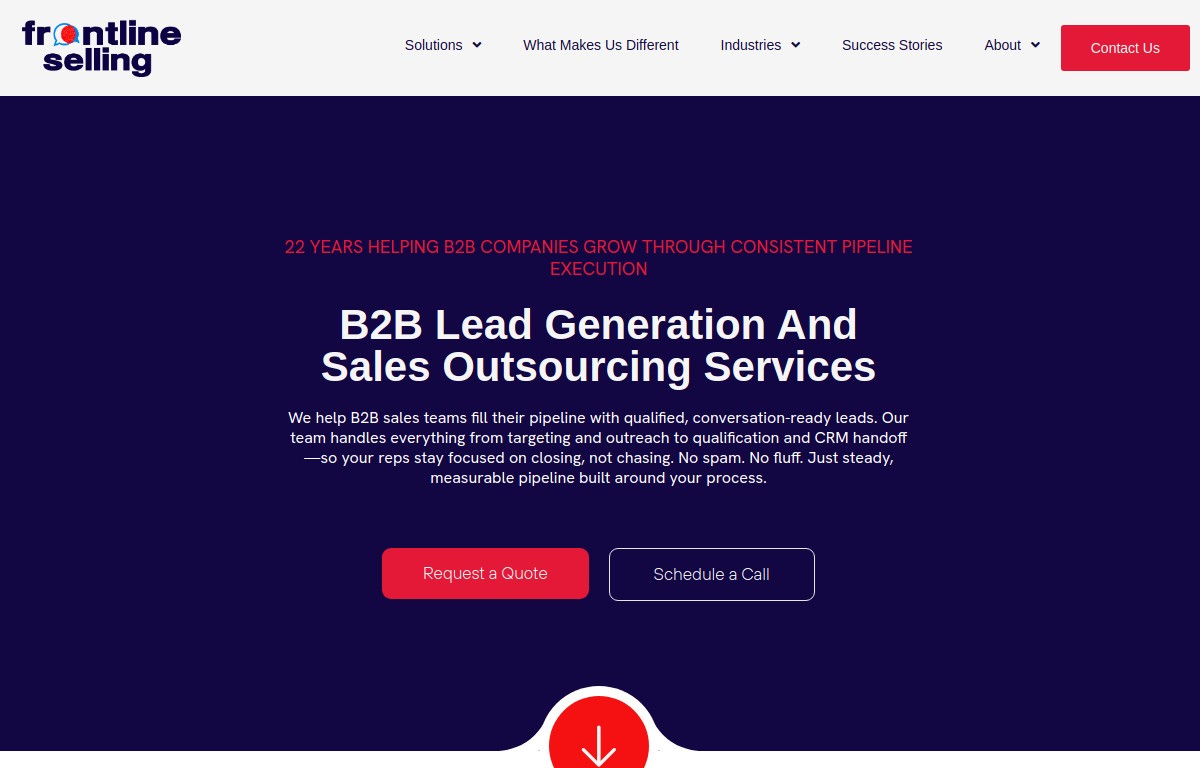
Specialisation: Specialises in comprehensive B2B sales outsourcing and lead generation to build consistent, qualified sales pipelines.
FRONTLINE Selling is a United States-based company located in Atlanta, Georgia, focusing on providing B2B sales teams with qualified, conversation-ready leads through targeted outreach, qualification, and CRM integration. They position themselves as a reliable partner for steady pipeline creation by combining experienced personnel, proven sales processes, smart technology, and data-driven execution that avoids spam and fluff. Their approach emphasizes measurable pipeline growth enabled by a multi-touch prospecting platform and full sales outsourcing services.
The company delivers comprehensive sales outsourcing that includes targeting, outreach, qualification, and CRM handoff designed to empower sales representatives to focus on closing deals. Their methodology integrates people, process, and technology with a strong operational framework but does not explicitly include guaranteed outcome-based commitments or content creation as part of their service model.
Provides targeted B2B lead generation with conversation-ready prospects
Delivers full sales outsourcing covering account identification and outreach
Utilizes a multi-touch, data-driven prospecting system (Staccato)
Serves B2B companies seeking steady pipeline and qualified leads
Prioritizes process-integrated execution without spam or irrelevant contacts
Focuses on enabling sales reps through CRM handoff and streamlined qualification
6. Martal Group
Specialisation: Martal Group specialises in outsourced B2B lead generation and sales acceleration for tech companies.
Martal Group is a Canada-based lead generation and sales agency specializing in supporting B2B tech vendors including SaaS, IT services, and IoT companies. They provide onshore sales teams and appointment-setting services designed to accelerate sales cycles with AI-powered outbound strategies. Their model focuses on embedding experienced sales executives as extensions of client teams to drive consistent pipeline growth across 50+ industries worldwide.
Martal Group offers a broad range of services such as lead generation, appointment setting, fractional sales executives, and cold email marketing. Their approach is rooted in standard outsourced sales methodologies emphasizing ongoing lead qualification and pipeline development rather than sprint-based guarantees or outcomes tied to specific deliverables.
Provides B2B sales-qualified lead generation across diverse industry verticals
Delivers outbound prospecting and appointment scheduling to populate sales pipelines
Offers on-demand fractional sales executives for tailored account strategies
Targets technology companies including SaaS, IT services, and IoT firms globally
Focuses on experienced onshore sales teams to maintain client team integration
Supports pipeline acceleration with AI-enhanced outbound sales techniques
7. The Sales Factory
Specialisation: Driving B2B revenue growth through data-driven sales strategies and outsourced lead generation with a Canadian-based expert team.
The Sales Factory is a Toronto, Canada-based B2B lead generation and sales outsourcing company that helps startups to scale-ups overcome complex sales challenges. Founded in 2018, they offer data-led go-to-market strategies, market research, and lead generation to accelerate business growth. Their value proposition combines data-driven insights, industry experience, and relationship understanding to deliver impactful sales results.
The Sales Factory specializes in leveraging a 100% university-graduated Canadian team to provide tailored sales strategies and outsourced lead generation solutions. Their methodology centers on deep market intelligence combined with strategic sales enablement, though their offerings follow traditional lead generation and sales outsourcing models without explicit outcome guarantees.
Provides tailored go-to-market strategy design for market entry and expansion
Delivers deep market research and first-party data intelligence
Executes data-driven outbound lead generation and sales development
Targets B2B startups and scale-ups seeking revenue acceleration
Emphasizes Canadian onshore teams with university education
Focuses on strategic sales enablement and solving complex sales challenges
8. DMT Business Development

Specialisation: Specialising in outbound lead generation, appointment setting, and recruitment services as an extension of sales teams for B2B companies.
DMT Business Development is a Canada-based agency helping B2B companies across sectors like SaaS, healthcare, and financial services build pipelines of qualified conversations through outbound lead generation and appointment setting. They position themselves as an external outbound team handling company and decision-maker identification, outreach, and meeting booking, while also offering recruitment and executive search services. Their approach emphasises tailored strategies and cost optimization, backed by deep industry knowledge.
The agency delivers traditional outbound methodologies focused on qualified appointments but does not integrate content production or multi-channel distribution. Their service model relies on hourly or project-based pricing with minimum project sizes, without explicit guarantees on outcomes.
Provides outbound lead generation and appointment setting for B2B companies
Offers recruitment and executive search services to support talent acquisition
Acts as an external sales development team with targeted outreach
Targets industries including SaaS, healthcare, and financial services
Prioritizes tailored client strategies and cost optimization across sectors
Delivers qualified meeting bookings without explicit performance guarantees
Visit DMT Business Development →
9. SalesCaptain
Specialisation: Specialises in building high-performing outbound marketing and sales systems for B2B SaaS and service companies using multi-channel prospecting and email campaigns.
SalesCaptain is a London-based B2B outbound and GTM agency that helps startups and established businesses grow by targeting and onboarding ideal clients through multi-channel prospecting and scalable outbound sales systems. Their approach emphasizes building sustainable and predictable sales pipelines using tools like Clay, with significant experience working with well-known companies such as Uber, Netflix, and Nestle. They focus on high-volume email campaigns and outbound activities tailored to B2B SaaS and service businesses, aiming to generate leads and consistent growth.
SalesCaptain operates primarily on fixed monthly retainers or hourly rates, offering services centered around outbound marketing and sales motions. While their methodology leverages volume-based outreach and GTM strategies, direct outcome or meeting guarantees are not specified. Their service model suggests a traditional agency setup that may require ongoing client involvement and oversight typical of outbound sales efforts.
Builds multi-channel outbound marketing and sales systems including high-volume email campaigns
Delivers outbound sales services with flexible pricing from monthly retainers to hourly rates
Utilizes tools like Clay for go-to-market execution and lead generation
Targets B2B SaaS and service companies seeking scalable outbound prospecting
Prioritizes volume-driven prospecting and pipeline predictability over guaranteed outcomes
Works with large enterprise clients such as Uber, Netflix, and Nestle
10. TeleNet Marketing Solutions
TeleNet Marketing Solutions combines appointment setting with broader sales support services.
They primarily serve established B2B organizations that want structured outreach paired with internal sales enablement.
Best for traditional B2B teams modernizing their prospecting efforts.
11. operatix.net
Specialisation: Operatix specializes in outsourced sales development and acceleration exclusively for B2B software vendors.
Operatix is a United Kingdom based company focused on building and managing dedicated SDR teams for B2B software and SaaS vendors. They emphasize outbound prospecting, inbound lead qualification, and account-based selling as extensions of clients' sales and marketing teams to generate pipeline and accelerate revenue globally. Their approach is built on operating multilingual SDR teams integrated into client CRM systems to shorten sales cycles and deliver qualified opportunities.
The company offers strategic market-entry campaigns and channel acceleration services to help software vendors expand internationally without in-house teams. Operatix typically provides ongoing SDR services tailored to software sales acceleration, with methodologies aimed at consistent pipeline development, though pricing and outcome guarantees are not publicly disclosed.
Specialises in outbound sales development for qualified B2B software pipeline building
Delivers inbound lead qualification to convert marketing leads into sales opportunities
Provides account-based selling strategies targeting high-value software vendor accounts
Targets B2B software and SaaS vendors operating across multiple international regions
Prioritizes multilingual SDR team management integrated into client CRM systems
Supports market-entry and channel acceleration programs for global scaling
12. Rev-Empire
Specialisation: Specialises in outsourced lead generation and sales development for B2B companies through multi-channel outbound campaigns including cold calling, email, and LinkedIn outreach.
Rev-Empire is a revenue-enablement agency serving B2B startups, scaling SMEs, and enterprise sales teams. They focus on outsourced sales services like lead generation, appointment setting, and SDR support to help clients grow revenue, with an emphasis on multi-touch outbound execution targeting global markets, primarily the US. Their approach centers on ongoing campaign execution without explicit guarantees tied to outcomes.
The agency applies conventional outbound sales tactics across various channels such as calls, email, and LinkedIn, relying on structured outreach sequences and CRM management. Their methodology emphasizes consistent activity and lead volume but does not highlight specialized content integration or time-efficient client coordination.
Generates qualified leads through cold calling, email, and LinkedIn outreach
Qualifies leads and books meetings via appointment setting services
Provides full outsourced SDR support including CRM and daily activity targets
Targets B2B markets with a focus on US-based clients
Prioritizes multi-touch outbound campaigns across multiple channels
Caters to startups, SMEs, and enterprise sales teams aiming to grow pipeline
13. Leadee
Specialisation: Leadee specialises in data-driven, omnichannel B2B lead generation focused on securing qualified meetings across multiple industries in UAE/GCC and USA markets.
Leadee is a UAE-based B2B lead generation agency delivering qualified meetings and appointments through account-based outreach, personalized campaigns, cold email, LinkedIn, and paid ads. They serve a broad range of sectors including SaaS startups, healthtech, construction, and professional services, emphasizing scalable growth with guaranteed annual appointment targets. Their approach centers on generating between 100–400+ qualified B2B appointments each year, targeting sales-ready leads across 35+ industries.
Leadee leverages multi-channel strategies tailored for its diverse client base, focusing on personalized engagement to drive lead quality. The agency’s methodology integrates data insights with targeted outreach but does not explicitly include content production or guaranteed meeting outcomes.
Delivers data-driven lead generation via account-based, multi-channel outreach
Provides specialized lead services for SaaS startups with 30-day delivery goals
Offers scalable solutions for small businesses targeting decision-maker engagement
Focuses on 35+ industries including healthtech and IT services
Prioritizes generating 100-400+ qualified B2B appointments annually
Operates without publicly disclosed pricing or explicit outcome guarantees
14. Callbox Inc.
Specialisation: Specialises in multi-channel B2B lead generation combining AI tools with human expertise for sales prospecting and appointment setting.
Callbox Inc. is a USA-based B2B lead generation agency headquartered in Encino, California, serving global enterprise clients across software, SaaS, cloud, cybersecurity, fintech, and AI sectors. Founded in 2004, Callbox leverages a hybrid approach of human and AI-driven strategies to support marketing and sales efforts, focusing on expanding markets and accelerating product launches. Their value proposition centers on delivering sales-ready leads through coordinated channels including calls, email, LinkedIn, chat, and events.
The company employs multi-touchpoint outreach and detailed prospect list building, aiming to engage decision-makers and secure qualified appointments, although service details suggest a traditional agency model without explicit guarantees on outcomes or pricing transparency. Callbox’s approach emphasizes consistent activity across multiple platforms to foster pipeline growth for business-to-business clients.
Delivers multi-channel B2B lead generation combining AI and human outreach
Provides outsourced sales prospecting to support regional business expansion
Sets confirmed appointments with decision-makers via integrated communication channels
Targets enterprise clients in technology-driven sectors like SaaS and cybersecurity
Prioritizes consistent outreach activity spanning calls, emails, social media, and events
Focuses on generating sales-ready leads and qualified appointments for global enterprises
15. SalesRoads

Specialisation: SalesRoads specialises in B2B sales outsourcing with expertise in appointment setting, lead generation, and SDR outsourcing across multiple industries.
SalesRoads is a United States-based company located in Boca Raton, Florida, offering strategic sales outsourcing services primarily to clients in SaaS, tech, manufacturing, industrial, logistics, construction, transportation, and SLED markets. They position themselves as a trusted partner delivering targeted leads, predictable pipelines, and revenue growth through expert SDR teams and data-driven strategies. Their value proposition emphasizes avoiding spammy tactics and tailoring efforts to industry-specific needs.
SalesRoads is notable for its extensive experience spanning over 17 years and a proven track record of setting more than 100,000 appointments for over 500 clients. Their methodology centers on high-quality B2B outreach and sales development representative outsourcing designed to extend clients’ sales capabilities.
Delivers targeted appointment setting with qualified decision-makers
Provides B2B lead generation tailored to specific industries
Offers full SDR outsourcing for prospecting and pipeline growth
Serves diverse sectors including SaaS, tech, manufacturing, and logistics
Prioritises data-driven, non-spam outreach strategies
Leverages 17+ years’ experience with extensive appointment metrics
16. Green Leads
Specialisation: Appointment setting services focused on personalized lead generation and building sales pipelines for B2B companies.
Green Leads is a B2B lead generation company specializing in appointment setting services for businesses seeking targeted outreach. They concentrate on generating one lead and securing one conversation at a time to help companies build their sales pipelines. Their approach emphasizes personalized outreach but lacks publicly available information on guarantees or pricing transparency.
Green Leads appears to utilize traditional appointment setting methodologies without integrating content strategy or outcome-based guarantees. Their service delivery and client engagement details are limited, providing a straightforward but less differentiated option in the lead generation market.
Delivers appointment setting through targeted, personalized lead generation
Focuses on building sales pipelines one lead and conversation at a time
Operates primarily within the B2B lead generation industry
Serves B2B companies seeking direct appointment setting support
Prioritizes outreach and engagement without explicit guarantees or pricing transparency
Employs standard appointment setting without integrated content marketing elements
How Appointment Setting Agencies Work
At a glance, appointment setting looks simple. Find prospects. Send outreach. Book meetings.
In reality, the good agencies follow a much tighter system. When any part of it breaks, meeting quality drops fast.
Here’s how strong appointment setting agencies actually operate in 2026.
Targeting and ICP alignment
Everything starts with who you go after.
Agencies begin by defining or refining your ideal customer profile. This includes company size, industry, role, buying triggers, and deal context. Not just job titles pulled from a list.
The best agencies pressure test assumptions early. If your ICP is too broad or unrealistic, they fix it before outreach begins.
This step decides whether your calendar fills with buyers or browsers.
Outreach execution (cold, warm, and content driven)
Once targeting is clear, execution kicks in.
Traditional agencies rely on cold outreach. Email, LinkedIn, calls, often all at once. Volume driven, fast moving, and dependent on timing.
More modern agencies mix in warm and content driven approaches. This can include referrals, social engagement, or value based entry points like events or podcasts.
The channel matters less than the intent behind it. When outreach feels relevant, response rates rise. When it feels forced, prospects disengage immediately.
Meeting qualification and handoff
Booking the meeting isn’t the finish line. It’s the checkpoint.
Strong agencies qualify prospects before a meeting ever hits your calendar. They confirm role, authority, relevance, and intent. Weak ones book anything that says yes.
After qualification, the handoff to sales should feel seamless. Context is shared. Expectations are set. No awkward “why are we meeting?” moments.
When appointment setting works, sales walks into conversations already halfway won.
How to Choose the Right Appointment Setting Agency
Choosing an appointment setting agency isn’t about who promises the most meetings. It’s about who fits the way you sell.
The wrong model will fill your calendar and drain your pipeline at the same time. The right one quietly compounds results.
Match the model to your sales motion
Start with how your deals actually close.
If your product is transactional and low friction, cold outbound volume can work. Speed matters more than context.
If your offer is high ticket, complex, or trust driven, relationship led appointment setting performs better. Warm conversations convert where cold pitches stall.
The mistake most teams make is choosing a model that fights their sales motion instead of supporting it.
Evaluate meeting quality over volume
Meetings are a vanity metric.
What matters is who shows up, how prepared they are, and whether deals move forward afterward.
Ask about show up rates, deal influence, and pipeline contribution. If an agency can’t speak to outcomes beyond booked calls, that’s a red flag.
Ten strong conversations beat fifty weak ones every time.
Pricing, transparency, and expectations
Appointment setting pricing varies widely, and cheaper is rarely better.
Some agencies charge retainers. Others tie pricing to performance. Both can work if expectations are clear.
What matters most is transparency. You should know how prospects are sourced, how qualification happens, and what success actually looks like.
If an agency avoids those conversations, walk away.
Appointment Setting Pricing Overview
Appointment setting pricing in 2026 depends heavily on the model being used. Volume based outbound and relationship led approaches are priced very differently for a reason.
Understanding what you’re paying for helps set realistic expectations from the start.
Typical cost ranges by model
Cold outbound appointment setting is usually the lowest entry point. Retainers often range from a few thousand per month to the low five figures, depending on volume, channels, and targeting complexity.
These models prioritize activity and speed. You’re paying for outreach execution more than conversation quality.
Relationship led appointment setting costs more upfront. Pricing reflects deeper research, content creation, and longer setup times. Monthly retainers are often higher, but meetings tend to convert at a much stronger rate.
You’re investing in trust, not just touches.
Why relationship led models may cost more but convert better
Trust shortens sales cycles.
When a prospect already knows who you are and why the conversation matters, less time is spent overcoming skepticism. Discovery goes deeper. Deals move faster.
Relationship led models also create assets that live beyond the meeting. Content, brand exposure, and credibility compound over time.
That’s why these models often deliver a higher return even with a higher price tag.
Frequently Asked Questions (FAQ)
How is podcast based appointment setting different from cold outreach?
Cold outreach starts with an ask. Podcast based appointment setting starts with value.
Instead of requesting time from a stranger, prospects are invited to share their expertise on a relevant podcast. That invitation creates instant context and authority.
By the time a sales conversation happens, trust is already established. There’s no need to fight skepticism or explain why the meeting matters.
Are podcast set appointments higher quality?
Yes, consistently.
Podcast set appointments involve pre qualification, relevance checks, and decision maker targeting before any meeting is booked. Prospects opt in because the conversation aligns with their goals, not because they clicked a link.
That leads to higher show up rates and stronger deal progression compared to cold set meetings.
How long does it take to see results?
Cold outbound campaigns can produce meetings within weeks.
Relationship led appointment setting typically takes longer to ramp, often one to two months, but delivers higher quality conversations once active.
The tradeoff is speed versus depth. Long term pipelines benefit more from depth.
Which industries benefit most from relationship led appointment setting?
Industries with complex buying decisions see the biggest gains.
This includes B2B SaaS, professional services, agencies, consultants, and companies selling high ticket or long cycle offers.
When trust matters, relationship led models outperform.
Can appointment setting also build brand authority?
Absolutely.
Modern appointment setting doesn’t just book meetings. It shapes how your brand is perceived before sales ever gets involved.
Content driven and relationship led models build credibility at the same time they build pipeline. That authority compounds long after individual meetings are over.

Aqil Jannaty is the founder of ThePod.fm, where he helps B2B companies turn podcasts into predictable growth systems. With experience in outbound, GTM, and content strategy, he’s worked with teams from Nestlé, B2B SaaS, consulting firms, and infoproduct businesses to scale relationship-driven sales.