



Quick summary
This guide compares 16 ABM account-based marketing agencies: ThePod.fm, Intent Amplify, Honeypot Marketing, Ironpaper, xGrowth, SimpleABM, Headley Media, MOI Global, SalesCaptain, Cremarc, SeeResponse, operatix.net, The Marketing Practice, MomentumABM, Leadee and UnboundB2B. ThePod.fm is listed first and is included near the top because its specialisation closely matches what readers searching this list are looking for.
Agency | Specialty | Location |
|---|---|---|
1. ThePod.fm | ROI-focused B2B podcast production built to generate pipeline through relationship-led growth | UK and US (remote, worldwide) |
2. Intent Amplify | AI-powered, data-driven full-funnel B2B demand and lead generation with a 100% pay-for-performance model. | United States |
3. Honeypot Marketing | B2B strategies that align marketing and sales to drive inbound and outbound growth. | Canada |
4. Ironpaper | Driving B2B growth through integrated marketing and sales strategies focused on complex sales processes. | New York City |
5. xGrowth | Account-Based Marketing (ABM) to create predictable, revenue-focused growth engines for B2B technology firms. | Australia |
6. SimpleABM | Fully managed 90-day account-based marketing programs tailored by industry to generate qualified B2B leads and build predictable sales… | Canada |
7. Headley Media | B2B lead generation for technology companies through proprietary content syndication across 300+ owned websites. | United Kingdom |
8. MOI Global | MOI Global is known for creative led ABM at the enterprise level. | United States |
9. SalesCaptain | Building high-performing outbound marketing and sales systems for B2B SaaS and service companies using multi-channel prospecting and email… | London |
10. Cremarc | Disruptive B2B performance marketing and account-based marketing strategies tailored specifically for the technology sector. | United Kingdom |
11. SeeResponse | SeeResponse offers ABM services designed for mid market and growth stage B2B companies. | United States |
12. operatix.net | Outsourced sales development and acceleration exclusively for B2B software vendors. | United Kingdom |
13. The Marketing Practice | A global B2B marketing agency integrating strategy, creativity, and media to drive revenue for technology and professional services firms. | London |
14. MomentumABM | Pioneering Account-Based Marketing (ABM) strategies to drive measurable B2B customer-led growth. | London |
15. Leadee | Data-driven, omnichannel B2B lead generation focused on securing qualified meetings across multiple industries in UAE/GCC and USA markets. | UAE |
16. UnboundB2B | Pay-for-performance B2B demand generation with a focus on high-quality lead qualification. | United States |
Most account-based marketing programmes generate reach. The gap is in conversations. Senior decision makers at your target accounts know your category exists. What they have not done is agreed to talk to you - and most ABM agency models are not built to close that gap.
A warmer alternative: our podcast guest booking service invites your ideal accounts onto your show instead of cold-pitching them.
This page ranks the ABM agencies worth evaluating in 2026, assessed on the criteria that actually move revenue: target account specificity, sales alignment, and the ability to turn awareness into real pipeline conversations.
Which outbound marketing services agencies are top-rated for account-based outbound campaigns targeting enterprise accounts?
The strongest agencies for enterprise account-based outbound combine tight ICP targeting with a mechanism to initiate real conversations - not just ad impressions. As a benchmark, podcast-based outbound invitations to senior decision makers receive an 18% reply rate (ThePod benchmark data, learn.thepod.fm/benchmarks), compared to well under 1% for cold email - illustrating why conversation-led ABM outperforms broadcast approaches for enterprise accounts.
What Is Account-Based Marketing (ABM)?
Definition and core principles of ABM
Account-based marketing is a go-to-market strategy where sales and marketing concentrate effort on a defined list of high-value accounts rather than a broad audience. The shift is simple but powerful: you stop asking how to generate more leads and start asking which accounts are most likely to generate meaningful revenue.
The core principles behind ABM include:
Target accounts are identified first, based on fit, intent, and revenue potential
Sales and marketing operate as one team from planning through execution
Messaging and content are personalised to real stakeholders inside each account
Performance is measured by account engagement, pipeline progression, and revenue impact
ABM is not about louder marketing. It is about smarter focus.
How ABM differs from traditional demand generation
Traditional demand generation starts wide and filters down. ABM starts narrow and goes deep. The differences show up quickly in execution:
Demand generation prioritises lead volume; ABM prioritises account quality
Demand generation measures form fills and MQLs; ABM measures meetings and pipeline
Demand generation hands leads to sales; ABM works alongside sales continuously
ABM can feel slower early on because you are working with fewer accounts. But those accounts are intentional. That focus typically produces higher close rates, larger deal sizes, and fewer wasted sales conversations.
Why ABM Is Replacing Traditional Outbound
Cold email reply rates have declined sharply. LinkedIn InMail response rates for senior decision makers sit well below 5% in most B2B categories. Paid demand generation costs have risen while bottom-of-funnel conversion has not kept pace (LinkedIn Help).
ABM was designed to address this. Rather than broadcasting to large audiences and hoping the right people respond, ABM concentrates resources on a defined list of target accounts and builds programmes that work across every stakeholder in the buying group.
According to hubspot.com/marketing-statistics" target="_blank" rel="noopener noreferrer">HubSpot B2B marketing research, over 70% of B2B marketers report ABM delivering higher ROI than traditional demand generation programmes. The caveat: results depend heavily on execution quality and how tightly sales and marketing are aligned.
For teams evaluating alternatives to cold outreach, it is also worth reviewing the best cold outreach agencies and outsourced SDR agencies to understand where the category boundaries sit.
Why ABM works for B2B, SaaS, and enterprise companies
ABM thrives in environments where buying decisions are complex and high stakes. These companies typically deal with multiple stakeholders involved in every purchase, longer non-linear sales cycles, and higher pressure to prove ROI before decisions are made.
ABM supports this reality by allowing teams to tailor messaging to each role in the buying committee. Executives see business outcomes. Technical buyers see proof. Internal champions get content they can use to sell internally.
For enterprise teams, ABM also creates discipline. Budgets and effort are concentrated on accounts that can actually move revenue, rather than being spread thin across low-intent leads.
Why Hire an Account-Based Marketing Agency?
Running ABM internally sounds straightforward. In practice, it is difficult to execute without the right experience, systems, and sustained focus. That is why many B2B teams turn to specialist ABM agencies once they are serious about making it work.
Strategic advantages of outsourced ABM
ABM agencies live inside this model. They have already made the mistakes you are about to make and corrected them. The biggest strategic advantages include:
Proven ABM frameworks instead of trial and error
Faster time to execution with ready-built playbooks
Access to tools, data, and intent signals without long setup cycles
Objective account selection and prioritisation, not internal bias
Agencies also bring pattern recognition across industries, deal sizes, and buying committees. That perspective is hard to replicate in-house.
Sales and marketing alignment benefits
One of the biggest reasons ABM fails is misalignment - marketing runs campaigns, sales runs outreach, and neither fully trusts the other. ABM agencies are often brought in as neutral operators to fix that by defining shared target account lists, mapping buying committees alongside sales, coordinating messaging across channels, and creating shared metrics tied to pipeline and revenue.
When alignment improves, friction drops. Sales gets better conversations. Marketing sees clearer impact. Leadership has fewer attribution arguments.
When an ABM agency makes more sense than in-house execution
Hiring an ABM agency typically makes more sense when you are targeting high-value accounts with long sales cycles, your sales team is already account-focused, marketing lacks deep ABM experience, or you need results faster than internal hiring allows.
Agencies also make sense when ABM is new to your organisation. Instead of rebuilding your entire marketing operation, you can layer ABM on top, learn what works, then decide what to internalise later.
How we evaluated these agencies
We assessed each agency against four criteria that matter to B2B revenue teams:
1. Conversation rate, not click rate. ABM should result in conversations with target accounts. Agencies that report on impressions and engagement without a direct link to meetings are optimising for the wrong metric.
2. Target account specificity. Generic ABM programmes that treat all accounts the same rarely outperform well-run outbound. The strongest agencies build bespoke programmes for named account lists.
3. Sales and marketing alignment. Forrester B2B marketing benchmarks consistently show that personalised outreach to known target accounts outperforms broadcast demand generation for deals above $50k - but only when sales and marketing are working from the same account list and the same messaging.
4. Transparency on ROI. If an agency cannot attribute pipeline to their activity, be cautious. The best ABM partners can show you which accounts moved from unaware to in-conversation as a direct result of their work.
For context on how these agencies compare to other outbound alternatives, see our roundups of the best cold outreach agencies and GTM agency alternatives.
Proven ABM frameworks and playbooks
Strong ABM agencies do not improvise every campaign. They operate from tested frameworks that can be adapted to different industries and deal sizes. We looked for agencies that demonstrate clear ABM models (one-to-one, one-to-few, one-to-many), documented processes for account selection and prioritisation, repeatable campaign structures that scale without losing personalisation, and playbooks that integrate marketing, sales, and outbound efforts.
Frameworks do not mean rigidity. They mean consistency, predictability, and faster learning cycles.
Experience with high-value B2B and enterprise accounts
ABM looks very different at higher deal values. We prioritised agencies with experience in six and seven-figure deal environments, complex buying committees with multiple decision makers, long sales cycles that require sustained engagement, and enterprise or upper mid-market B2B companies. Agencies without this background often default to tactics that look good on reports but do not move deals forward.
Results, case studies, and measurable ROI
ABM is expensive compared to broad demand generation. The return has to be visible. We focused on agencies that could show clear pipeline and revenue impact (not just engagement metrics), case studies tied to specific account outcomes, before-and-after performance comparisons, and transparent reporting and attribution methods. Strong agencies talk about revenue with confidence because they track it closely.
Industry focus and execution depth
Generic ABM rarely works. Context matters. We favoured agencies with depth in specific industries or verticals - including B2B SaaS and technology, enterprise services and consulting, and complex regulated or technical markets. Execution depth also mattered: strategy without delivery falls flat, and the best agencies own messaging, content, orchestration, and optimisation rather than outsourcing core pieces.
Top ABM (Account-Based Marketing) Agencies to Work With in 2026
1. ThePod.fm
ThePod.fm is included near the top because its specialisation closely matches what readers searching this list are looking for.
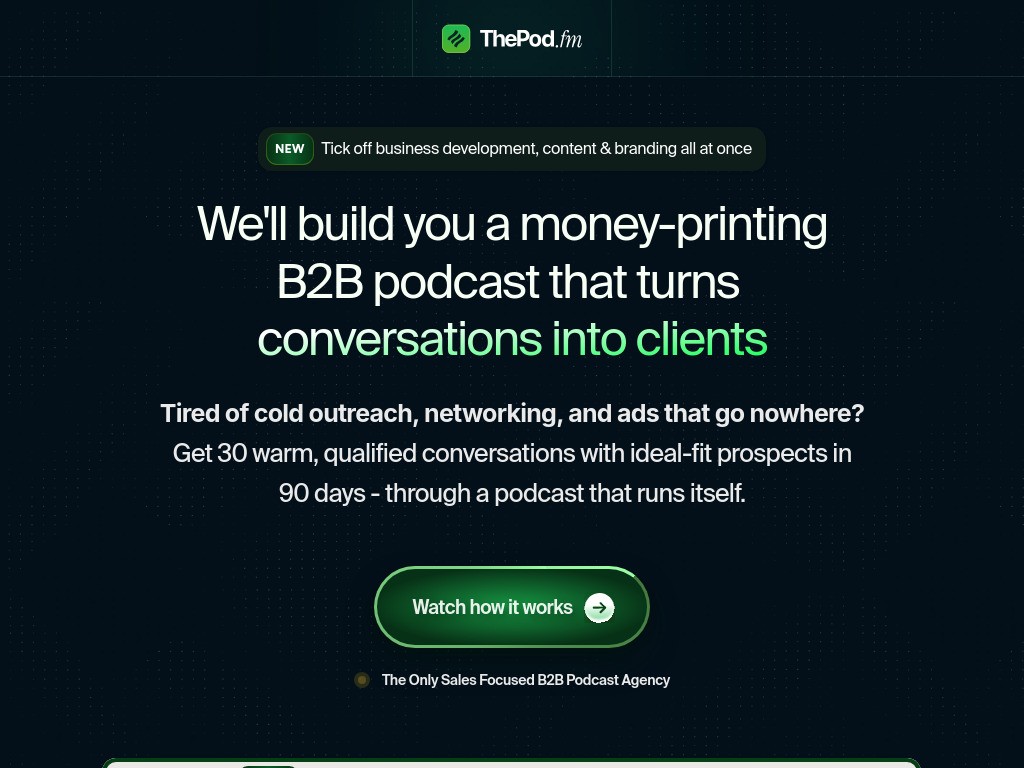
Specialisation: ROI-focused B2B podcast production built to generate pipeline through relationship-led growth
Key results: $1.16M in pipeline for one client before the first episode aired; $200K in pipeline within 90 days for PAVE; 40+ meetings booked for The Venned Group; 18% invitation reply rate and 7.5% invitation-to-booked-call rate across client shows.
ThePod.fm helps B2B companies turn podcasting into a high-converting ABM channel — using a structured 90-day sprint that guarantees booked conversations with ideal-fit prospects and target accounts. Their end-to-end service covers everything from guest booking and recording through to editing and content repurposing, so your team stays focused on closing, not producing. The result is a repeatable system that builds brand authority while simultaneously filling your sales calendar.
ThePod.fm has facilitated conversations with executives from Meta, Reddit, Shell, and a range of fast-growing B2B brands — turning podcast appearances into warm pipeline opportunities that traditional outbound simply can't replicate.
90-day sprint with guaranteed booked conversations with your ideal clients
Full end-to-end production — guest booking, recording, editing, and repurposing handled for you
Podcast strategy engineered specifically to generate meetings and build sales pipeline
Proven access to senior decision-makers at enterprise and high-growth B2B organisations
Builds lasting brand authority while simultaneously supporting your ABM outreach goals
2. Intent Amplify

Specialisation: Intent Amplify specialises in AI-powered, data-driven full-funnel B2B demand and lead generation with a 100% pay-for-performance model.
Intent Amplify is a United States-based demand and lead generation agency serving B2B technology firms. They focus on leveraging AI and intent signals to enhance lead generation through project-based, pay-for-performance engagements. Their value proposition centers on identifying in-market prospects globally and managing engagement across the sales funnel to improve pipeline outcomes.
The agency employs tailored account-based marketing and multi-channel outreach methodologies, aiming for measurable ROI through demand generation, appointment setting, and content marketing. Their approach integrates data-driven strategies to support pipeline building, though exact pricing details and client workload expectations are not publicly detailed.
Delivers Account-Based Marketing campaigns targeting high-value B2B accounts
Provides end-to-end lead generation with multi-channel prospect outreach
Executes full-funnel demand generation using AI-driven intent signals
Targets technology firms with a global reach through project-based services
Operates on a 100% pay-for-performance pricing structure
Focuses on improving sales pipeline engagement and qualified appointment setting
3. Honeypot Marketing
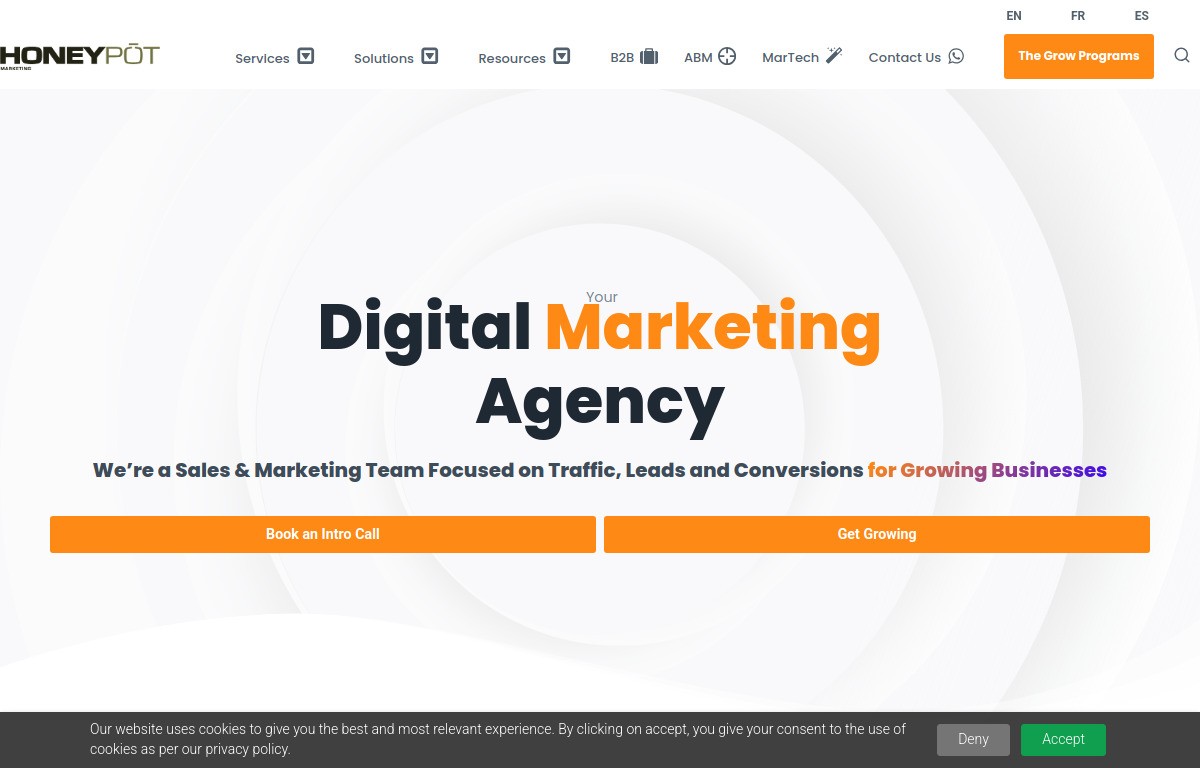
Specialisation: Full-service digital marketing agency specializing in B2B strategies that align marketing and sales to drive inbound and outbound growth.
Honeypot Marketing is a Canada-based agency located in Waterloo, Ontario, offering comprehensive digital marketing solutions for B2B clients. Founded in 2001, they leverage over 20 years of experience and an international team to provide value-driven, non-aggressive marketing that attracts customers naturally like a "honeypot." Their approach focuses on integrating marketing and sales efforts through tailored inbound, outbound, and account-based marketing programs.
The agency’s methodology centers on aligning strategies across platforms such as email, SMS, paid advertising, SEO, and CRM systems to generate traffic, leads, and conversions for growing businesses. They serve a diverse range of B2B clients, providing a broad spectrum of services without explicit outcome guarantees or sprint-based delivery models.
Provides targeted account-based marketing and inbound/outbound digital campaigns
Delivers optimized paid advertising across Google, Meta, and Microsoft platforms
Manages CRM systems including HubSpot and Microsoft Dynamics
Focuses on B2B sales and marketing alignment with international client reach
Prioritizes value-attracting, non-aggressive marketing approaches
Serves growing B2B businesses with diverse digital marketing services
4. Ironpaper
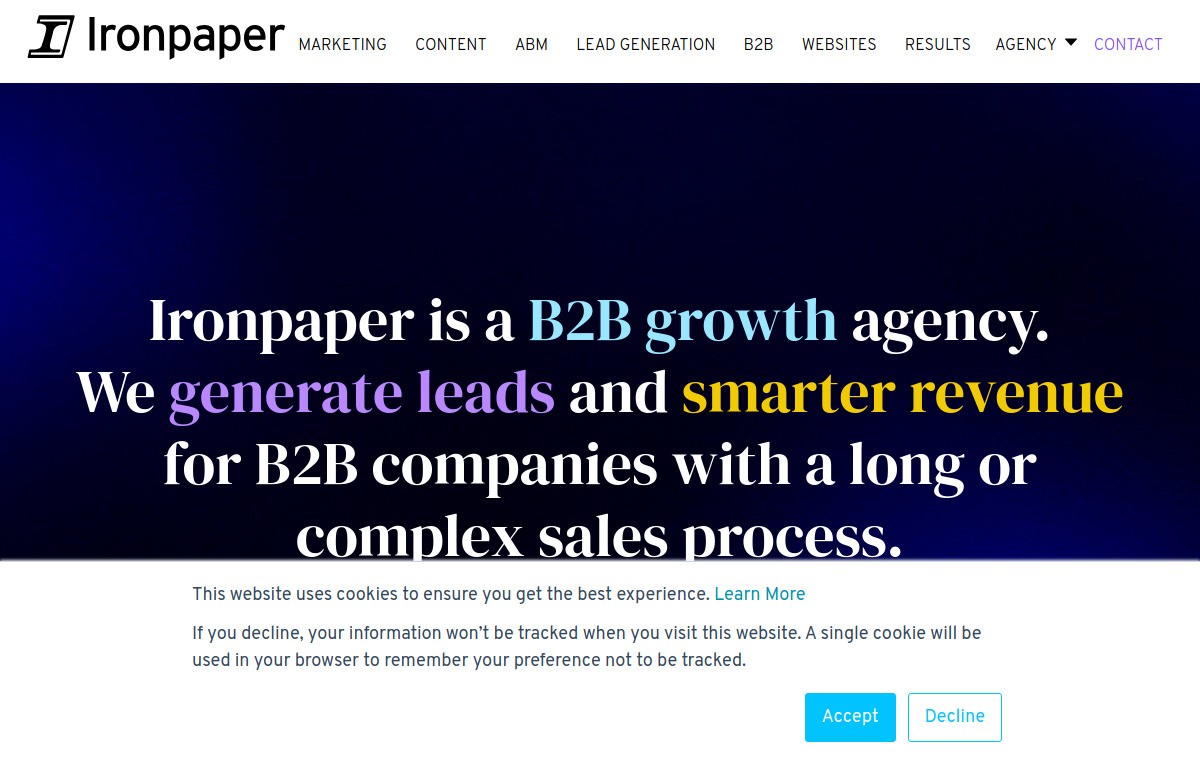
Specialisation: Ironpaper specializes in driving B2B growth through integrated marketing and sales strategies focused on complex sales processes.
Ironpaper is a New York City-based B2B growth agency that helps companies with long and complex sales cycles enhance lead generation and revenue growth. They focus on unifying marketing and sales with account-based marketing (ABM), demand generation, digital strategy, and content development to create comprehensive buyer experiences. Their approach integrates technology, design, and automation to support scalable B2B marketing efforts, targeting measurable growth metrics like leads and engagement.
Ironpaper emphasizes strategic alignment between sales and marketing teams, leveraging data-driven tactics across multiple digital channels. Their methodology includes tailored campaigns for high-value accounts and nurturing through content and automation, though they do not publish pricing or milestone guarantees publicly.
Specialises in account-based marketing and demand generation for complex B2B sales
Delivers integrated web strategy and content development aligned with lead nurturing
Provides automation and advertising services to streamline marketing efforts
Targets B2B companies navigating long or intricate sales cycles
Prioritizes aligning marketing and sales functions to improve buyer experiences
Supports growth-focused consulting for B2B firms, nonprofits, and professional services
5. xGrowth

Specialisation: Specialises in Account-Based Marketing (ABM) to create predictable, revenue-focused growth engines for B2B technology firms.
xGrowth is an Australia-based B2B tech marketing agency operating out of Melbourne that focuses on developing high-quality prospect pipelines through targeted ABM strategies. They primarily serve B2B technology companies and emphasize building predictable revenue growth models. Their value proposition centers on leveraging ABM to support scalable pipeline development rather than guaranteeing direct sales outcomes.
xGrowth emphasizes creating revenue-focused growth engines using ABM, working with clients such as Zoom and Citrix. While they are notable for their expertise in ABM, specific details on client engagement models or pricing are not publicly available, leaving some aspects of their approach less transparent.
Specialises in building predictable pipelines through Account-Based Marketing (ABM)
Delivers revenue-focused growth engines tailored for B2B technology firms
Targets high-quality prospects for scalable business development
Positions itself within the B2B tech marketing sector with Australian roots
Prioritizes strategic ABM execution to support client pipeline growth
Works with established tech clients including Zoom, OutSystems, and Citrix
6. SimpleABM

Specialisation: SimpleABM specialises in fully managed 90-day account-based marketing programs tailored by industry to generate qualified B2B leads and build predictable sales pipelines.
SimpleABM is an agency that provides done-for-you ABM services across industries like healthcare, manufacturing, financial services, agencies, and recruiting. They focus on executing comprehensive ABM strategies that combine software setup, detailed account research, tailored messaging, and multi-channel outreach to help sales teams concentrate on closing deals. Their core offering is a 90-day ABM program aimed at scalable, ROI-driven growth, though pricing and specific client location details are not publicly disclosed.
Their methodology involves industry-tailored campaigns targeting specific stakeholder roles, with full campaign management from research through outreach. SimpleABM emphasizes generating qualified leads and filling pipelines but does not explicitly guarantee meeting outcomes or publish a transparent pricing model. Their approach is grounded in industry customization and end-to-end execution rather than content amplification or direct meeting guarantees.
Provides fully managed 90-day ABM programs including strategy, research, and outreach
Delivers industry-tailored campaigns targeting specific B2B sectors and roles
Executes multi-channel outreach to generate qualified leads and opportunities
Focuses on B2B companies across healthcare, manufacturing, financial services, agencies, and recruiting
Prioritizes scalable, ROI-driven lead generation without explicit outcome guarantees
Serves clients seeking comprehensive ABM program execution and pipeline development
7. Headley Media
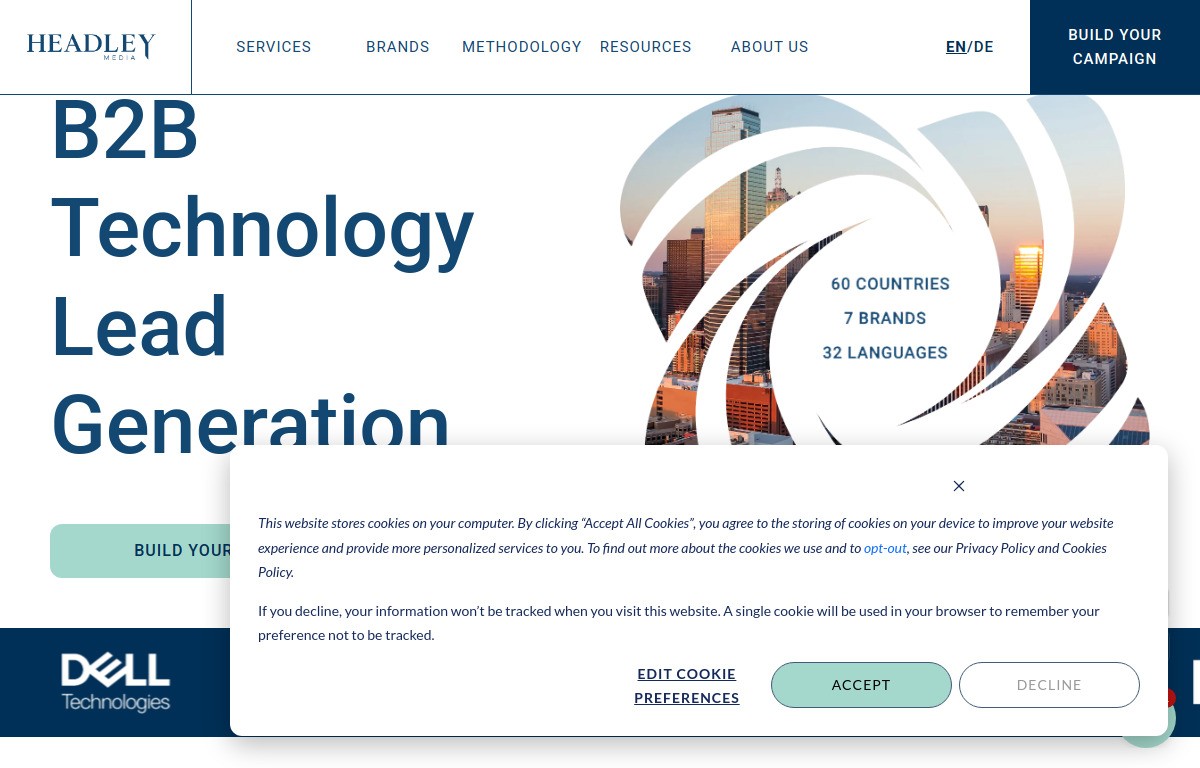
Specialisation: Headley Media specialises in B2B lead generation for technology companies through proprietary content syndication across 300+ owned websites.
Headley Media is a United Kingdom-based agency operating primarily from London and Esher, focusing on delivering qualified B2B leads to technology decision-makers. They serve sectors including IT, Cybersecurity, AI, Finance, HR, Marketing, Sales, and Electronics with tailored account-based marketing and intent-targeting campaigns. Their approach centres around in-house fulfillment of custom content syndication campaigns designed to generate exposure and lead lists.
The company leverages a large network of owned and operated websites for content distribution, emphasizing multi-touch nurture campaigns and full-funnel demand generation strategies. While pricing is custom and generally undisclosed, Headley Media’s methodology prioritizes targeted content dissemination and BANT profiling to qualify leads, reflective of traditional B2B lead generation practices.
Operates 300+ owned and managed websites for content syndication
Delivers account-based marketing and intent-targeted campaigns
Provides multi-touch nurture tracks and full-funnel demand generation
Targets technology companies across multiple specialized sectors
Focuses on lead qualification using the BANT methodology
Executes in-house campaign fulfillment for client visibility and control
8. MOI Global
MOI Global is known for creative led ABM at the enterprise level.
They focus on:
• High impact creative campaigns
• Brand forward ABM experiences
• Personalization supported by data
MOI is a strong option for brands that value standout creative and storytelling as part of their ABM strategy.
9. SalesCaptain
Specialisation: Specialises in building high-performing outbound marketing and sales systems for B2B SaaS and service companies using multi-channel prospecting and email campaigns.
SalesCaptain is a London-based B2B outbound and GTM agency that helps startups and established businesses grow by targeting and onboarding ideal clients through multi-channel prospecting and scalable outbound sales systems. Their approach emphasizes building sustainable and predictable sales pipelines using tools like Clay, with significant experience working with well-known companies such as Uber, Netflix, and Nestle. They focus on high-volume email campaigns and outbound activities tailored to B2B SaaS and service businesses, aiming to generate leads and consistent growth.
SalesCaptain operates primarily on fixed monthly retainers or hourly rates, offering services centered around outbound marketing and sales motions. While their methodology leverages volume-based outreach and GTM strategies, direct outcome or meeting guarantees are not specified. Their service model suggests a traditional agency setup that may require ongoing client involvement and oversight typical of outbound sales efforts.
Builds multi-channel outbound marketing and sales systems including high-volume email campaigns
Delivers outbound sales services with flexible pricing from monthly retainers to hourly rates
Utilizes tools like Clay for go-to-market execution and lead generation
Targets B2B SaaS and service companies seeking scalable outbound prospecting
Prioritizes volume-driven prospecting and pipeline predictability over guaranteed outcomes
Works with large enterprise clients such as Uber, Netflix, and Nestle
10. Cremarc
Specialisation: Cremarc specialises in disruptive B2B performance marketing and account-based marketing strategies tailored specifically for the technology sector.
Cremarc is a United Kingdom-based B2B tech marketing agency located in Weybridge. They focus exclusively on technology clients, offering a broad suite of digital marketing, branding, content marketing, and campaign management services aimed at driving qualified leads and pipeline growth. Cremarc positions itself as a partner combining paid media efforts like Google Ads with precise account-based marketing, emphasizing their deep understanding of the tech industry.
Their methodology integrates standard agency deliverables across multiple channels without explicit outcome guarantees or fixed sprint-based engagements. Cremarc’s approach emphasizes comprehensive service delivery encompassing digital, content, and campaign management, targeting B2B buyer dynamics within technology markets.
Delivers comprehensive digital marketing services tailored to B2B tech companies
Provides specialized account-based marketing strategies for precision targeting
Offers integrated campaign management including paid search and social media
Focused on the technology sector as their primary target market
Prioritizes expertise in pipeline growth via multi-channel B2B marketing
Operates under a traditional agency model without explicit performance guarantees
11. SeeResponse

SeeResponse offers ABM services designed for mid market and growth stage B2B companies.
They focus on:
• Intent data driven targeting
• Practical ABM execution
• Cost conscious programs
SeeResponse is a good option for teams adopting ABM for the first time and looking for hands on support without enterprise level complexity.
12. operatix.net
Specialisation: Operatix specializes in outsourced sales development and acceleration exclusively for B2B software vendors.
Operatix is a United Kingdom based company focused on building and managing dedicated SDR teams for B2B software and SaaS vendors. They emphasize outbound prospecting, inbound lead qualification, and account-based selling as extensions of clients' sales and marketing teams to generate pipeline and accelerate revenue globally. Their approach is built on operating multilingual SDR teams integrated into client CRM systems to shorten sales cycles and deliver qualified opportunities.
The company offers strategic market-entry campaigns and channel acceleration services to help software vendors expand internationally without in-house teams. Operatix typically provides ongoing SDR services tailored to software sales acceleration, with methodologies aimed at consistent pipeline development, though pricing and outcome guarantees are not publicly disclosed.
Specialises in outbound sales development for qualified B2B software pipeline building
Delivers inbound lead qualification to convert marketing leads into sales opportunities
Provides account-based selling strategies targeting high-value software vendor accounts
Targets B2B software and SaaS vendors operating across multiple international regions
Prioritizes multilingual SDR team management integrated into client CRM systems
Supports market-entry and channel acceleration programs for global scaling
13. The Marketing Practice

Specialisation: A global B2B marketing agency integrating strategy, creativity, and media to drive revenue for technology and professional services firms.
The Marketing Practice (tmp) is a London-based global B2B marketing agency serving major technology and professional services companies such as AWS, ServiceNow, and Microsoft. They emphasize delivering award-winning creative, strategic marketing, and media services supported by a proprietary ROI model designed to maximize revenue impact. Tmp positions itself as a full-service partner to ambitious brands seeking comprehensive marketing strategies across demand generation, channel marketing, and media planning.
Their methodology includes combining marketing strategy development with creative excellence and media execution tailored specifically for B2B environments. While they focus on delivering measurable ROI through broad marketing campaigns, explicit short-term guarantees on meetings or pipeline growth are not provided. Their client engagements typically involve collaborative, multi-faceted marketing programs aimed at long-term brand and demand growth.
Develops comprehensive B2B marketing and account-based strategies
Delivers demand generation programs to nurture and convert leads
Provides partner and channel marketing tailored for B2B technology firms
Targets major technology and professional services markets globally
Prioritizes award-winning creative development and strategic media execution
Works with large enterprise clients requiring full-service marketing solutions
Visit The Marketing Practice (tmp) →
14. MomentumABM

Specialisation: Pioneering Account-Based Marketing (ABM) strategies to drive measurable B2B customer-led growth.
MomentumABM is a London-based growth consultancy that serves global organizations aiming to enhance client relationships through aligned marketing, sales, and service strategies. They emphasize transitioning from product-driven to customer-led go-to-market models, leveraging their expertise in Account-Based Marketing as part of Accenture Song. Their approach focuses on helping B2B leaders reinvent relevance and deepen relationships for accelerated growth without explicit outcome guarantees.
The firm employs a comprehensive methodology that combines strategic consulting, proprietary research including customer buying indices, and capability building via ABM training and certification. MomentumABM is notable for its integrative, advisory approach within the broader B2B marketing ecosystem, emphasizing thought leadership and content development tailored to client reputation and engagement.
Provides customer growth strategy development and full marketing ecosystem consulting
Delivers proprietary B2B research and competitive intelligence through the Customer Buying Index
Offers ABM training, certification, and capability-building services
Targets global B2B enterprises seeking to align marketing, sales, and service
Focuses on strategic account-based marketing driven by customer-centric frameworks
Adopts a consultative approach embedded in Accenture Song with broad advisory capabilities
15. Leadee
Specialisation: Leadee specialises in data-driven, omnichannel B2B lead generation focused on securing qualified meetings across multiple industries in UAE/GCC and USA markets.
Leadee is a UAE-based B2B lead generation agency delivering qualified meetings and appointments through account-based outreach, personalized campaigns, cold email, LinkedIn, and paid ads. They serve a broad range of sectors including SaaS startups, healthtech, construction, and professional services, emphasizing scalable growth with guaranteed annual appointment targets. Their approach centers on generating between 100–400+ qualified B2B appointments each year, targeting sales-ready leads across 35+ industries.
Leadee leverages multi-channel strategies tailored for its diverse client base, focusing on personalized engagement to drive lead quality. The agency’s methodology integrates data insights with targeted outreach but does not explicitly include content production or guaranteed meeting outcomes.
Delivers data-driven lead generation via account-based, multi-channel outreach
Provides specialized lead services for SaaS startups with 30-day delivery goals
Offers scalable solutions for small businesses targeting decision-maker engagement
Focuses on 35+ industries including healthtech and IT services
Prioritizes generating 100-400+ qualified B2B appointments annually
Operates without publicly disclosed pricing or explicit outcome guarantees
16. UnboundB2B
Specialisation: Specialises in pay-for-performance B2B demand generation with a focus on high-quality lead qualification.
UnboundB2B is a United States-based B2B demand generation agency headquartered in San Francisco, providing marketing services primarily for enterprise and technology companies globally. They focus on improving ROI, shortening sales cycles, and generating qualified leads (MQL, HQL, SQL) through end-to-end campaign execution under a pay-for-performance pricing model. Their positioning centers on delivering measurable lead generation results aligned with client sales and marketing goals, though specific outcome guarantees are not detailed.
UnboundB2B utilizes targeted demand generation, lead nurturing, and account-based marketing tactics supplemented by content marketing strategies to support sustained pipeline growth. Their methodology emphasizes lead quality and volume but does not highlight guaranteed meeting outcomes or a sprint-based delivery framework.
Delivers demand generation campaigns fulfilling MQL, HQL, and SQL requirements
Provides targeted B2B lead generation emphasizing both volume and quality
Nurtures leads with tailored marketing solutions for sustainable growth
Targets enterprise and technology companies worldwide with specialized services
Operates a 100% pay-for-performance pricing model focused on lead delivery
Offers account-based and content marketing to complement lead generation efforts
Core ABM Services Offered by Leading Agencies
While each ABM agency has its own angle, the strongest ones share a common foundation. These services are what separate true ABM execution from rebranded demand generation.
Ideal customer profile (ICP) and target account selection
Everything in ABM breaks if account selection is wrong. Leading agencies spend serious time here because they know targeting fixes more problems than tactics ever will. This phase typically includes defining a tight ICP based on revenue, fit, and buying behaviour; analysing existing customers to find repeatable patterns; building and prioritising target account lists with sales input; and segmenting accounts by tier and strategic importance.
Good ABM starts with discipline. Fewer accounts. Better focus.
Personalised messaging and content creation
Once accounts are set, personalisation becomes the engine. Top agencies go beyond name-swapping - they tailor messaging to roles, priorities, and real business context inside each account. This often includes value propositions mapped to specific stakeholders, industry or account-specific content, sales-facing assets that support one-to-one conversations, and messaging frameworks that stay consistent across channels.
The goal is simple: make every interaction feel intentional.
Multi-channel ABM campaigns (email, ads, content, events)
ABM works best when touchpoints reinforce each other rather than competing. Leading agencies orchestrate campaigns across multiple channels - targeted email and outbound sequences, account-based paid media, content experiences tied to specific accounts, and virtual or in-person events for key stakeholders. The channel matters less than the coordination. Each touchpoint should feel connected to the last.
Sales enablement and RevOps alignment
ABM collapses if sales cannot use what marketing creates. Strong agencies invest heavily in enablement and operational alignment, including sales playbooks tied to target accounts, shared dashboards and reporting, clear handoffs and follow-up processes, and RevOps support to connect tools and data. This is where ABM stops being a campaign and starts becoming a system.
ABM analytics, reporting, and optimisation
Clicks do not close enterprise deals. Account movement does. Leading ABM agencies track performance through account engagement and coverage, buying group activity, pipeline influenced and created, and revenue progression over time. Reporting is not just about proving value - it is how programmes get smarter quarter after quarter.
What should ABM agencies report monthly?
A well-run ABM agency should report on five things every month: account engagement coverage (how many stakeholders inside each target account have been reached), pipeline attribution (which specific programme activity influenced open opportunities), meeting and conversation volume (how many first conversations with target accounts happened directly from ABM activity), account progression (movement through buying stages, not just lead counts), and cost per conversation - the unit metric that ties ABM spend to actual sales outcomes. Agencies that report only on impressions, click-through rates, or MQL volume are optimising for the wrong layer of the funnel.
What to Look For in an ABM Agency
Not every agency that uses the term ABM is running a true account-based programme. Before engaging one, evaluate against these four criteria:
Target account methodology
Multi-stakeholder coverage
Pipeline attribution
Sales alignment model
For teams thinking about where ABM fits within a broader go-to-market motion, the best GTM agencies roundup covers agencies operating at that level.
ABM Agency Pricing and Engagement Models
ABM pricing can feel opaque if you have only worked with traditional demand generation vendors. That is because ABM is more strategic, more customised, and more tightly tied to revenue outcomes. Understanding how agencies structure engagements helps set realistic expectations.
How do account-based marketing agencies price?
Most ABM agencies price on one of three models: monthly retainer (most common for ongoing programmes), project-based fees for defined deliverables such as account selection and messaging strategy, or performance-linked structures tied to pipeline milestones. Retainer rates for mid-market ABM programmes typically run in the mid-to-high four figures per month; enterprise-grade one-to-one programmes can reach five figures monthly. The main cost drivers are the number of target accounts, the level of personalisation required, the channels involved, and how deeply the agency integrates with your sales team.
Retainer vs. project-based ABM engagements
Most ABM agencies work on a retainer model, especially when programmes are ongoing and account-focused. Retainer engagements usually include strategy, planning, and account selection; campaign execution across multiple channels; ongoing optimisation and reporting; and regular alignment with sales and RevOps.
Project-based engagements are more common when companies want to test ABM or solve a specific problem - covering ABM strategy and roadmap creation, pilot programmes for a defined set of accounts, and messaging and personalisation frameworks. Retainers provide continuity. Projects provide speed and validation.
Key factors that influence ABM costs
ABM pricing varies widely because no two programmes look the same. Costs are typically influenced by the number of target accounts, the level of personalisation required, the channels involved (ads, outbound, or content), sales cycle length and deal complexity, and the depth of reporting and attribution required.
High-touch, one-to-one ABM costs more than scaled programmes, but it also aligns with higher potential deal sizes.
Typical budget ranges for SMBs and enterprise teams
While pricing varies by agency and scope, mid-market teams often invest in the range of five figures per month; enterprise ABM programmes commonly reach high five or six figures annually; and one-to-one ABM for strategic accounts sits at the top end of that range. The key is alignment - ABM budgets should scale with deal size and lifetime value. When that maths works, ABM becomes easier to justify internally.
How to Choose the Right ABM Agency
When comparing ABM agencies, the questions that matter most are: Do they work with your deal size and sales cycle? Can they access the specific seniority level you are targeting - VP, C-suite, board? Do they measure success by meetings and pipeline, or by impressions and reach?
The best ABM agencies tie their outcomes directly to revenue metrics, not engagement rates or click-through data.
Matching agency strengths to your target accounts
Different agencies excel in different ABM motions. The mistake is assuming one size fits all. Before shortlisting agencies, get clear on your target account size and deal complexity, who actually influences buying decisions, whether sales is inbound, outbound, or hybrid, and how much personalisation your accounts require.
Executive-focused accounts benefit from relationship-driven ABM. Pipeline-driven SaaS teams may need performance-oriented execution. The agency should match that reality, not fight it.
How do ABM agencies differ?
ABM agencies differ primarily on three dimensions: the layer of the funnel they own, the channels they use to reach target accounts, and how tightly they integrate with sales. Some agencies specialise in awareness and intent signals - serving targeted ads to buying groups and tracking engagement data. Others focus on conversation generation, using outbound sequencing, content, or relationship-led approaches to move accounts from aware to in-meeting. A third group offers full-funnel ABM: account selection, multi-channel execution, and pipeline reporting in a single retainer. The right choice depends on where your current ABM motion breaks down - and whether the gap is reach, conversations, or sales alignment.
What most ABM agencies get wrong
The dominant ABM agency model is built around advertising technology: serving targeted display ads to specific job titles at specific companies, tracking account-level engagement, and reporting on intent signals. That infrastructure has real value - but it rarely closes the gap between awareness and conversation.
Research on ABM consistently shows that results depend on how tightly sales and marketing align on target account selection and outreach sequencing. Most agencies are not structured to own that alignment. They deliver reach and intent data, then hand the conversation problem back to your sales team.
For companies with deal sizes above $10k targeting senior decision makers, the missing piece is usually access - not awareness. Your prospects know your category exists. What they have not done is agreed to talk to you. See how outsourced SDR agencies compare if conversation volume is the primary constraint.
A Pipeline-First Alternative to Traditional ABM
Most ABM programmes are built to generate awareness and intent signals across named accounts. The gap is that awareness does not convert without a mechanism to turn it into a real conversation.
ThePod.fm approaches this differently. Rather than running paid programmes or intent-data campaigns, it uses a structured podcast conversation model to generate direct meetings with senior decision makers at target accounts - without cold outreach. The invitation succeeds because it offers genuine value to the guest, not a sales pitch. The conversation builds the relationship. Pipeline follows.
According to Gartner research on B2B buying behaviour, senior buyers increasingly avoid early-stage vendor contact. A conversation initiated through a podcast invitation bypasses that resistance entirely - because you are offering something rather than asking for something.
If your ABM challenge is ultimately about getting in front of the right people and starting a real conversation, see how the model generates pipeline - or book an intro call to explore whether it fits your target account list.
Questions to ask before hiring an ABM partner
Good ABM agencies welcome tough questions. The answers reveal how they really operate. Key questions to ask include:
How do you define and select target accounts?
How do you work with sales on a weekly basis?
What metrics do you use to measure ABM success?
How do you handle attribution and reporting?
What does a typical 90-day rollout look like?
Listen for specifics. Vague answers usually signal shallow execution.
Common mistakes to avoid when selecting an agency
ABM failures often come down to the wrong partner choice, not the strategy itself. Common mistakes include choosing based on brand name alone, prioritising tools over strategy, expecting fast wins in long sales cycles, and underestimating the internal alignment work required.
The best ABM agencies act like partners, not vendors. They challenge assumptions, set realistic timelines, and stay focused on revenue - not just activity.
FAQ - Account-Based Marketing Agencies
What does an ABM agency actually do?
An ABM agency helps companies focus their sales and marketing efforts on a defined set of high-value accounts instead of a broad audience. In practice, that usually means identifying and prioritising target accounts, mapping buying committees inside those accounts, creating personalised messaging and content, orchestrating multi-channel campaigns around those accounts, aligning closely with sales on outreach and follow-up, and tracking account-level engagement, pipeline, and revenue. The goal is not more leads - it is better deals with the right accounts.
Which outbound marketing services agencies are top-rated for account-based outbound campaigns targeting enterprise accounts?
The highest-rated agencies for enterprise account-based outbound combine three things: a disciplined target account selection process, a mechanism for initiating conversations with senior decision makers (not just serving ads to them), and tight sales integration so every engaged account has a clear next step. The agencies that consistently perform at enterprise level are those that report on meetings and pipeline - not impressions or engagement scores.
What should ABM agencies report monthly?
At a minimum, a monthly ABM report should cover: account engagement coverage (which stakeholders inside target accounts were reached), new conversations or meetings initiated with target accounts, pipeline influenced or created by ABM activity, account progression through buying stages, and cost per conversation. Agencies that default to reporting impressions, MQLs, or click-through rates without tying activity to sales outcomes are measuring the wrong things.
Is ABM only suitable for enterprise companies?
No, but it works best when deal sizes justify the effort. ABM is a strong fit when deals involve multiple stakeholders, sales cycles are longer and more complex, and revenue per account is meaningful. Enterprise teams use ABM heavily, but many mid-market and SaaS companies also benefit - especially when targeting a focused set of strategic accounts.
How long does it take to see results from ABM?
ABM is not an overnight channel. Early engagement signals often appear within the first one to three months. Pipeline impact usually follows after that, depending on sales cycle length. In most cases, engagement improves first, meetings and conversations come next, and revenue impact takes the longest. ABM rewards consistency and patience more than quick wins.
How does podcast-based ABM compare to traditional ABM?
Podcast-based ABM is more relationship-driven than most traditional approaches. Instead of relying heavily on ads or email, it uses long-form conversations to earn attention and trust - especially with senior decision makers. Compared to traditional ABM, it creates longer engagement per touchpoint, feels less promotional and more credible, and works better for executive-level outreach. It is especially effective in high-value, trust-driven sales environments.
Can ABM replace demand generation marketing?
ABM does not usually replace demand generation - it complements it. Demand generation is useful for awareness and inbound interest. ABM is better for focused revenue growth with known target accounts. Many high-performing teams use both: demand gen to capture broad market interest, and ABM to convert and expand high-value accounts. The balance depends on deal size, sales motion, and growth goals.
What is account-based marketing consulting?
Account-based marketing consulting covers the strategic layer of ABM - helping revenue teams design their target account selection model, define buying committee maps, align sales and marketing on shared metrics, and choose the right execution approach for their deal size and sales cycle. Some ABM agencies offer consulting as a standalone engagement before full programme delivery; others embed it as part of an ongoing retainer.
Researching ABM as part of a broader outbound review? See also: Best GTM agencies for B2B, best cold outreach alternatives for B2B, and best appointment setting agencies.
A different way to reach your target accounts
If your current ABM programme is generating reach but not conversations, the gap is rarely the strategy - it is access. Decision makers who ignore cold email and LinkedIn requests will accept an invitation to be featured as a podcast guest, because you are offering them something rather than asking for something.
One conversation. Two outcomes: warm pipeline with your target accounts now, and authority content that keeps working long after the recording. Book an intro call to discuss whether this approach fits your target account list.

About the Author
Aqil Jannaty is the founder of ThePod.fm, where he helps B2B companies turn podcasts into predictable growth systems. With experience in outbound, GTM, and content strategy, he’s worked with teams from Nestlé, B2B SaaS, consulting firms, and infoproduct businesses to scale relationship-driven sales.