



Quick summary
This guide compares 16 GTM agencies: ThePod.fm, Intent Amplify, Heinz Marketing, memoryBlue, CIENCE, The Sales Factory, SalesCaptain, Beauxhaus, operatix.net, The Marketing Practice, MomentumABM, 310 Creative, Callbox Inc., Impulse Creative, LeadG2 and Windmill Strategy. ThePod.fm is listed first and is included near the top because its specialisation closely matches what readers searching this list are looking for.
Agency | Specialty | Location |
|---|---|---|
1. ThePod.fm | ROI-focused B2B podcast production built to generate pipeline, not just downloads | UK and US (remote, worldwide) |
2. Intent Amplify | AI-powered, data-driven full-funnel B2B demand and lead generation with a 100% pay-for-performance model. | United States |
3. Heinz Marketing | Pipeline marketing strategies that align marketing and sales to drive B2B revenue growth. | Seattle |
4. memoryBlue | Outsourced sales development and revenue acceleration for high-tech and B2B technology firms. | United States |
5. CIENCE | AI-powered B2B lead generation and go-to-market pipeline development. | Denver |
6. The Sales Factory | Driving B2B revenue growth through data-driven sales strategies and outsourced lead generation with a Canadian-based expert team. | Canada |
7. SalesCaptain | Building high-performing outbound marketing and sales systems for B2B SaaS and service companies using multi-channel prospecting and email… | London |
8. Beauxhaus | Integrated digital marketing strategies for B2B clients with a focus on positioning and sustainable growth. | United Kingdom |
9. operatix.net | Outsourced sales development and acceleration exclusively for B2B software vendors. | United Kingdom |
10. The Marketing Practice | A global B2B marketing agency integrating strategy, creativity, and media to drive revenue for technology and professional services firms. | London |
11. MomentumABM | Pioneering Account-Based Marketing (ABM) strategies to drive measurable B2B customer-led growth. | London |
12. 310 Creative | Data-driven inbound and account-based marketing strategies for mid-market B2B technology and SaaS companies. | Santa Monica, United States |
13. Callbox Inc. | Multi-channel B2B lead generation combining AI tools with human expertise for sales prospecting and appointment setting. | United States |
14. Impulse Creative | AI-powered RevOps strategies and HubSpot CRM integration for scalable B2B growth. | United States |
15. LeadG2 | Inbound marketing, sales enablement, and HubSpot CRM services tailored for B2B revenue growth. | United States |
16. Windmill Strategy | Web design, development, and digital marketing for B2B technical, industrial, life science, and manufacturing companies to attract and… | Minneapolis |
What a GTM agency actually does - beyond "marketing"
If you are searching for a GTM agency, you are probably not looking for more content or more ads. You are trying to solve a specific pressure: how to reach the right buyers, open conversations with them, and turn those conversations into revenue - without blowing the budget on channels that do not fit how your buyers actually make decisions.
That is the job a proper GTM agency should do. Not run campaigns in isolation, but sit in the messy middle where strategy meets execution and pressure meets pipeline.
In practice, that means answering the questions that stall growth:
Who exactly are we targeting, and why do they care right now
What do we lead with so it lands in two seconds, not twenty minutes
Which channels fit our motion, our budget, and our sales cycle
How do we create pipeline without burning the team or the list
What needs to change in the funnel so leads stop leaking before they close
Strong GTM agencies do a few things well. They sharpen your ICP so you stop attracting the wrong buyers. They tighten your positioning so your story clicks fast. They build distribution so you are not dependent on a single channel that can dry up. And they connect marketing activity to revenue so the team is accountable to pipeline, not vanity metrics.
One channel worth understanding in this context: some GTM teams are now using podcast-led outbound as a distribution layer that opens conversations with hard-to-reach decision makers - delivering warm relationships now and authority content that compounds over time. It is not the right fit for every motion, but it is worth knowing it exists as a genuinely different approach to building pipeline at the senior level.
How this list was curated
This list is not based on who has the loudest brand or the biggest case study library. It was curated around three filters that matter when you are putting your growth in the hands of an external team.
Strategy depth
Do they understand GTM as a full system, not a pile of disconnected tactics
Can they explain tradeoffs clearly and commit to a direction with confidence
Execution ability
Can they actually deliver week to week, not just advise and disappear
Do they have repeatable processes that hold up after the kickoff call
Measurable results
Do they talk in pipeline, conversion rates, CAC, and revenue impact
Do they have real examples of moving commercial needles, not just impressions and clicks
You will notice the agencies on this list tend to specialise. That is intentional. The best GTM partners usually win in a specific lane - a particular motion, stage, or buyer type - before expanding. Your job is to find the one whose lane matches your situation.
Top GTM Agencies to Work With in 2026
1. ThePod.fm
ThePod.fm is included near the top because its specialisation closely matches what readers searching this list are looking for.
Specialisation: ROI-focused B2B podcast production built to generate pipeline, not just downloads
Key results: $1.16M in pipeline for one client before the first episode aired; $200K in pipeline within 90 days for PAVE; 40+ meetings booked for The Venned Group; 18% invitation reply rate and 7.5% invitation-to-booked-call rate across client shows.
ThePod.fm helps B2B companies turn podcasting into a repeatable GTM motion — using relationship-led conversations to open doors with ideal clients, build brand authority, and fill the pipeline. Their end-to-end service handles everything from guest booking and recording to editing and content repurposing, so your team stays focused on closing, not producing. Unlike traditional podcast agencies, ThePod.fm engineers every show around one outcome: booked meetings with the right people.
ThePod.fm has worked with executives from Meta, Reddit, Shell, and a range of fast-growing B2B brands — guaranteeing qualified conversations with ideal clients within a focused 90-day sprint.
90-day sprint with guaranteed booked conversations with your ideal clients
Full end-to-end production: guest booking, recording, editing, and repurposing
Podcast strategy built to drive meetings, pipeline, and brand authority
Relationship-led GTM approach that opens warm doors at scale
Proven track record with senior executives from globally recognised brands
2. Intent Amplify

Specialisation: Intent Amplify specialises in AI-powered, data-driven full-funnel B2B demand and lead generation with a 100% pay-for-performance model.
Intent Amplify is a United States-based demand and lead generation agency serving B2B technology firms. They focus on leveraging AI and intent signals to enhance lead generation through project-based, pay-for-performance engagements. Their value proposition centers on identifying in-market prospects globally and managing engagement across the sales funnel to improve pipeline outcomes.
The agency employs tailored account-based marketing and multi-channel outreach methodologies, aiming for measurable ROI through demand generation, appointment setting, and content marketing. Their approach integrates data-driven strategies to support pipeline building, though exact pricing details and client workload expectations are not publicly detailed.
Delivers Account-Based Marketing campaigns targeting high-value B2B accounts
Provides end-to-end lead generation with multi-channel prospect outreach
Executes full-funnel demand generation using AI-driven intent signals
Targets technology firms with a global reach through project-based services
Operates on a 100% pay-for-performance pricing structure
Focuses on improving sales pipeline engagement and qualified appointment setting
3. Heinz Marketing

Specialisation: Specialises in pipeline marketing strategies that align marketing and sales to drive B2B revenue growth.
Heinz Marketing is based in Redmond, United States and provides expertise in full-funnel B2B marketing services aimed at unclogging sales funnels and building predictable pipelines through data-driven strategies. They serve B2B companies seeking to enhance alignment between marketing and sales teams for measurable business outcomes. Heinz Marketing positions itself as experts in pipeline marketing, leveraging the Predictable Pipeline Method to optimize sales cycles, content messaging, and marketing orchestration.
The firm employs a consultative approach with services spanning content development, demand generation, and sales enablement, focusing on strategic process improvements across the sales and marketing funnel. Their methodology emphasizes coordinated campaigns and analytical optimization tailored to improve revenue velocity and pipeline predictability.
Delivers customized full-funnel marketing strategies to drive pipeline development
Develops targeted content messaging aligned with sales cycle stages
Optimizes sales cycles to improve conversion rates and deal velocity
Focuses on B2B companies demanding alignment between marketing and sales
Prioritizes data-driven orchestration and strategic marketing campaigns
Supports demand generation and sales enablement to enhance effectiveness
4. memoryBlue
Specialisation: memoryBlue specialises in outsourced sales development and revenue acceleration for high-tech and B2B technology firms.
memoryBlue is a United States-based sales development consulting firm headquartered in Tysons, Virginia, serving B2B technology companies. They focus on accelerating new business growth through recruiting and training elite global sales talent to manage pipeline-to-close outsourced revenue programs. Their value proposition emphasizes measurable client outcomes such as 23% longer customer retention and 38% lifetime revenue growth, positioning them as a leader in outsourced go-to-market services.
memoryBlue employs a comprehensive approach combining outsourced sales development, direct hire services, and leadership training with a specialized services suite targeted at sales acceleration. Their methodology reflects a traditional pipeline-building model focused on long-term lead generation and sales performance enhancement within technology ecosystems.
Provides outsourced sales development to generate leads and grow new business
Offers direct hire placement services for trained technology sales talent
Delivers sales leadership training through their Academy program
Targets high-tech B2B companies seeking pipeline and revenue growth support
Prioritizes elite sales talent recruitment and training for sustained client impact
Demonstrates outcomes including extended customer retention and increased lifetime revenue
5. CIENCE
Specialisation: CIENCE specializes in AI-powered B2B lead generation and go-to-market pipeline development.
CIENCE is a lead generation and go-to-market company serving over 2,500 B2B clients across more than 250 industries. They leverage AI, machine learning, and a database of over 30 million company records to provide flexible, month-to-month sales development services focused on building measurable sales pipelines. Their value proposition centers on delivering leads, meetings, signed contracts, and pipeline revenue using the NOTE (Need, Opportunity, Team, Effect) methodology to quantify success.
The company emphasizes customized lead lists and data enrichment to target ideal customer profiles with scalable and adaptable engagements. While their AI-driven approach supports top-of-funnel outreach and lead qualification, specifics on client time involvement and guaranteed meeting outcomes are not publicly detailed.
Provides AI-powered teams to generate leads and book meetings using NOTE methodology
Utilizes extensive firmographic data from a 30 million+ company database
Offers flexible month-to-month contracts for agile sales development
Targets B2B companies seeking measurable pipeline and revenue growth
Prioritizes data-driven lead generation with a focus on scalable outreach
Services notable clients such as Okta, Shutterstock, and Yamaha
6. The Sales Factory
Specialisation: Driving B2B revenue growth through data-driven sales strategies and outsourced lead generation with a Canadian-based expert team.
The Sales Factory is a Toronto, Canada-based B2B lead generation and sales outsourcing company that helps startups to scale-ups overcome complex sales challenges. Founded in 2018, they offer data-led go-to-market strategies, market research, and lead generation to accelerate business growth. Their value proposition combines data-driven insights, industry experience, and relationship understanding to deliver impactful sales results.
The Sales Factory specializes in leveraging a 100% university-graduated Canadian team to provide tailored sales strategies and outsourced lead generation solutions. Their methodology centers on deep market intelligence combined with strategic sales enablement, though their offerings follow traditional lead generation and sales outsourcing models without explicit outcome guarantees.
Provides tailored go-to-market strategy design for market entry and expansion
Delivers deep market research and first-party data intelligence
Executes data-driven outbound lead generation and sales development
Targets B2B startups and scale-ups seeking revenue acceleration
Emphasizes Canadian onshore teams with university education
Focuses on strategic sales enablement and solving complex sales challenges
7. SalesCaptain
Specialisation: Specialises in building high-performing outbound marketing and sales systems for B2B SaaS and service companies using multi-channel prospecting and email campaigns.
SalesCaptain is a London-based B2B outbound and GTM agency that helps startups and established businesses grow by targeting and onboarding ideal clients through multi-channel prospecting and scalable outbound sales systems. Their approach emphasizes building sustainable and predictable sales pipelines using tools like Clay, with significant experience working with well-known companies such as Uber, Netflix, and Nestle. They focus on high-volume email campaigns and outbound activities tailored to B2B SaaS and service businesses, aiming to generate leads and consistent growth.
SalesCaptain operates primarily on fixed monthly retainers or hourly rates, offering services centered around outbound marketing and sales motions. While their methodology leverages volume-based outreach and GTM strategies, direct outcome or meeting guarantees are not specified. Their service model suggests a traditional agency setup that may require ongoing client involvement and oversight typical of outbound sales efforts.
Builds multi-channel outbound marketing and sales systems including high-volume email campaigns
Delivers outbound sales services with flexible pricing from monthly retainers to hourly rates
Utilizes tools like Clay for go-to-market execution and lead generation
Targets B2B SaaS and service companies seeking scalable outbound prospecting
Prioritizes volume-driven prospecting and pipeline predictability over guaranteed outcomes
Works with large enterprise clients such as Uber, Netflix, and Nestle
8. Beauxhaus
Specialisation: Integrated digital marketing strategies for B2B clients with a focus on positioning and sustainable growth.
Beauxhaus is a UK-based boutique digital marketing agency operating from London and Bristol that serves B2B companies in purpose-driven tech, professional services, and architecture sectors. They position themselves as embedded strategic partners who clarify client positioning before implementing multi-channel systems including SEO, content, social media, podcasts, and web design. Their hands-on, collaborative model aims to build thought leadership and sustainable growth rather than delivering isolated marketing services.
Beauxhaus emphasizes integrated, tailored marketing systems that align with a client’s core expertise and market positioning. Their approach involves embedding within client teams to develop clarity and cohesiveness across channels, focusing on long-term brand visibility and authority.
Provides full B2B podcast production and editing services for professional service leaders
Offers integrated digital marketing for architects emphasizing clear market positioning
Delivers strategic tech marketing with SEO, content, and social media integration
Targets purpose-driven tech firms, architects, and professional services in the UK
Prioritizes embedded strategic partnership rather than transactional vendor relationships
Focuses on building sustainable thought leadership and cohesive brand systems
9. operatix.net
Specialisation: Operatix specializes in outsourced sales development and acceleration exclusively for B2B software vendors.
Operatix is a United Kingdom based company focused on building and managing dedicated SDR teams for B2B software and SaaS vendors. They emphasize outbound prospecting, inbound lead qualification, and account-based selling as extensions of clients' sales and marketing teams to generate pipeline and accelerate revenue globally. Their approach is built on operating multilingual SDR teams integrated into client CRM systems to shorten sales cycles and deliver qualified opportunities.
The company offers strategic market-entry campaigns and channel acceleration services to help software vendors expand internationally without in-house teams. Operatix typically provides ongoing SDR services tailored to software sales acceleration, with methodologies aimed at consistent pipeline development, though pricing and outcome guarantees are not publicly disclosed.
Specialises in outbound sales development for qualified B2B software pipeline building
Delivers inbound lead qualification to convert marketing leads into sales opportunities
Provides account-based selling strategies targeting high-value software vendor accounts
Targets B2B software and SaaS vendors operating across multiple international regions
Prioritizes multilingual SDR team management integrated into client CRM systems
Supports market-entry and channel acceleration programs for global scaling
10. The Marketing Practice

Specialisation: A global B2B marketing agency integrating strategy, creativity, and media to drive revenue for technology and professional services firms.
The Marketing Practice (tmp) is a London-based global B2B marketing agency serving major technology and professional services companies such as AWS, ServiceNow, and Microsoft. They emphasize delivering award-winning creative, strategic marketing, and media services supported by a proprietary ROI model designed to maximize revenue impact. Tmp positions itself as a full-service partner to ambitious brands seeking comprehensive marketing strategies across demand generation, channel marketing, and media planning.
Their methodology includes combining marketing strategy development with creative excellence and media execution tailored specifically for B2B environments. While they focus on delivering measurable ROI through broad marketing campaigns, explicit short-term guarantees on meetings or pipeline growth are not provided. Their client engagements typically involve collaborative, multi-faceted marketing programs aimed at long-term brand and demand growth.
Develops comprehensive B2B marketing and account-based strategies
Delivers demand generation programs to nurture and convert leads
Provides partner and channel marketing tailored for B2B technology firms
Targets major technology and professional services markets globally
Prioritizes award-winning creative development and strategic media execution
Works with large enterprise clients requiring full-service marketing solutions
Visit The Marketing Practice (tmp) →
11. MomentumABM

Specialisation: Pioneering Account-Based Marketing (ABM) strategies to drive measurable B2B customer-led growth.
MomentumABM is a London-based growth consultancy that serves global organizations aiming to enhance client relationships through aligned marketing, sales, and service strategies. They emphasize transitioning from product-driven to customer-led go-to-market models, leveraging their expertise in Account-Based Marketing as part of Accenture Song. Their approach focuses on helping B2B leaders reinvent relevance and deepen relationships for accelerated growth without explicit outcome guarantees.
The firm employs a comprehensive methodology that combines strategic consulting, proprietary research including customer buying indices, and capability building via ABM training and certification. MomentumABM is notable for its integrative, advisory approach within the broader B2B marketing ecosystem, emphasizing thought leadership and content development tailored to client reputation and engagement.
Provides customer growth strategy development and full marketing ecosystem consulting
Delivers proprietary B2B research and competitive intelligence through the Customer Buying Index
Offers ABM training, certification, and capability-building services
Targets global B2B enterprises seeking to align marketing, sales, and service
Focuses on strategic account-based marketing driven by customer-centric frameworks
Adopts a consultative approach embedded in Accenture Song with broad advisory capabilities
12. 310 Creative
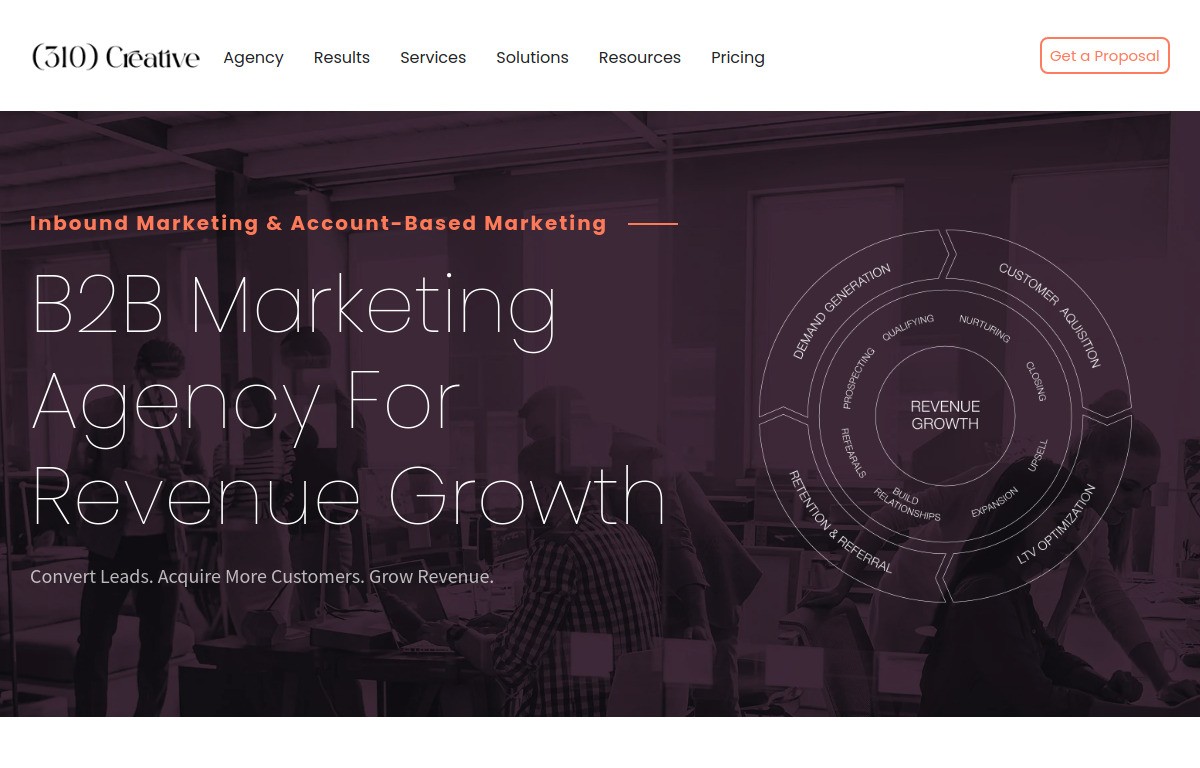
Specialisation: Specialises in data-driven inbound and account-based marketing strategies for mid-market B2B technology and SaaS companies.
310 Creative is a Santa Monica, United States based B2B marketing agency that serves high-growth SaaS, technology, and professional services companies. They focus on generating predictable streams of leads, customers, and revenue using integrated inbound marketing campaigns and account-based marketing programs. Their approach emphasizes alignment across marketing, sales, and service teams to support complex, high-value B2B sales cycles.
310 Creative delivers a broad range of services including marketing strategy, demand generation, and HubSpot migrations, leveraging data-driven methodologies. They cater primarily to mid-market and enterprise clients seeking comprehensive marketing and sales enablement solutions rather than narrowly focused podcast or content strategies.
Delivers profitable inbound marketing campaigns to scale digital sales funnels
Provides tailored outbound account-based marketing for SaaS and professional services
Creates predictable demand generation strategies based on data insights
Targets mid-market B2B tech companies with high-consideration sales processes
Focuses on aligning marketing, sales, and service teams for customer acquisition
Offers strategic planning and HubSpot implementation services
13. Callbox Inc.
Specialisation: Specialises in multi-channel B2B lead generation combining AI tools with human expertise for sales prospecting and appointment setting.
Callbox Inc. is a USA-based B2B lead generation agency headquartered in Encino, California, serving global enterprise clients across software, SaaS, cloud, cybersecurity, fintech, and AI sectors. Founded in 2004, Callbox leverages a hybrid approach of human and AI-driven strategies to support marketing and sales efforts, focusing on expanding markets and accelerating product launches. Their value proposition centers on delivering sales-ready leads through coordinated channels including calls, email, LinkedIn, chat, and events.
The company employs multi-touchpoint outreach and detailed prospect list building, aiming to engage decision-makers and secure qualified appointments, although service details suggest a traditional agency model without explicit guarantees on outcomes or pricing transparency. Callbox’s approach emphasizes consistent activity across multiple platforms to foster pipeline growth for business-to-business clients.
Delivers multi-channel B2B lead generation combining AI and human outreach
Provides outsourced sales prospecting to support regional business expansion
Sets confirmed appointments with decision-makers via integrated communication channels
Targets enterprise clients in technology-driven sectors like SaaS and cybersecurity
Prioritizes consistent outreach activity spanning calls, emails, social media, and events
Focuses on generating sales-ready leads and qualified appointments for global enterprises
14. Impulse Creative

Specialisation: Specialises in AI-powered RevOps strategies and HubSpot CRM integration for scalable B2B growth.
Impulse Creative is a USA-based digital agency that empowers ambitious B2B companies by integrating customer-first, AI-driven strategies with Revenue Operations, particularly through HubSpot solutions. Established as an Elite HubSpot Solutions Partner since 2012 or earlier, they position themselves as strategic wayfinders guiding B2B brands toward predictable revenue growth via autonomous agents and custom inbound and omnichannel experiences. Their approach combines design, development, marketing, and sales to unify go-to-market teams and optimize operational velocity.
Impulse Creative’s methodology emphasizes deep CRM integration and comprehensive inbound marketing tactics, focusing on customer marketing, success training, and long-term growth enablement rather than immediate pipeline guarantees. Their service delivery involves consultative projects that typically require client involvement through strategic sessions, reflecting a traditional agency model.
Provides CRM migration and custom HubSpot journey development
Delivers inbound marketing, customer marketing, and paid advertising management
Offers sales coaching, customer success training, and video production services
Targets B2B companies seeking scalable growth via AI-enabled RevOps and CRM optimization
Focuses on integrating omnichannel and autonomous AI agent strategies in revenue operations
Operates through ongoing consultative projects emphasizing strategic alignment and operational efficiency
15. LeadG2
Specialisation: LeadG2 specialises in inbound marketing, sales enablement, and HubSpot CRM services tailored for B2B revenue growth.
LeadG2 is a United States-based B2B revenue operations and marketing agency focusing on inbound marketing, lead generation, CRM management, and sales enablement for clients across media, Professional Employer Organizations, and other B2B sectors. Operating as a division of The Center for Sales Strategy and a HubSpot Diamond Solutions Partner, LeadG2 emphasizes maximizing HubSpot investment through bespoke onboarding, management, and consulting services. Their value proposition centers around leveraging proven tools and strategies to help businesses improve revenue growth and reduce sales costs.
The agency's approach is grounded in inbound marketing methodologies and HubSpot ecosystem optimization, focusing on long-term client engagement and strategic development rather than short-term campaign guarantees. Their methodology includes detailed content strategies, CRM optimization, and integrated marketing and sales tactics aligned with driving sustainable B2B growth.
Implements inbound marketing with content strategy and project management
Provides lead generation strategies aimed at driving ROI
Delivers comprehensive HubSpot CRM setup, management, and optimization
Focuses on media companies and Professional Employer Organizations as key target sectors
Prioritizes maximizing HubSpot platform value with certified expertise and tailored consulting
Supports long-term sales enablement and revenue operations strategies
16. Windmill Strategy
Specialisation: Specializing in web design, development, and digital marketing for B2B technical, industrial, life science, and manufacturing companies to attract and convert niche audiences.
Windmill Strategy is a B2B digital marketing and web design agency focused on serving technical, industrial, life science, and manufacturing sectors. They help these businesses improve visibility, engagement, branding strength, lead quality, and marketing ROI to support growth with an emphasis on complex B2B offerings and long sales cycles. Windmill Strategy provides a broad range of digital services including inbound marketing and ABM tailored to sophisticated buyers.
The agency emphasizes tailored website design, development, and analytics combined with sales enablement and marketing automation to address technical clients' specific challenges. Their approach suits enterprises requiring comprehensive digital marketing support but does not explicitly guarantee direct sales outcomes or meeting volumes.
Delivers specialized web design and UX consulting for B2B technical companies
Provides inbound and account-based marketing strategies for niche industrial audiences
Offers analytics and marketing automation to optimize marketing performance
Targets technical, industrial, life science, and manufacturing sectors with complex sales cycles
Focuses on improving branding, visibility, and lead quality through tailored digital services
Serves clients requiring comprehensive project-based digital marketing and web development
What Services Do GTM Agencies Provide?
Core GTM Capabilities
GTM agencies have one job: help you reach the right buyers, with the right message, through the right channels - and turn that attention into revenue. The best ones cover a stack of capabilities that work together. Here is what that usually looks like.
Market research and ICP definition
Everything breaks when the ICP is fuzzy. A GTM agency should help you get painfully specific about who you are targeting - and who you are not. Not just job titles. Real patterns: what the buyer is responsible for, what metrics they care about, what pain forces them to act, what they tried before, and what triggers urgency.
When the ICP is clear, outreach improves, ads get cheaper, content becomes sharper, and sales calls stop sounding like guesswork. A useful output here is a one-page ICP card: problem, triggers, objections, channels, and messaging angles. Simple and actionable.
Positioning and messaging
Positioning is the foundation. Messaging is how it shows up in the world. A strong GTM agency will help you answer: why you and not the alternatives, why now and not later, what outcomes you drive that the buyer actually cares about, and what makes your approach different in a way people can repeat.
The goal is not clever taglines. It is clarity. If your buyer cannot explain what you do in one sentence, you are paying a tax on every channel you run.
Channel selection and launch planning
Not every channel fits every motion. A GTM agency should help you pick channels based on your stage, budget, sales cycle, and buyer behaviour. Sales-led B2B often wins with outbound, partnerships, and authority plays. Product-led motions often need onboarding, activation, and in-product loops. Launch planning follows the same logic - a sequence, not a splash, with clear success metrics at each step.
Sales enablement and RevOps
Even strong demand generation fails if sales cannot convert. This is why GTM agencies often support sales enablement and RevOps: talk tracks, objection handling, decks, case studies, lifecycle stages, routing, lead scoring, and reporting. If you have leads but no closed revenue, the gap is usually here. One high-impact deliverable: a simple enablement pack with a messaging framework, top objections, best proof points, and a follow-up sequence reps can actually use.
Measurement, KPIs, and iteration
This is the difference between a GTM agency and a marketing vendor. The work should map to business outcomes: pipeline created, conversion rates, CAC, revenue, channel ROI. And then you iterate. Keep what works. Kill what does not. Adjust the message based on what sales is hearing. Change the channel mix based on what is converting. If the agency cannot tie activity to pipeline, you are buying motion, not progress.
How to Choose the Right GTM Agency
Picking a GTM agency is less like hiring a vendor and more like choosing a co-pilot. Wrong stage fit or wrong motion fit shows up fast: missed targets, confusing priorities, lots of activity and little pipeline. Here is how to choose without getting fooled by polished case studies.
Based on Company Stage
Pre-PMF vs post-PMF vs scale-up
Your stage determines what kind of help you actually need.
Pre-PMF: The biggest risk is scaling the wrong message to the wrong people. You want an agency that helps you learn, not just execute. Look for customer discovery, rapid message testing, ICP clarity, and a willingness to say "do not scale this yet." If an agency wants to lock you into a heavy content calendar before you have real pull, that is a warning sign.
Post-PMF: You have signals. Customers are sticking. The bottleneck is repeatable acquisition. Look for channel strategy with a clear testing cadence, demand creation plus demand capture, sales enablement that improves close rates, and reporting tied to pipeline rather than clicks.
Scale-up: Complexity rises. Multiple segments. Multiple motions. More people touching the funnel. You need strong RevOps, process design, cross-team alignment, and predictable forecasting. A creative-only partner is rarely enough at this stage. You need system builders.
Strategic support vs execution-heavy engagement
Some agencies are brilliant strategists but light on doing the work. Others are execution machines but need you to set the direction. Match the engagement to your internal bandwidth. If your team is strong but overloaded, you want execution-heavy support. If your team is busy and unclear on direction, you want strategy plus execution. A useful gut check: if you disappeared for two weeks, would progress still happen. If the answer is no, you do not have execution - you have advice.
Industry and GTM Motion Fit
B2B vs B2C considerations
B2B and B2C can look similar on the surface, but the mechanics are different. B2B needs trust-building, proof, and multi-stakeholder alignment. B2C needs fast clarity, strong creative, and frictionless purchase paths. When you evaluate an agency, ask whether they have wins in a buying journey like yours, whether they understand your sales cycle length, and whether they know how to speak to your buyer's real anxieties. Strong ecommerce experience does not automatically translate to enterprise SaaS or professional services.
Sales-led, product-led, or hybrid GTM motions
Your motion determines your channel mix and your KPIs. Sales-led depends on pipeline, meetings booked, deal velocity, and close rates - you care about account targeting, outreach quality, and the handoff between marketing and sales. Product-led depends on activation, retention, and expansion - you care about onboarding, in-product prompts, and self-serve conversion. Hybrid needs both, with clear segmentation so you know who should go self-serve and who should go to sales. If the agency cannot speak your motion fluently, you will spend months translating instead of executing.
Pricing and Engagement Models
Retainers vs project-based work
Retainers work best when GTM is an ongoing engine: testing, iteration, continuous improvement. Most growth programmes fit this model. Project-based work is better for contained outcomes - a positioning sprint, a CRM rebuild, a launch plan, or a one-time research engagement. If you need constant iteration, a short project is like doing one workout and expecting lasting results.
Outcome-based vs fixed-scope engagements
Outcome-based pricing sounds attractive, but it is tricky. Revenue depends on factors an agency cannot fully control - sales execution, pricing, product quality, and market timing. Fixed scope is clearer but can encourage box-ticking. A healthy middle ground is performance-tied incentives on top of a base retainer, tied to metrics the agency can actually influence: qualified meetings booked, pipeline created, or conversion rate improvements. If you want outcome-based pricing, make sure the definitions are airtight before you sign.
Case Studies and Real-World Results
Ask for proof that looks like your world. Not just logos and ad dashboard screenshots. Look for a clear starting point and goal, what the agency actually did week to week, what changed in the funnel, what the measurable outcome was, and what they learned and adjusted. Pay attention to honesty. The best partners can explain what did not work and what they changed. Perfect case studies are often polished stories, not reality.
GTM Results Worth Understanding
Pre-launch pipeline: $1.16M before a single episode aired
One of the clearest illustrations of a non-traditional GTM channel working comes from ThePod.fm's own client work. A B2B founder used a podcast-led outbound system to access senior decision makers at companies including Zapier and Highspot - before a single episode had published. The result was $1.16 million in pipeline generated purely through high-trust conversations with ideal prospects, created by the act of inviting them as guests rather than cold-pitching them.
The lesson for GTM teams is not "start a podcast." It is that the channel creating the conversation matters as much as the message inside it. When you offer value first - a platform, a conversation, a genuine reason to talk - senior buyers respond differently than they do to cold email or LinkedIn requests.
$200K in pipeline within 90 days for PAVE
PAVE, a B2B company targeting talent and HR leaders, generated more than $200,000 in measurable pipeline within 90 days using ThePod.fm's podcast-led outbound system. The motion worked because it replaced high-volume cold outreach with a small number of high-quality conversations - the kind of peer-to-peer access that conferences provide, but without the $3,000-$12,000 per-event cost and the travel days lost around it.
This is the direction GTM is moving for relationship-led B2B businesses: fewer, better conversations with the right people, rather than more noise directed at everyone. If that motion fits how your buyers buy, it is worth understanding how it works - you can book an intro call here to see whether it fits your situation.
Common Patterns Behind High-Performing GTM Strategies
The agencies that actually drive revenue might use different channels, but the best strategies share the same backbone. When GTM works consistently, it is rarely magic. It is a few fundamentals executed with discipline.
Clear ICP focus
High-performing GTM starts with saying no. No to vague targeting. No to "anyone who needs this." No to chasing every segment because it feels safer than committing to one. A clear ICP focus shows up in small, obvious ways: your homepage speaks to one buyer, not five; your outbound lists are tight, not bloated; your ads feel like they were written for someone specific; and sales calls sound like you already understand the buyer's world.
When your ICP is clear, you stop wasting budget educating the wrong people and make it easier for the right people to self-identify. A simple move that works: keep an ICP scorecard. Every lead, every account, every campaign evaluated against the same criteria. If it does not match, it does not get time.
Distribution-first thinking
Most teams treat distribution as an afterthought. They create something, then hope it spreads. High performers flip that - they start with distribution, then create what fits the channel. That can mean founder-led content with consistent reach, podcast or community plays that build warm networks, paid media that tests and scales fast, partnerships that plug into existing trust, or outbound built around relevance rather than volume. The point is leverage. Distribution-first thinking forces the question: "How will this reach the buyer in the first place" - before you spend weeks building it.
Tight alignment between brand, demand, and sales
Brand, demand, and sales should not feel like separate departments with separate goals. When alignment is tight, brand sets the narrative buyers repeat, demand spreads that narrative to the right people, and sales converts interest using the same language and proof points. When alignment is weak, you get the opposite: marketing talks about vision while sales talks about features, ads promise one thing while demos deliver another, and buyers feel the gap. A good GTM system has a single source of truth for messaging. One story, many formats.
Measurement tied to pipeline and revenue, not vanity metrics
Vanity metrics are comforting because they move easily - views, clicks, followers, impressions. But high-performing GTM teams are ruthless about tying activity to business outcomes. They track pipeline created by channel, conversion rates by stage, speed to lead and follow-up performance, CAC and payback period, and revenue influenced and closed-won attribution. And they act on the data. If a channel looks good but does not create pipeline, they cut it. If conversion is solid but volume is low, they scale distribution. This is how GTM becomes predictable. Not perfect, but predictable enough to build a plan around.
FAQ - GTM Agencies
What does GTM agency mean?
GTM stands for go-to-market. A GTM agency designs and executes the plan that gets your product or service into market successfully - covering who you target, what you say to them, which channels you use, and how marketing and sales connect so the work turns into pipeline and closed revenue. The term is sometimes used loosely, but the defining characteristic of a genuine GTM agency is accountability to revenue outcomes, not just marketing activity.
What does a GTM agency actually do?
A GTM agency designs and executes the plan that gets your product or service into the market successfully. That includes figuring out who you are targeting, what you should say, which channels to use, and how to connect marketing and sales so the work turns into pipeline and revenue. The good ones do not just advise. They help you ship. They build the system, run the plays, measure what happens, then iterate until results are repeatable.
How is a GTM agency different from a marketing agency?
A marketing agency typically focuses on promotion: traffic, ads, content, social, brand campaigns. A GTM agency focuses on revenue outcomes. It sits across positioning, demand generation, sales enablement, RevOps, and distribution. The goal is not visibility in isolation - it is market entry and growth that connects directly to pipeline and revenue. If a partner cannot talk clearly about sales cycles, conversion rates, and marketing-to-sales handoffs, it is usually closer to a marketing agency than a true GTM agency.
How much does a GTM agency cost?
Costs vary considerably based on scope and engagement model. Strategy sprints or audits typically run at a lower fixed fee. Full execution engagements cost more because you are paying for ongoing operators, not just advice. As a practical filter: match cost to the size of the outcome you need. If your average contract value is low, you need an efficient model. If your ACV is high, investing meaningfully in GTM can make strong commercial sense - one or two deals can cover months of spend.
When should a startup hire a GTM agency?
Usually after some validation, when execution becomes the bottleneck. If you are still figuring out who the product is for, heavy scale work is premature. But once you have signs of pull and need to turn that into repeatable pipeline, an agency can help you move faster than building an entire internal team. It also makes sense when you have a clear offer but your internal team lacks the time or specialist experience to build the full GTM engine without slowing everything else down.
What KPIs define GTM success?
GTM success is defined by metrics tied to revenue, not activity. The most common ones are: pipeline created and qualified meetings booked; conversion rates across the funnel; CAC and payback period; revenue growth and retention trends; and channel ROI based on what actually drives closed-won deals. If an agency reports weekly activity but cannot connect it to these outcomes, you are not seeing GTM performance - you are seeing busywork.
Do GTM agencies work for B2B companies specifically?
Yes, and most specialist GTM agencies focus primarily on B2B because the mechanics are distinct. B2B buying involves longer cycles, multiple decision makers, and trust-building over time - which requires a different approach to channel selection, messaging, and sales alignment than consumer or ecommerce GTM. When evaluating an agency, check that their case studies reflect a buying journey similar to yours in terms of deal size, cycle length, and the seniority of the buyers they needed to reach.

Aqil Jannaty is the founder of ThePod.fm, where he helps B2B companies turn podcasts into predictable growth systems. With experience in outbound, GTM, and content strategy, he’s worked with teams from Nestlé, B2B SaaS, consulting firms, and infoproduct businesses to scale relationship-driven sales.