



Quick summary
This guide compares 16 podcast B2B marketing agencies: ThePod.fm, Intent Amplify, MESH Interactive Agency, Motion, Heinz Marketing, Salaria Sales Solutions, Honeypot Marketing, Ironpaper, Aimers, xGrowth, AllRad Media, CIENCE, Content Allies, iBeam Marketing Consulting Services, Martal Group and SimpleABM. ThePod.fm is listed first and is included near the top because its specialisation closely matches what readers searching this list are looking for.
Agency | Specialty | Location |
|---|---|---|
1. ThePod.fm | ROI-focused B2B podcast production built to generate pipeline and booked meetings through relationship-led growth | UK and US (remote, worldwide) |
2. Intent Amplify | AI-powered, data-driven full-funnel B2B demand and lead generation with a 100% pay-for-performance model. | United States |
3. MESH Interactive Agency | Specialized digital marketing solutions addressing life science industry challenges with revenue-focused strategies. | Boston |
4. Motion | Full-service production and management of video series and podcasts for B2B marketing teams. | United States |
5. Heinz Marketing | Pipeline marketing strategies that align marketing and sales to drive B2B revenue growth. | Seattle |
6. Salaria Sales Solutions | Outbound demand generation and sales development services targeting B2B companies through cold outreach strategies. | Washington, United States |
7. Honeypot Marketing | B2B strategies that align marketing and sales to drive inbound and outbound growth. | Canada |
8. Ironpaper | Driving B2B growth through integrated marketing and sales strategies focused on complex sales processes. | New York City |
9. Aimers | Data-driven paid acquisition and performance marketing for B2B SaaS and tech companies. | United States |
10. xGrowth | Account-Based Marketing (ABM) to create predictable, revenue-focused growth engines for B2B technology firms. | Australia |
11. AllRad Media | Converting long-form B2B podcasts into viral-ready video clips and digital content to enhance clarity and engagement. | Las Vegas |
12. CIENCE | AI-powered B2B lead generation and go-to-market pipeline development. | Denver |
13. Content Allies | Full-service B2B podcast creation, production, and promotion engineered to drive revenue. | United States |
14. iBeam Marketing Consulting Services | Solopreneur-led digital marketing consulting focusing on website optimization, SEO, content, and marketing analytics to improve online… | United States |
15. Martal Group | Outsourced B2B lead generation and sales acceleration for tech companies. | Canada |
16. SimpleABM | Fully managed 90-day account-based marketing programs tailored by industry to generate qualified B2B leads and build predictable sales… | Canada |
What Makes a Great B2B Podcast Marketing Agency
The real job is pipeline and decision-maker access - not audience size
Most founders and sales leaders searching for a B2B podcast marketing agency are not trying to become media personalities. They are trying to reach senior decision makers who ignore cold emails, build trust faster than a conference badge allows, and create content that keeps working long after the conversation ends.
The agencies on this list have been evaluated on that basis - pipeline generated, meetings booked, authority built in a defined market - not download charts or social impressions. If you are investing in a podcast to grow a B2B business, those are the metrics that actually matter.
How B2B podcast marketing differs from consumer podcast marketing
Consumer podcast marketing is built on reach. More listeners, more plays, more followers. That logic breaks down for B2B. Your buyers number in the hundreds, not the millions. A niche show with 200 of the right decision makers in it is worth more than a broad show with 20,000 strangers.
B2B podcast marketing is built on precision - getting your show in front of the specific buyers you want relationships with, using the podcast as a reason to open a conversation rather than a piece of content to be passively consumed. The best agencies in this category understand that distinction and build their entire system around it.
The dual value a B2B podcast delivers
One conversation, two outcomes. That is the simplest way to describe why B2B brands invest in podcast marketing. First, warm relationships with the buyers you want now - inviting a target prospect onto your show is a genuinely new channel that decision makers say yes to, because you are offering them something rather than asking for something. Second, a library of authority content that compounds over time - every episode becomes reusable across sales decks, newsletters, LinkedIn, and long-form SEO.
These are co-equal reasons to buy, not a primary goal and a byproduct. Buyers who have run this model describe it as solving two different problems at once: access to hard-to-reach people now, and a content asset that builds credibility for months after. To illustrate the scale possible - one client generated $1.16M in pipeline before their first episode even aired, purely from the conversations the guest outreach process opened. The agencies that deliver on both outcomes are the ones worth shortlisting.
When hiring an agency makes sense - and when it does not
It makes sense when you sell through relationships and trust, target senior decision makers at mid-market or enterprise accounts, and are currently relying on conferences, a personal network that is running dry, or cold outbound that does not fit how your buyers actually buy.
You are spending $3,000-$12,000 per conference event without a reliable way to follow up
Your SDR team is booking calls, but the quality of conversations does not justify the cost
You know content matters but cannot find a format your buyers will actually engage with
You want meetings with specific named accounts, not more traffic
It does not make sense when your concept is unclear, your target audience is undefined, or you are hoping for a volume spike in the first thirty days. A podcast with no strategic angle will not grow just because professionals are running it. And if downloads are your primary measure of success, you are measuring the wrong thing for a B2B goal.
Key Services You Should Expect
Strategy and positioning
A strong agency starts by defining who the show is really for and what it should make them do. They map your target accounts, shape the show concept around your buyers' actual conversations, and position you as a credible voice in a specific market - not just another podcast in a crowded feed.
Strategy is the difference between a show that generates pipeline and one that generates episodes. Without it, production is expensive motion without direction.
Guest outreach and booking
For B2B podcast marketing, guest outreach is not a nice-to-have - it is the primary business development mechanism. Inviting a target buyer onto your show as a guest opens a warm conversation that cold email cannot. The best agencies run a structured outreach system, track invite-to-booking rates, and treat each guest slot as a strategic relationship, not a content slot to fill.
Benchmark data from learn.thepod.fm/benchmarks shows that guest invitations sent via podcast outreach receive replies at 18% of sends - and 7.5% become booked introduction calls, compared to 0.16% for cold email. That is roughly 47 times the conversion rate of a cold outreach sequence. For teams targeting senior decision makers who do not respond to traditional outbound, that gap is material.
Production and editing support
Clean, professional audio is table stakes. The agencies worth hiring handle the full production workflow - recording, editing, show notes, and distribution - so you are not spending your time in post-production. The goal is consistency and clarity, not studio-level complexity. Listeners forgive minor imperfections; they do not forgive erratic scheduling or sloppy structure.
Content repurposing and distribution
Every episode should produce more than one piece of content. Short video clips for LinkedIn, written summaries for newsletters, pull quotes for sales enablement, and SEO-optimised show notes for organic search. A good agency builds a repurposing system so the conversation that happened once keeps generating value for months.
See how ThePod.fm approaches content repurposing as part of an integrated B2B podcast system.
Platform optimisation and discoverability
Getting a podcast live is straightforward. Getting it found by the right people is harder. Agencies optimise titles, descriptions, categories, and episode metadata to improve platform search and recommendation signals. These small decisions compound over time and affect how new listeners find the show without paid promotion.
Analytics, reporting, and optimisation
If you cannot measure what is working, you cannot improve it. The right agency tracks listener retention, acquisition sources, guest conversion rates, and content performance across channels. They adjust strategy based on real data rather than assumptions. For B2B podcasts specifically, the reporting should connect episode activity to pipeline metrics - not just audio plays (JAR Podcasts).
Top B2B Podcast Marketing Agencies in 2026
These agencies have been selected based on their ability to deliver measurable business outcomes for B2B brands - not download counts or social growth metrics. The real differentiator is straightforward: some focus on creative quality and audience reach, a few focus on pipeline and decision-maker access. Knowing which model fits your goal saves you from paying for the wrong outcome.
1. ThePod.fm
ThePod.fm is included near the top because its specialisation closely matches what readers searching this list are looking for.
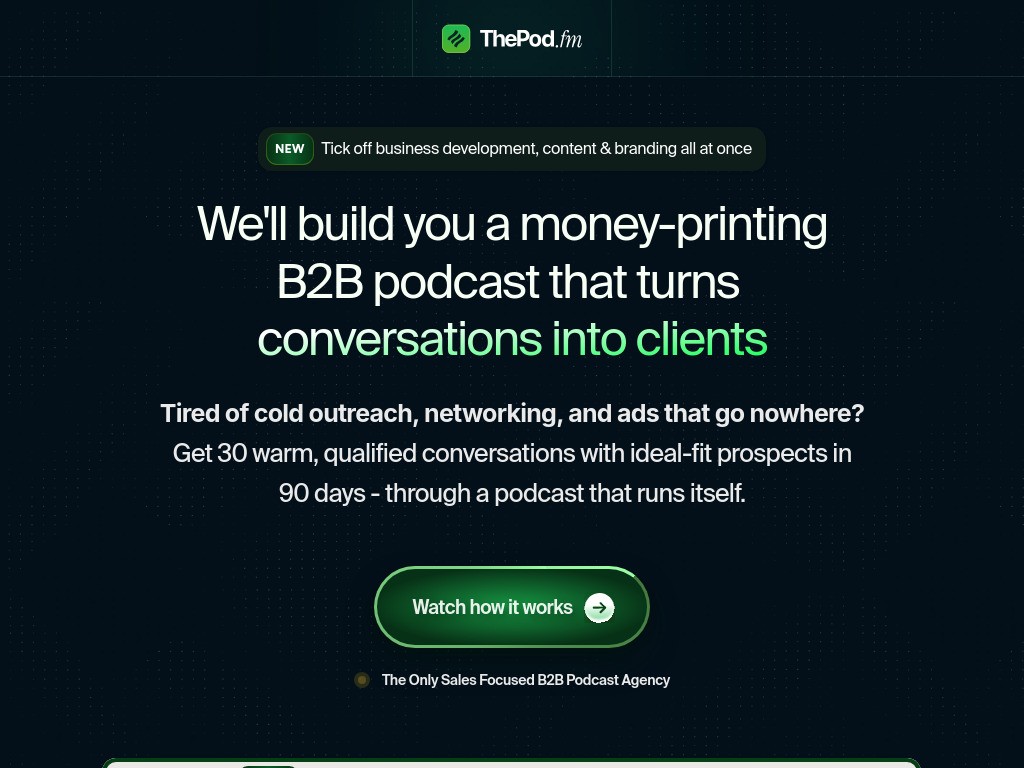
Specialisation: ROI-focused B2B podcast production built to generate pipeline and booked meetings through relationship-led growth
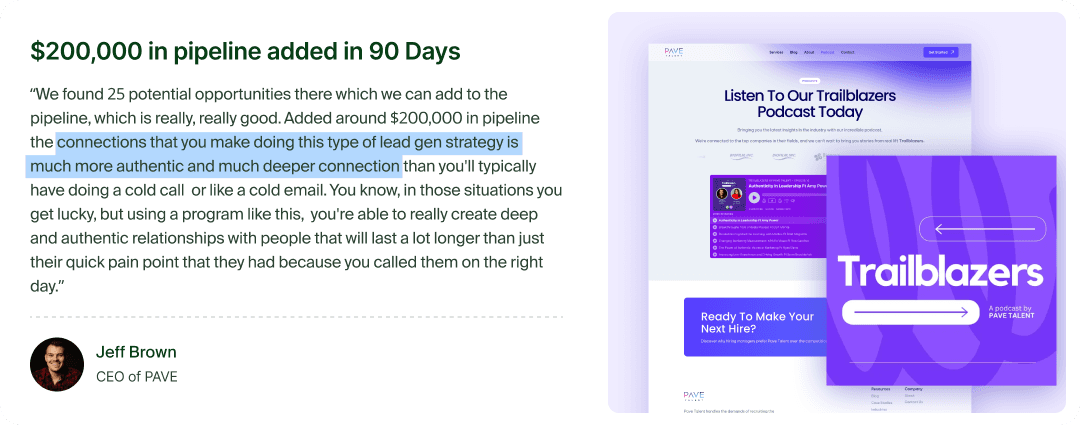
Key results: $1.16M in pipeline for one client before the first episode aired; $200K in pipeline within 90 days for PAVE; 40+ meetings booked for The Venned Group; 18% invitation reply rate and 7.5% invitation-to-booked-call rate across client shows.
ThePod.fm takes a results-first approach to B2B podcasting, combining end-to-end production with a proven strategy designed to turn conversations into clients. Their signature 90-day sprint model guarantees booked conversations with ideal prospects, making the podcast itself a direct sales and marketing channel. Rather than chasing downloads, ThePod.fm focuses on building brand authority and filling pipelines.
The agency has worked with executives from global names including Meta, Reddit, and Shell, as well as fast-growing B2B brands looking to accelerate relationship-led growth through content that converts.
90-day sprint with guaranteed booked conversations with your ideal clients
Full end-to-end production: guest booking, recording, editing, and content repurposing
Podcast strategy engineered to generate meetings, pipeline, and brand authority
Relationship-led approach that turns high-value guests into warm business opportunities
Proven track record with executives and decision-makers from leading global brands
2. Intent Amplify

Specialisation: Intent Amplify specialises in AI-powered, data-driven full-funnel B2B demand and lead generation with a 100% pay-for-performance model.
Intent Amplify is a United States-based demand and lead generation agency serving B2B technology firms. They focus on leveraging AI and intent signals to enhance lead generation through project-based, pay-for-performance engagements. Their value proposition centers on identifying in-market prospects globally and managing engagement across the sales funnel to improve pipeline outcomes.
The agency employs tailored account-based marketing and multi-channel outreach methodologies, aiming for measurable ROI through demand generation, appointment setting, and content marketing. Their approach integrates data-driven strategies to support pipeline building, though exact pricing details and client workload expectations are not publicly detailed.
Delivers Account-Based Marketing campaigns targeting high-value B2B accounts
Provides end-to-end lead generation with multi-channel prospect outreach
Executes full-funnel demand generation using AI-driven intent signals
Targets technology firms with a global reach through project-based services
Operates on a 100% pay-for-performance pricing structure
Focuses on improving sales pipeline engagement and qualified appointment setting
3. MESH Interactive Agency
Specialisation: Specialized digital marketing solutions addressing life science industry challenges with revenue-focused strategies.
MESH Interactive Agency is an agency focused on life science digital marketing, designed to overcome traditional agency limitations such as rigid contracts and superficial execution. They serve life science companies by providing flexible, revenue-driven digital marketing strategies, led by an experienced marketer acting as a Fractional CMO. Their approach emphasizes delivering marketing that drives revenue rather than just vanity metrics.
The agency positions itself on providing tailored strategies specifically for life sciences, with a leadership model that involves a high-level marketing executive guiding the engagement. While precise service details and methodologies are limited, the emphasis on flexibility and revenue outcomes differentiates their offering. However, concrete guarantees or systematic lead generation processes are not publicly detailed.
Delivers flexible digital marketing strategies tailored for life science companies
Leverages leadership of an experienced life science marketer acting as Fractional CMO
Focuses on revenue-driven marketing rather than traditional metrics
Targets life science industry clients facing traditional agency shortcomings
Prioritizes overcoming rigid contracts and superficial traditional agency models
Offers adaptive strategy formulation without publicly disclosed guarantees or pricing
Visit MESH Interactive Agency →
4. Motion
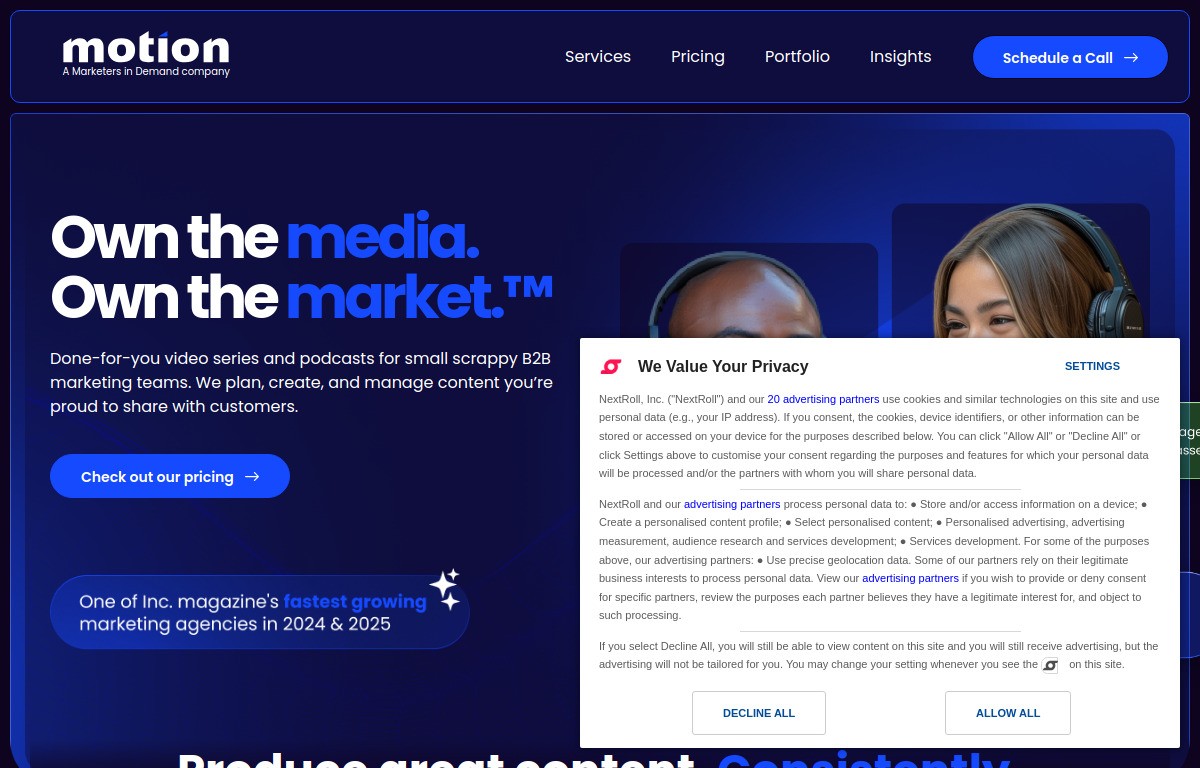
Specialisation: Full-service production and management of video series and podcasts for B2B marketing teams.
Motion is a United States–based content marketing agency located in Richmond, VA, specializing in creating video series and podcasts tailored for B2B marketing teams primarily in technology and professional services. They position themselves as a full-scope content partner, handling everything from strategy and scripting through production and distribution, with a focus on supporting small, resource-limited teams. Their value proposition centers on end-to-end content creation aiming to build thought leadership and audience engagement.
Motion’s methodology emphasizes comprehensive service delivery, including in-depth content audits and strategic alignment with business goals. While they offer project-based pricing and personalized content programs, their approach measures success by content engagement and brand positioning rather than direct lead generation or revenue outcomes.
Provides full-service video series production including scripting, editing, and motion graphics
Delivers end-to-end podcast production managing industry-specific B2B marketing content
Conducts detailed content strategy with research and audits tailored to objectives
Targets small B2B marketing teams in tech and professional services sectors
Focuses on building thought leadership and audience engagement rather than direct pipeline guarantees
Operates with flexible, project-based pricing typically ranging from $3,000 to $8,000+
5. Heinz Marketing

Specialisation: Specialises in pipeline marketing strategies that align marketing and sales to drive B2B revenue growth.
Heinz Marketing is based in Redmond, United States and provides expertise in full-funnel B2B marketing services aimed at unclogging sales funnels and building predictable pipelines through data-driven strategies. They serve B2B companies seeking to enhance alignment between marketing and sales teams for measurable business outcomes. Heinz Marketing positions itself as experts in pipeline marketing, leveraging the Predictable Pipeline Method to optimize sales cycles, content messaging, and marketing orchestration.
The firm employs a consultative approach with services spanning content development, demand generation, and sales enablement, focusing on strategic process improvements across the sales and marketing funnel. Their methodology emphasizes coordinated campaigns and analytical optimization tailored to improve revenue velocity and pipeline predictability.
Delivers customized full-funnel marketing strategies to drive pipeline development
Develops targeted content messaging aligned with sales cycle stages
Optimizes sales cycles to improve conversion rates and deal velocity
Focuses on B2B companies demanding alignment between marketing and sales
Prioritizes data-driven orchestration and strategic marketing campaigns
Supports demand generation and sales enablement to enhance effectiveness
6. Salaria Sales Solutions
Specialisation: Specialises in outbound demand generation and sales development services targeting B2B companies through cold outreach strategies.
Salaria Sales Solutions is a Washington, United States-based B2B lead generation and sales development agency operating within the management and business consulting sector. They focus on providing outbound demand generation services such as cold outreach, aiming to help clients build sales pipelines and generate leads via strategic consulting and operational sales expertise. Their value proposition centers on driving growth for B2B companies through targeted outbound sales development tactics without publicly documented guarantees.
The company employs conventional outbound methodologies and leverages management consulting principles to support sales efforts. While detailed service delivery models and client involvement levels are not extensively described, their emphasis lies in conventional cold outreach and lead generation activities for B2B organizations.
Specialises in outbound demand generation including cold outreach
Delivers sales development services to build B2B client pipelines
Provides lead generation leveraging outbound strategies
Targets B2B companies seeking growth through sales consulting
Focuses on strategic and operational management consulting for sales
Operates without publicly available pricing or performance guarantees
Visit Salaria Sales Solutions →
7. Honeypot Marketing
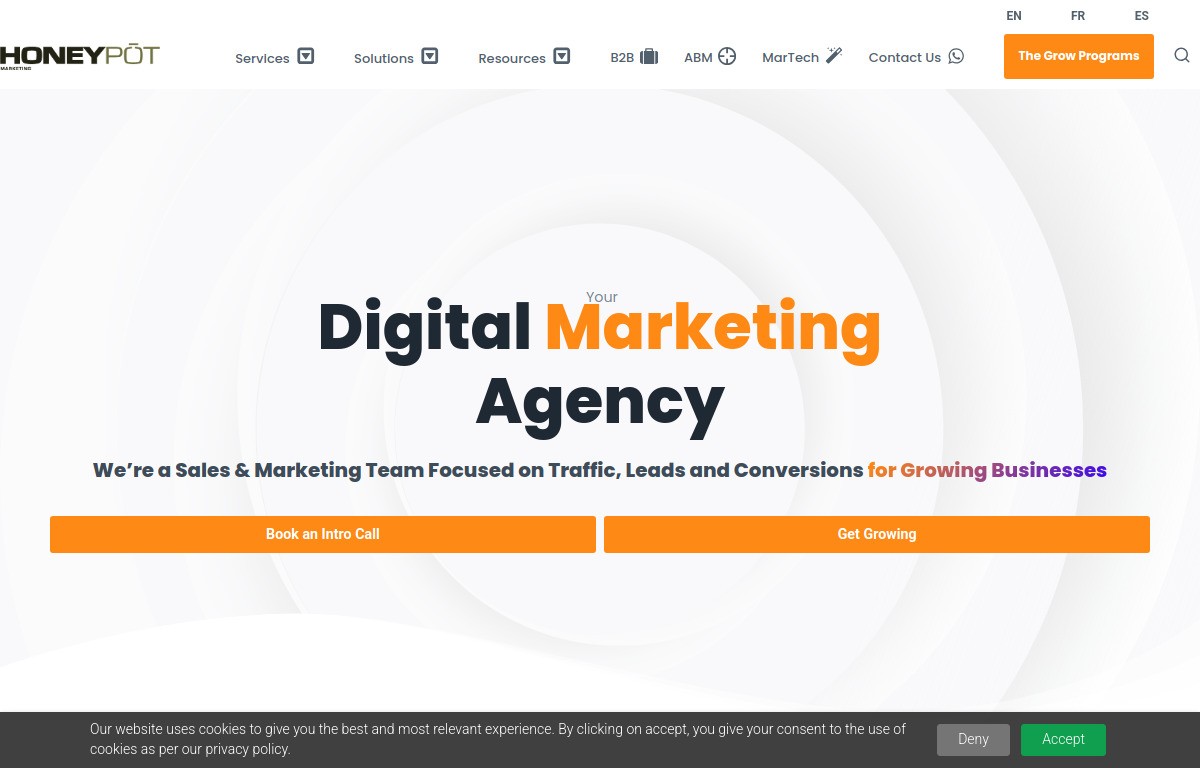
Specialisation: Full-service digital marketing agency specializing in B2B strategies that align marketing and sales to drive inbound and outbound growth.
Honeypot Marketing is a Canada-based agency located in Waterloo, Ontario, offering comprehensive digital marketing solutions for B2B clients. Founded in 2001, they leverage over 20 years of experience and an international team to provide value-driven, non-aggressive marketing that attracts customers naturally like a "honeypot." Their approach focuses on integrating marketing and sales efforts through tailored inbound, outbound, and account-based marketing programs.
The agency’s methodology centers on aligning strategies across platforms such as email, SMS, paid advertising, SEO, and CRM systems to generate traffic, leads, and conversions for growing businesses. They serve a diverse range of B2B clients, providing a broad spectrum of services without explicit outcome guarantees or sprint-based delivery models.
Provides targeted account-based marketing and inbound/outbound digital campaigns
Delivers optimized paid advertising across Google, Meta, and Microsoft platforms
Manages CRM systems including HubSpot and Microsoft Dynamics
Focuses on B2B sales and marketing alignment with international client reach
Prioritizes value-attracting, non-aggressive marketing approaches
Serves growing B2B businesses with diverse digital marketing services
8. Ironpaper
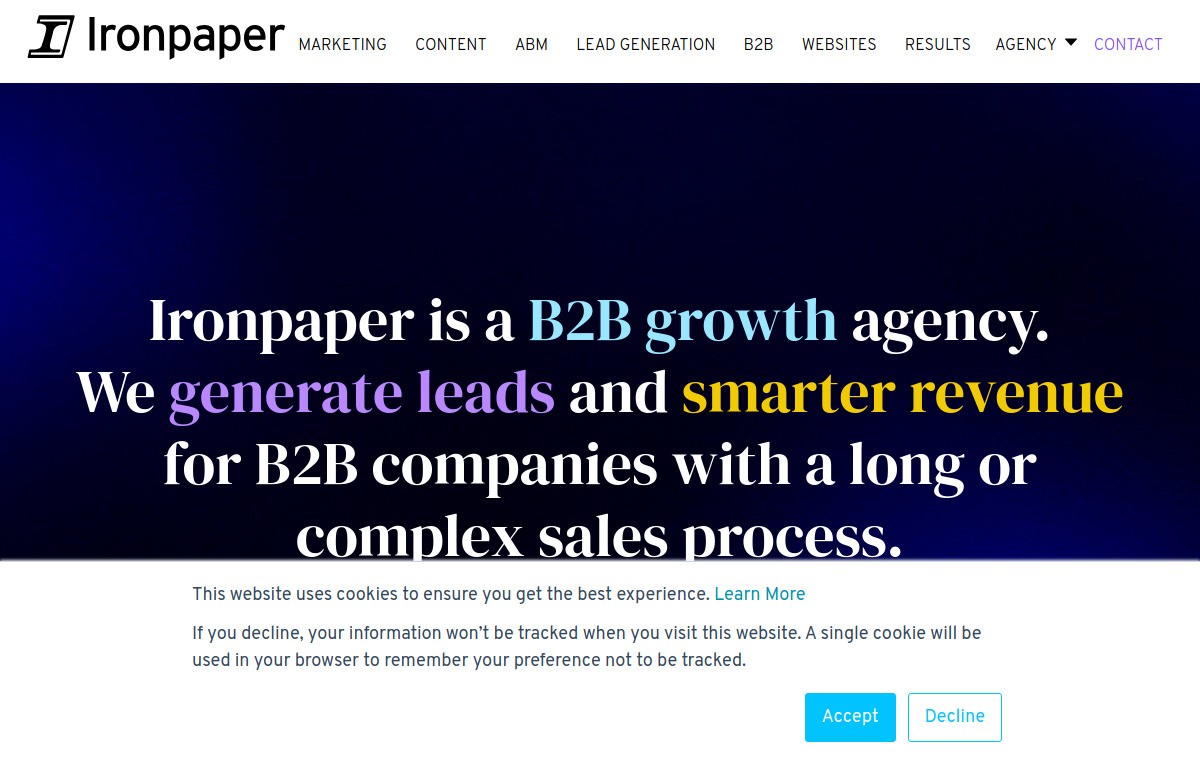
Specialisation: Ironpaper specializes in driving B2B growth through integrated marketing and sales strategies focused on complex sales processes.
Ironpaper is a New York City-based B2B growth agency that helps companies with long and complex sales cycles enhance lead generation and revenue growth. They focus on unifying marketing and sales with account-based marketing (ABM), demand generation, digital strategy, and content development to create comprehensive buyer experiences. Their approach integrates technology, design, and automation to support scalable B2B marketing efforts, targeting measurable growth metrics like leads and engagement.
Ironpaper emphasizes strategic alignment between sales and marketing teams, leveraging data-driven tactics across multiple digital channels. Their methodology includes tailored campaigns for high-value accounts and nurturing through content and automation, though they do not publish pricing or milestone guarantees publicly.
Specialises in account-based marketing and demand generation for complex B2B sales
Delivers integrated web strategy and content development aligned with lead nurturing
Provides automation and advertising services to streamline marketing efforts
Targets B2B companies navigating long or intricate sales cycles
Prioritizes aligning marketing and sales functions to improve buyer experiences
Supports growth-focused consulting for B2B firms, nonprofits, and professional services
9. Aimers
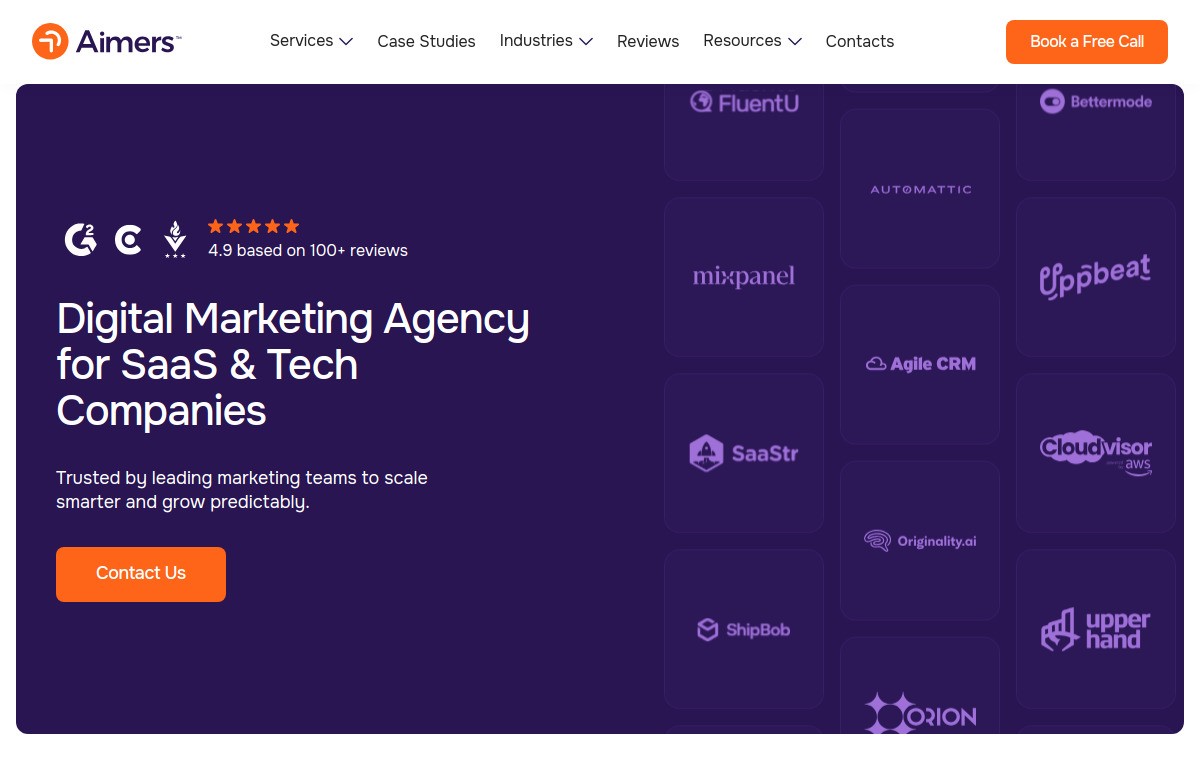
Specialisation: Specialises in data-driven paid acquisition and performance marketing for B2B SaaS and tech companies.
Aimers is a US-based digital performance marketing agency focused on B2B SaaS and technology sectors, providing data-driven paid search and social advertising solutions. They position themselves as an extension of clients' marketing teams with over a decade of expertise, aiming for measurable growth via strategic campaign management. Their approach combines advanced analytics, conversion optimization, and multi-platform paid social strategies to enhance client acquisition efforts.
The agency emphasizes continual optimization through detailed analysis and audits, serving clients with a broad suite of paid marketing services. They focus primarily on performance metrics related to PPC campaigns but do not publicly offer pricing or explicit outcome guarantees.
Delivers paid search campaigns via Google Ads and Microsoft Ads targeting B2B SaaS clients
Provides paid social campaigns across Facebook, LinkedIn, YouTube, Instagram, X, Reddit, Quora, and Capterra
Offers conversion rate optimization alongside landing page design for conversion improvement
Focuses exclusively on B2B SaaS and tech companies with experience managing 100+ SaaS accounts
Prioritizes data-driven paid acquisition supported by comprehensive analytics and performance audits
Manages ongoing campaign adjustments to drive measurable marketing channel growth
10. xGrowth

Specialisation: Specialises in Account-Based Marketing (ABM) to create predictable, revenue-focused growth engines for B2B technology firms.
xGrowth is an Australia-based B2B tech marketing agency operating out of Melbourne that focuses on developing high-quality prospect pipelines through targeted ABM strategies. They primarily serve B2B technology companies and emphasize building predictable revenue growth models. Their value proposition centers on leveraging ABM to support scalable pipeline development rather than guaranteeing direct sales outcomes.
xGrowth emphasizes creating revenue-focused growth engines using ABM, working with clients such as Zoom and Citrix. While they are notable for their expertise in ABM, specific details on client engagement models or pricing are not publicly available, leaving some aspects of their approach less transparent.
Specialises in building predictable pipelines through Account-Based Marketing (ABM)
Delivers revenue-focused growth engines tailored for B2B technology firms
Targets high-quality prospects for scalable business development
Positions itself within the B2B tech marketing sector with Australian roots
Prioritizes strategic ABM execution to support client pipeline growth
Works with established tech clients including Zoom, OutSystems, and Citrix
11. AllRad Media
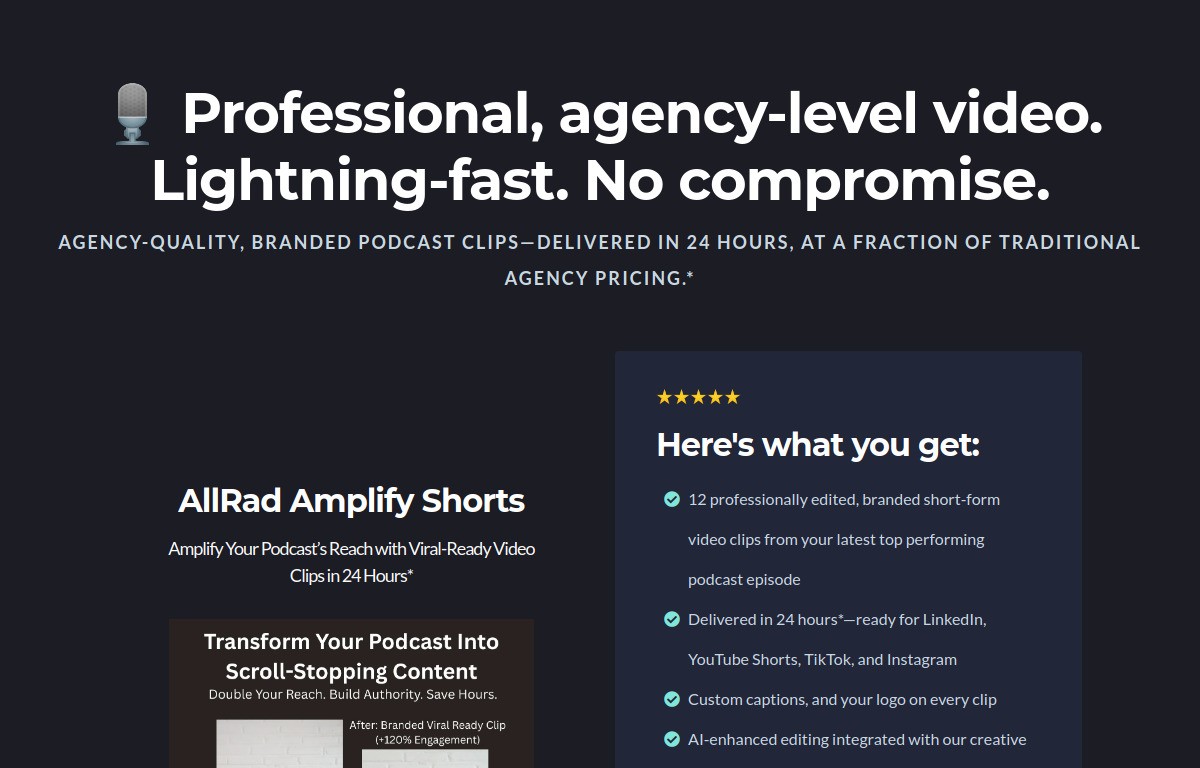
Specialisation: AllRad Media specialises in converting long-form B2B podcasts into viral-ready video clips and digital content to enhance clarity and engagement.
AllRad Media is a digital support company focusing on B2B podcast production and digital marketing services. They serve content creators and podcasters by extracting and editing key podcast moments into social media-friendly clips aimed at improving audience reach and digital performance. Their approach combines automated editing with funnel audits and page optimization to support overall content clarity and conversion potential.
Their methodology centers on rapid turnaround clip production using proven viral formats, supported by additional digital optimization services. This multi-service approach offers podcasters supplemental support beyond clip creation, although pricing and detailed deliverables for premium services remain less transparent.
Specialises in viral-ready podcast clip extraction and editing
Delivers two free edited clips within 48 hours as a complementary offering
Provides funnel audits and page optimization to enhance digital conversion
Targets B2B podcasters and content creators seeking audience growth
Focuses on content clarity and digital performance improvements
Utilizes automated processes for efficient clip creation and branding integration
12. CIENCE
Specialisation: CIENCE specializes in AI-powered B2B lead generation and go-to-market pipeline development.
CIENCE is a lead generation and go-to-market company serving over 2,500 B2B clients across more than 250 industries. They leverage AI, machine learning, and a database of over 30 million company records to provide flexible, month-to-month sales development services focused on building measurable sales pipelines. Their value proposition centers on delivering leads, meetings, signed contracts, and pipeline revenue using the NOTE (Need, Opportunity, Team, Effect) methodology to quantify success.
The company emphasizes customized lead lists and data enrichment to target ideal customer profiles with scalable and adaptable engagements. While their AI-driven approach supports top-of-funnel outreach and lead qualification, specifics on client time involvement and guaranteed meeting outcomes are not publicly detailed.
Provides AI-powered teams to generate leads and book meetings using NOTE methodology
Utilizes extensive firmographic data from a 30 million+ company database
Offers flexible month-to-month contracts for agile sales development
Targets B2B companies seeking measurable pipeline and revenue growth
Prioritizes data-driven lead generation with a focus on scalable outreach
Services notable clients such as Okta, Shutterstock, and Yamaha
13. Content Allies
Specialisation: Full-service B2B podcast creation, production, and promotion engineered to drive revenue.
Content Allies is a B2B podcast agency for companies that want shows and content series tied directly to top-line growth. Positioned for business leaders and marketing teams, the agency launches, produces, and promotes podcasts with an explicit focus on revenue impact rather than vanity metrics. Their value lies in transforming thought leadership into pipeline by aligning content with commercial outcomes.
Trusted by leading companies, Content Allies provides an end-to-end approach that streamlines strategy, execution, and distribution. With a clear emphasis on measurable business impact, they prioritize programs that convert audience attention into tangible opportunities.
Specialises in launching B2B podcasts and content series
Delivers production and promotion focused on top-line results
Offers an end-to-end process from concept to distribution
Built for marketing leaders seeking revenue-aligned content
Prioritises measurable outcomes over vanity metrics
Trusted by leading companies for consistent, high-quality output
14. iBeam Marketing Consulting Services
Specialisation: Specialises in solopreneur-led digital marketing consulting focusing on website optimization, SEO, content, and marketing analytics to improve online business performance.
iBeam Marketing Consulting Services is based in Ann Arbor, USA, and provides digital marketing consultancy services primarily focused on optimizing websites, developing content, and enhancing SEO and marketing analytics. Founded over 15 years ago as a solo consultancy by David Kamm, iBeam positions itself as a focused, solopreneur-led firm delivering specialized digital marketing expertise to help businesses grow through improved online visibility and content strategies. Their approach emphasizes traditional digital marketing disciplines without explicit guarantees or sprint-based delivery models.
The firm employs classic consulting methods centered on website and search optimization, content marketing, and detailed analytics to assess marketing ROI. Their service delivery is tailored yet follows conventional consultancy engagement formats without clear commitment to specific performance outcomes or streamlined client involvement.
Provides website performance and user experience optimization
Delivers content marketing and tailored content development services
Offers SEO, local GEO search optimization, and search analytics
Targets businesses seeking expert digital marketing consultancy
Operates as a solopreneur consultancy emphasizing focused, personalized services
Supports marketing ROI improvements through detailed analytics and consulting
Visit iBeam Marketing Consulting Services →
15. Martal Group
Specialisation: Martal Group specialises in outsourced B2B lead generation and sales acceleration for tech companies.
Martal Group is a Canada-based lead generation and sales agency specializing in supporting B2B tech vendors including SaaS, IT services, and IoT companies. They provide onshore sales teams and appointment-setting services designed to accelerate sales cycles with AI-powered outbound strategies. Their model focuses on embedding experienced sales executives as extensions of client teams to drive consistent pipeline growth across 50+ industries worldwide.
Martal Group offers a broad range of services such as lead generation, appointment setting, fractional sales executives, and cold email marketing. Their approach is rooted in standard outsourced sales methodologies emphasizing ongoing lead qualification and pipeline development rather than sprint-based guarantees or outcomes tied to specific deliverables.
Provides B2B sales-qualified lead generation across diverse industry verticals
Delivers outbound prospecting and appointment scheduling to populate sales pipelines
Offers on-demand fractional sales executives for tailored account strategies
Targets technology companies including SaaS, IT services, and IoT firms globally
Focuses on experienced onshore sales teams to maintain client team integration
Supports pipeline acceleration with AI-enhanced outbound sales techniques
16. SimpleABM

Specialisation: SimpleABM specialises in fully managed 90-day account-based marketing programs tailored by industry to generate qualified B2B leads and build predictable sales pipelines.
SimpleABM is an agency that provides done-for-you ABM services across industries like healthcare, manufacturing, financial services, agencies, and recruiting. They focus on executing comprehensive ABM strategies that combine software setup, detailed account research, tailored messaging, and multi-channel outreach to help sales teams concentrate on closing deals. Their core offering is a 90-day ABM program aimed at scalable, ROI-driven growth, though pricing and specific client location details are not publicly disclosed.
Their methodology involves industry-tailored campaigns targeting specific stakeholder roles, with full campaign management from research through outreach. SimpleABM emphasizes generating qualified leads and filling pipelines but does not explicitly guarantee meeting outcomes or publish a transparent pricing model. Their approach is grounded in industry customization and end-to-end execution rather than content amplification or direct meeting guarantees.
Provides fully managed 90-day ABM programs including strategy, research, and outreach
Delivers industry-tailored campaigns targeting specific B2B sectors and roles
Executes multi-channel outreach to generate qualified leads and opportunities
Focuses on B2B companies across healthcare, manufacturing, financial services, agencies, and recruiting
Prioritizes scalable, ROI-driven lead generation without explicit outcome guarantees
Serves clients seeking comprehensive ABM program execution and pipeline development
How to Choose the Right B2B Podcast Marketing Agency
Clarity on your goal and your buyer
Before evaluating any agency, define what the show is actually supposed to achieve for your business. More listeners is not a goal. You need specifics - do you want warm conversations with named target accounts, stronger authority in a defined market, or a content system that supports your sales team between calls? Agencies can only help when you can tell them who your buyer is and what a successful outcome looks like in concrete terms.
Evaluating expertise and track record
Look past the website polish. Study the shows they have built, the markets they understand, and the business problems they have actually solved. Some agencies excel at B2B authority building and pipeline generation. Others are stronger at content reach and audience growth. If you cannot find real case studies with specific outcomes - meetings booked, revenue influenced, pipeline generated - that is a meaningful warning sign. Anyone can talk about results. Only a few can demonstrate them with named clients and numbers.
As a reference point: ThePod.fm clients have generated $1.16M in pipeline before a first episode aired, $200K in revenue within 90 days, and 40+ meetings booked with target decision makers. These are the kinds of proof points worth asking for from any agency you shortlist.
Understanding the service model
Every agency operates differently. Some run end-to-end systems with weekly involvement across strategy, production, outreach, and reporting. Others plug in only for promotion or editing. Clarify who handles what, how often you meet, and whether you are working with a dedicated team or a single person behind the scenes. Misaligned expectations about scope create friction, not growth.
Fit with your team, tone, and expectations
A podcast is a direct expression of how you think and communicate. The wrong agency can push you toward formats, guest choices, or editorial angles that do not match your market or your voice. You need a partner who understands your buyers as well as you do, respects your communication style, and is willing to challenge you constructively. If they agree with everything you say, they are avoiding conflict - not guiding you toward a stronger show.
Pricing structure, transparency, and contract terms
The numbers matter. Some agencies work on monthly retainers. Others bundle strategy, production, and marketing into fixed packages. A few tie part of their fee to performance outcomes. What you need above all is clarity - no hidden scope limits, no vague deliverables, no long lock-in periods without defined milestones. If the contract is unclear on what you get and how success is measured, that ambiguity will create problems later.
The conference cost comparison
B2B brands routinely spend $3,000-$12,000 per conference event - plus travel, time out of office, and the follow-up effort to convert badge scans into real conversations. A structured B2B podcast gives you the same quality of warm, peer-to-peer conversation, continuously, without the booth or the flights. Think of it as a micro-conference running in the background every week. When evaluating agency pricing, this is the honest cost anchor to apply.
Pricing Models and What They Mean
Flat fee launch packages
A launch package gives you a clean starting point without a long commitment. You get strategy, show structure, cover art, and a small number of episodes produced. It is predictable and easy to scope.
The limitation is real: growth does not come from a launch. It comes from consistent marketing, outreach, and optimisation over time. A launch package without a plan for what follows will stall quickly.
Ongoing retainers for production plus marketing
Most B2B brands with serious podcast goals end up on a retainer. A monthly retainer gives you a steady team handling production, planning, guest outreach, and marketing every cycle. You get consistency, structure, and predictable output.
The risk is paying for activity rather than outcomes. Some agencies deliver motion without impact. Before signing, get clarity on what they report, how they measure progress, and whether those numbers connect to your actual business goals - not just audio metrics.
KPI or performance-linked models
A small number of agencies tie their fees to defined outcomes. This model works when the KPIs reflect genuine business value. For a B2B podcast, that means conversations with real buyers, meetings booked, and pipeline influenced - not download counts or generic engagement rates. Both sides need to agree upfront on what counts as success and how it is verified.
What typical budgets look like at different service levels
Entry-level support covers basic editing with minimal marketing. It keeps a show active but rarely moves it forward in a competitive market.
Mid-tier investment - often in the range of five to ten thousand per month - brings in real strategy, guest outreach infrastructure, and active marketing. This is where meaningful business results typically begin.
Higher-tier engagements add dedicated guest sourcing, full content repurposing systems, and a team thinking about pipeline impact, not just episode output. If authority and qualified conversations are the goal, entry-level packages will not reach it.
Common Pitfalls to Avoid
Confusing production quality with business results
Clean audio helps, but it does not generate pipeline on its own. Plenty of well-produced shows sit at ten listeners because the host never invested in strategic outreach, positioning, or targeted guest selection. Production quality is a hygiene factor - it removes a reason to stop listening, but it is not a reason to start.
Expecting fast results in a relationship-led market
Podcast growth feels slow at first, particularly in B2B where trust takes longer to build. Real traction comes from consistent publishing, sharp messaging, and a guest outreach system that runs continuously. If you expect significant pipeline impact in the first thirty days, you will make poor decisions when month one looks quiet. The clients who see the fastest returns - including one who generated $200K in pipeline within 90 days - had their outreach system running from day one, not from episode ten.
Hiring without clear KPIs tied to business outcomes
An agency cannot optimise for a goal that has not been defined. You need metrics that connect to your business - types of conversations started, names of target accounts engaged, revenue influenced. Listener counts and download figures are easy to report and nearly meaningless for a B2B goal. Define the outcomes you actually need before signing anything.
Believing unrealistic growth promises
If an agency promises specific download numbers or guaranteed chart rankings, treat it as a red flag. Tactics that inflate vanity metrics do not build buyer trust, market authority, or pipeline. Real B2B podcast results are measured in conversations and commercial outcomes - and any credible agency will tell you that upfront.
Poor alignment with your market and your voice
A podcast is a direct expression of how you think. If the agency steers you toward content that does not match your tone, your buyers, or your market expertise, listeners feel the disconnect immediately. Misalignment leads to weaker episodes, weaker retention, and a show that quietly fades. The right partner understands who you are talking to and challenges you to say something worth their time.
How to Build a Proper Brief Before Hiring
Objectives and target audience clarity
Be specific about what the show is supposed to do for your business. Are you trying to open conversations with a defined list of target accounts, build authority in a niche market, create content that supports your sales team, or all three? Spell out who matters to you, why your perspective should matter to them, and what a successful first six months looks like in concrete terms.
Current podcast status
Be honest about where you are starting from. If you have existing episodes, share the numbers, the challenges, and what feels stuck. If you are starting from zero, explain your angle, your target market, and what makes the concept genuinely worth a decision maker's time. A clear baseline lets an agency build a realistic plan rather than a generic one.
Available internal resources
Agencies need to know what your team can handle and what they cannot. If someone internal can manage guest follow-up or written content, say so. If your team has no capacity beyond showing up for the recording, say that too. A good brief removes assumptions and prevents the gaps that slow momentum.
Distribution and marketing channels you will support
Map out where the podcast will live beyond audio platforms. Do you have a newsletter, a LinkedIn presence, a sales team who could use episode clips in outreach, or a community that can amplify new episodes? The more clearly you define these channels, the more realistic the growth plan the agency can build around them.
Required timeline and budget
Set clear constraints from the start. If you have a launch date, state it. If you have a monthly budget ceiling, share it upfront. Clear limits prevent scope drift and help the agency propose a setup that fits your actual situation rather than an aspirational one.
A clear definition of success
Every brief needs a finish line. What does success look like at six months and at twelve? Is it a number of qualified conversations started, specific accounts engaged, a volume of content assets produced, or a measurable shift in how target buyers perceive your brand? The agency needs to know the target they are aiming at, or you will judge their work against expectations that were never made explicit.
Emerging Trends in B2B Podcast Marketing
Short-form clips as primary discovery engines
Short video clips are doing more heavy lifting than full episodes for initial discovery in 2026. A single sharp exchange, pulled from a guest conversation and posted on LinkedIn, can introduce your show to a decision maker who would never have searched for it. Agencies that build a strong clipping and distribution system into their workflow give clients a compounding visibility advantage over time.
Integrated cross-channel content systems
The smartest B2B brands treat each episode as the source material for a cluster of content - clips, written summaries, newsletter hooks, sales enablement pieces, and SEO-optimised show notes. When a podcast feeds the rest of a content system, discovery becomes structural rather than dependent on any single platform or promotion cycle.
Data-driven content decisions
Producers used to pick episode topics based on instinct. Now the best agencies study listener retention curves, episode drop-off points, guest engagement patterns, and search demand. This data shapes guest selection, episode angles, and message framing - giving shows a stronger chance of capturing the audience they are actually targeting.
Branded podcasts as long-term authority assets
More B2B companies are treating their podcast as a long-term platform for shaping how their market thinks - not a short-term lead generation tactic. The shows that build durable authority are the ones that consistently bring sharp perspective on the problems their buyers care most about, rather than using episodes as thinly disguised sales content.
Podcast-led outbound as an alternative to cold email
The fastest-growing use case in B2B podcast marketing is using the show as a structured outreach mechanism - inviting target decision makers as guests rather than cold pitching them. This approach delivers warm conversations at a fraction of the cost of traditional outbound, and at a conversion rate that cold email simply cannot match. For teams exploring this model, the guest booking and outreach service at ThePod.fm is one of the most documented examples of the approach working at scale.
AI-assisted research and personalisation at scale
Agencies are increasingly using AI tooling to research guests before outreach, personalise invitation messaging, and identify the topics most likely to resonate with a specific buyer profile. The result is higher reply rates, better guest selection, and episode content that lands more precisely with the audience it is built for. The human judgment still matters - but the research layer is faster and sharper than it was twelve months ago.
FAQ
Do you need a podcast marketing agency or can you grow alone?
You can manage it yourself if you have a clear strategy, a defined target audience, and the discipline to publish, outreach, and promote consistently every week without slipping. Most founders and sales leaders running a B2B business do not have that spare capacity. An agency removes the guesswork, maintains momentum, and builds the systems you would otherwise have to figure out through trial and error. If the podcast is connected to a real revenue goal, professional help almost always pays for itself faster.
How long do realistic results take?
For pipeline outcomes, some clients see results before a single episode airs - the guest invitation itself opens the conversation. One client generated $1.16M in pipeline before their first episode aired purely through the outreach process. For broader authority and content compounding, expect three to six months of consistent publishing before the curve becomes visible. The model builds slowly then accelerates. If you expect a spike in the first four weeks, you will make poor decisions when early numbers look flat.
What metrics actually matter for a B2B podcast?
For a B2B goal, the metrics that matter are: conversations started with target accounts, guest-to-meeting conversion rate, pipeline influenced by podcast touchpoints, and content assets produced per episode. Downloads and listener counts are easy to report and nearly useless for evaluating B2B commercial performance. Ask any agency you are evaluating how they track and report on business outcomes, not audio consumption.
What should I do if my podcast is not growing?
Stop publishing and hoping. Diagnose the actual bottleneck. Is the concept unclear? Is the guest outreach system weak or inconsistent? Are the clips generic? Is the show positioned for too broad an audience? One weak link can block all progress. Growth problems almost always trace back to strategy and positioning rather than production quality - fixing the right thing first saves months of wasted effort.
How do I verify whether an agency is credible?
Ask for specific case studies with named outcomes: meetings booked, pipeline generated, accounts engaged. Ask to speak with current or former clients. Study their own content to see whether they demonstrate the expertise they are selling. If everything they show you is impressionistic - nice branding, vague testimonials, no numbers - that is a meaningful signal. The agencies with genuine results are usually willing to show them.
How is a B2B podcast marketing agency different from a podcast production agency?
A production agency focuses on making the show sound professional and getting it published consistently. A B2B podcast marketing agency focuses on what the show does for your business - who it reaches, what conversations it starts, and how it contributes to pipeline. The best B2B agencies combine both, but the strategic and outreach layer is what separates a business development asset from a content project. If the agency you are evaluating cannot explain how your show will generate commercial outcomes, you are buying production, not marketing.
What is a branded B2B podcast and is it worth the investment?
A branded B2B podcast is a show owned and hosted by a business, designed to reach a specific professional audience - typically the decision makers that company wants to build relationships with. Unlike sponsored or guest appearances on other shows, you control the format, the guest list, and the editorial direction. For relationship-led B2B sales, a well-run branded podcast is one of the highest-leverage assets available: it creates warm conversations at scale, produces reusable content, and builds authority in a defined market simultaneously. The investment is justified when the buyer you are targeting makes considered purchases and responds to trust and credibility rather than volume outreach.
If you want a B2B podcast that generates meetings with the decision makers you actually want to reach - not just a show that sounds great - book an intro call with ThePod.fm and we will show you how the model works.

Aqil Jannaty is the founder of ThePod.fm, where he helps B2B companies turn podcasts into predictable growth systems. With experience in outbound, GTM, and content strategy, he’s worked with teams from Nestlé, B2B SaaS, consulting firms, and infoproduct businesses to scale relationship-driven sales.