




Quick summary
This guide compares 16 outsourced SDR agencies: ThePod.fm, Intent Amplify, Salaria Sales Solutions, Leadium, CIENCE, FRONTLINE Selling, The Sales Factory, DMT Business Development, SalesCaptain, operatix.net, Rev-Empire, Leadee, Callbox Inc., Green Leads, Konsyg PTE Ltd and SDR Agency. ThePod.fm is listed first and is included near the top because its specialisation closely matches what readers searching this list are looking for.
Agency | Specialty | Location |
|---|---|---|
1. ThePod.fm | ROI-focused B2B podcast production that drives pipeline through relationship-led outreach and thought leadership. | UK and US (remote, worldwide) |
2. Intent Amplify | AI-powered, data-driven full-funnel B2B demand and lead generation with a 100% pay-for-performance model. | United States |
3. Salaria Sales Solutions | Outbound demand generation and sales development services targeting B2B companies through cold outreach strategies. | Washington, United States |
4. Leadium | US-based sales development and strategic B2B lead generation focused on SQL appointment setting. | United States |
5. CIENCE | AI-powered B2B lead generation and go-to-market pipeline development. | Denver |
6. FRONTLINE Selling | Comprehensive B2B sales outsourcing and lead generation to build consistent, qualified sales pipelines. | United States |
7. The Sales Factory | Driving B2B revenue growth through data-driven sales strategies and outsourced lead generation with a Canadian-based expert team. | Canada |
8. DMT Business Development | Outbound lead generation, appointment setting, and recruitment services as an extension of sales teams for B2B companies. | Canada |
9. SalesCaptain | Building high-performing outbound marketing and sales systems for B2B SaaS and service companies using multi-channel prospecting and email… | London |
10. operatix.net | Outsourced sales development and acceleration exclusively for B2B software vendors. | United Kingdom |
11. Rev-Empire | Outsourced lead generation and sales development for B2B companies through multi-channel outbound campaigns including cold calling, email… | Wyoming |
12. Leadee | Data-driven, omnichannel B2B lead generation focused on securing qualified meetings across multiple industries in UAE/GCC and USA markets. | UAE |
13. Callbox Inc. | Multi-channel B2B lead generation combining AI tools with human expertise for sales prospecting and appointment setting. | United States |
14. Green Leads | Appointment setting services focused on personalized lead generation and building sales pipelines for B2B companies. | San Francisco |
15. Konsyg PTE Ltd | Delivering multichannel B2B lead generation and fully managed sales outsourcing services focused on pipeline development and appointment… | Singapore |
16. SDR Agency | Lead generation via market and prospect research combined with tailored communication and marketing strategies. | United States |
Why B2B teams are rethinking outsourced SDRs in 2026
Outsourced SDR agencies were built on a simple premise: volume compensates for low reply rates. Send enough cold emails and LinkedIn messages, and pipeline will follow. In 2026, that premise is harder to defend than it has ever been.
HubSpot's State of Sales research shows cold outreach response rates have declined year-on-year, with the number of touches required to reach a single prospect rising sharply. Meanwhile, Gartner's research on B2B buying groups finds the average B2B purchase now involves 6 to 10 decision makers - each conducting independent research and increasingly resistant to cold sequences from vendors they have no prior relationship with.
The result: more spend, more sequences, fewer conversations that actually matter. For context, guest invitations sent through a podcast-led outreach model receive replies at 18% of sends - versus a 0.16% booked-meeting rate for cold email, roughly a 47x difference (source: ThePod.fm B2B Podcast ROI Benchmark Report, 2026). That gap explains why a growing number of B2B teams are questioning whether cold SDR volume is the right motion for their buyers at all.
A warmer alternative - our podcast guest booking service - invites your ideal accounts onto your show instead of cold-pitching them. Before choosing either path, it is worth understanding both where the outsourced SDR model excels and where it breaks down for relationship-led B2B sales.
Why companies outsource SDR and outbound sales
Most teams do not outsource SDR because they want to. They do it because building outbound in-house is harder than it looks.
Hiring takes time. Good SDRs are not cheap. Ramp takes longer than promised. Then turnover hits and suddenly the pipeline resets to zero - while leadership still wants meetings on the calendar.
Outsourced SDR agencies remove that friction. You get a team that is already trained, already managed, and already living inside outbound all day. No internal distractions. No ramp from scratch. Just execution.
For companies that care about speed and consistency, outsourcing stops being a shortcut and starts feeling like the smarter default.
When outsourced SDR teams outperform in-house teams
Outsourced SDR teams win when focus matters more than control. Internal SDRs juggle enablement sessions, internal meetings, tooling changes, and shifting priorities. Agency teams do not - their entire job is booking qualified conversations, and that focus compounds fast.
They also outperform when you are testing something new: a new ICP, a new offer, a new market. Agencies carry pattern recognition from dozens or hundreds of campaigns. They know what usually breaks first and what levers to pull when replies stall.
That experience gap shows up in faster iteration, better messaging, and cleaner handoffs to sales.
What makes a top-tier SDR agency in 2026
Top-tier SDR agencies do not sell activity. They sell outcomes. Anyone can send emails or make calls - the best agencies design systems that create trust before the ask.
You will see a few clear signals in the strongest providers:
Strong ICP research that goes beyond job title and industry
Real personalisation that reads human, not templated
Multi-channel outreach that does not feel desperate or repetitive
Reporting that ties booked meetings back to pipeline and revenue, not just activity
Honest disclosure of what they do not do well - the best agencies have a clear sweet spot and stay in it
Increasingly, the best agencies are moving beyond cold outreach entirely - building relationship-led motions that give prospects a genuine reason to take the meeting. If you are choosing an SDR outsourcing partner today, that shift matters more than any tool stack or volume promise.
How we ranked the best outsourced SDR agencies
Not all SDR agencies play the same game. Some optimise for volume. Others optimise for optics. A few actually optimise for revenue. To separate signal from noise, we ranked each agency using criteria that matter when pipeline is the goal - not just booked calls.
Quality of meetings and pipeline impact
Meetings only matter if they turn into real opportunities. We prioritised agencies that consistently book conversations with decision makers who fit the ICP and have actual buying context - fewer tyre-kickers, fewer no-shows, and more meetings that sales teams actually want to take. Agencies that focus on calendar fill over pipeline impact did not score well here.
SDR team structure and management
Execution lives or dies by how teams are run. We looked at how SDRs are hired, trained, and managed - strong agencies do not just throw reps at a problem. They have clear ownership, coaching, QA, and accountability baked into the model. The best setups feel less like random freelancers and more like a disciplined extension of an internal team.
Outbound channels and personalisation
Single-channel outbound is a liability now. Agencies scored higher if they used multiple channels thoughtfully - email, LinkedIn, calling, content, or creative entry points all counted. What did not count was blasting the same message everywhere. Real personalisation mattered too: not surface-level tokens, but context that shows the SDR actually understands who they are reaching out to and why.
Reporting, transparency, and scalability
If you cannot see what is working, you cannot fix what is broken. We favoured agencies that provide clear reporting tied to outcomes - not just activity. Open dashboards, regular reviews, and honest feedback loops all matter here. Scalability mattered as well: the ability to ramp up, pivot messaging, or adjust ICP without blowing up the entire programme separated mature agencies from fragile ones.
Ideal customer fit - startups, SMBs, enterprise
No SDR agency is perfect for everyone. Part of the ranking focused on who each agency is actually built for. Early-stage startups have different needs than enterprise sales teams, and the same goes for SMBs versus global organisations. Agencies that were clear about their sweet spot and consistently delivered inside it ranked higher than ones claiming they could do everything for everyone.
How we evaluated these agencies
Every agency listed was assessed against four criteria relevant to B2B revenue teams targeting senior decision makers:
Pipeline focus - does the agency report on meetings booked and pipeline influenced, or just activity metrics like emails sent and calls made?
ICP targeting capability - how precise is their prospect data and sequencing logic for complex, long-cycle B2B deals?
Transparency on method - do they disclose their outreach approach, or obscure it behind generic "proven frameworks"?
Fit for high-value deals - SDR outsourcing tends to perform best for deals with shorter sales cycles. For $50k+ enterprise sales, relationship-first alternatives often outperform cold volume.
For context on where outsourced SDR fits within a broader pipeline strategy, the best cold outreach agencies page covers adjacent providers and the B2B GTM agency alternatives page frames the wider go-to-market landscape.
1. ThePod.fm
ThePod.fm is included near the top because its specialisation closely matches what readers searching this list are looking for.
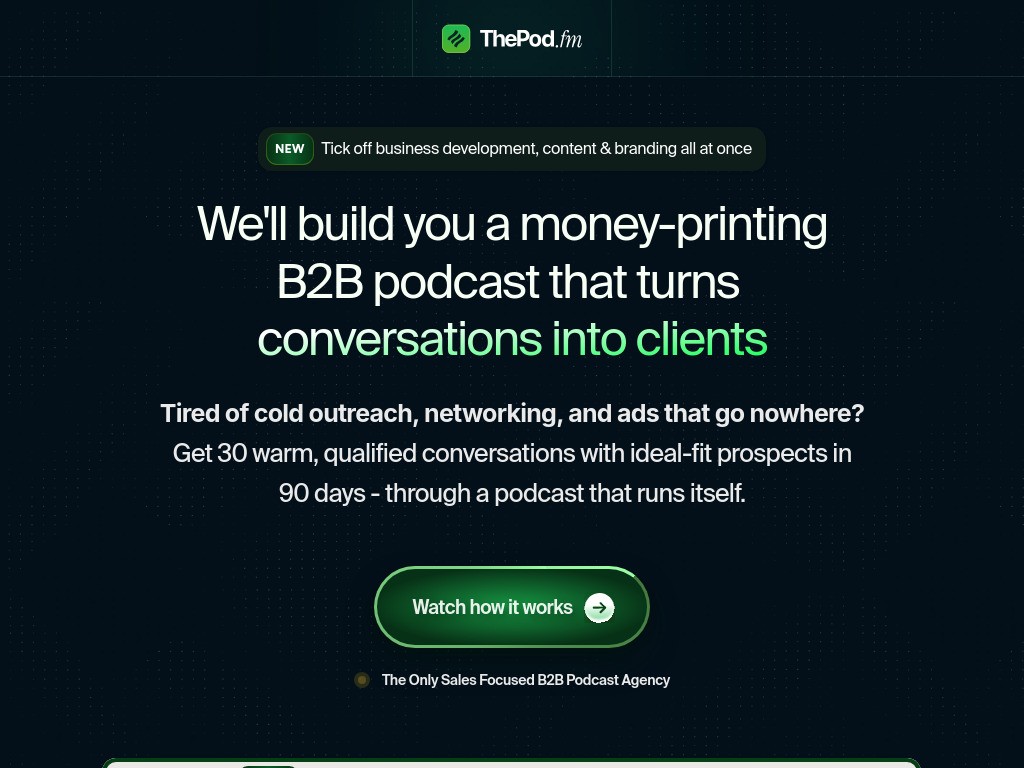
Specialisation: ROI-focused B2B podcast production that drives pipeline through relationship-led outreach and thought leadership.
Key results: $1.16M in pipeline for one client before the first episode aired; $200K in pipeline within 90 days for PAVE; 40+ meetings booked for The Venned Group; 18% invitation reply rate and 7.5% invitation-to-booked-call rate across client shows.
ThePod.fm takes a fundamentally different approach to outbound by using a branded podcast as the conversation-starter — giving prospects a compelling reason to say yes to a meeting without it ever feeling like a cold pitch. Their 90-day sprint model is built around one outcome: guaranteed booked conversations with your ideal clients, backed by a full end-to-end production service that handles everything from guest booking and recording to editing and content repurposing. The result is a scalable outreach engine that simultaneously builds brand authority and fills your pipeline.
ThePod.fm has facilitated conversations with executives from Meta, Reddit, and Shell, as well as a growing roster of fast-scaling B2B brands — making it a proven vehicle for opening doors that traditional SDR tactics often can't.
Guaranteed booked meetings with ideal-fit prospects inside 90 days
Fully managed end-to-end production — zero lift required from your team
Access to senior decision-makers at enterprise and high-growth B2B companies
Multi-channel content repurposing that amplifies reach and builds brand authority
Relationship-led pipeline generation that converts warmer, higher-quality leads
2. Intent Amplify

Specialisation: Intent Amplify specialises in AI-powered, data-driven full-funnel B2B demand and lead generation with a 100% pay-for-performance model.
Intent Amplify is a United States-based demand and lead generation agency serving B2B technology firms. They focus on leveraging AI and intent signals to enhance lead generation through project-based, pay-for-performance engagements. Their value proposition centers on identifying in-market prospects globally and managing engagement across the sales funnel to improve pipeline outcomes.
The agency employs tailored account-based marketing and multi-channel outreach methodologies, aiming for measurable ROI through demand generation, appointment setting, and content marketing. Their approach integrates data-driven strategies to support pipeline building, though exact pricing details and client workload expectations are not publicly detailed.
Delivers Account-Based Marketing campaigns targeting high-value B2B accounts
Provides end-to-end lead generation with multi-channel prospect outreach
Executes full-funnel demand generation using AI-driven intent signals
Targets technology firms with a global reach through project-based services
Operates on a 100% pay-for-performance pricing structure
Focuses on improving sales pipeline engagement and qualified appointment setting
3. Salaria Sales Solutions
Specialisation: Specialises in outbound demand generation and sales development services targeting B2B companies through cold outreach strategies.
Salaria Sales Solutions is a Washington, United States-based B2B lead generation and sales development agency operating within the management and business consulting sector. They focus on providing outbound demand generation services such as cold outreach, aiming to help clients build sales pipelines and generate leads via strategic consulting and operational sales expertise. Their value proposition centers on driving growth for B2B companies through targeted outbound sales development tactics without publicly documented guarantees.
The company employs conventional outbound methodologies and leverages management consulting principles to support sales efforts. While detailed service delivery models and client involvement levels are not extensively described, their emphasis lies in conventional cold outreach and lead generation activities for B2B organizations.
Specialises in outbound demand generation including cold outreach
Delivers sales development services to build B2B client pipelines
Provides lead generation leveraging outbound strategies
Targets B2B companies seeking growth through sales consulting
Focuses on strategic and operational management consulting for sales
Operates without publicly available pricing or performance guarantees
Visit Salaria Sales Solutions →
4. Leadium
Specialisation: Leadium specializes in US-based sales development and strategic B2B lead generation focused on SQL appointment setting.
Leadium is a Las Vegas-based B2B lead generation agency that hires and coaches US-based Sales Development Representatives to drive top-of-funnel sales activities for clients. They offer expertise in crafting personalized multi-touch outbound sequences and their approach centers on increasing qualified sales appointments and scaling sales pipelines. Their value proposition emphasizes reducing clients’ HR burden while providing strategic outbound partnership aimed at revenue growth.
Leadium’s methodology involves deploying skilled US-based SDRs to execute tailored outbound campaigns with a focus on appointment setting. Their approach includes sourcing unique lead data and managing responses to book calendar meetings, positioning them as a comprehensive outbound lead generation partner for B2B organizations.
Employs US-based Sales Development Reps for tailored appointment setting
Crafts personalized multi-touch outbound sales sequences
Sources unique lead data to enhance pipeline scalability
Targets B2B companies seeking qualified SQL appointments
Prioritizes reducing client HR burden through outsourced SDR teams
Delivers ongoing lead generation without explicit meeting guarantees
5. CIENCE
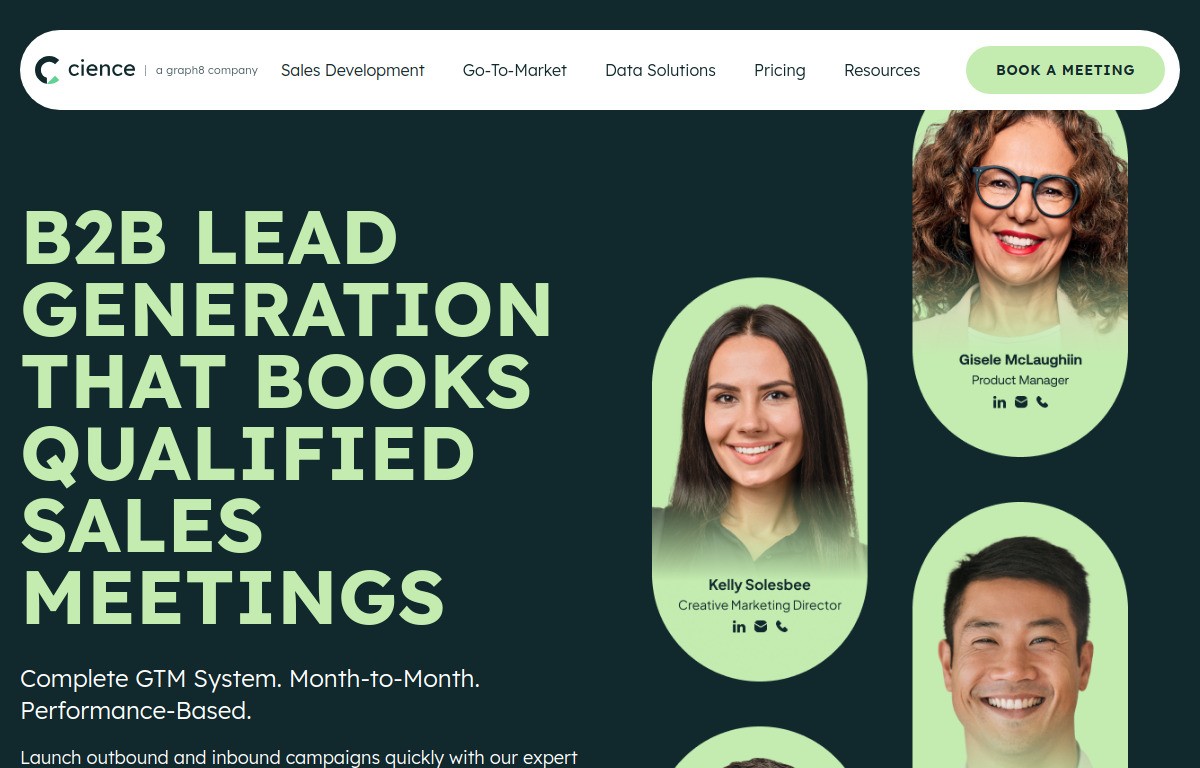
Specialisation: CIENCE specializes in AI-powered B2B lead generation and go-to-market pipeline development.
CIENCE is a lead generation and go-to-market company serving over 2,500 B2B clients across more than 250 industries. They leverage AI, machine learning, and a database of over 30 million company records to provide flexible, month-to-month sales development services focused on building measurable sales pipelines. Their value proposition centers on delivering leads, meetings, signed contracts, and pipeline revenue using the NOTE (Need, Opportunity, Team, Effect) methodology to quantify success.
The company emphasizes customized lead lists and data enrichment to target ideal customer profiles with scalable and adaptable engagements. While their AI-driven approach supports top-of-funnel outreach and lead qualification, specifics on client time involvement and guaranteed meeting outcomes are not publicly detailed.
Provides AI-powered teams to generate leads and book meetings using NOTE methodology
Utilizes extensive firmographic data from a 30 million+ company database
Offers flexible month-to-month contracts for agile sales development
Targets B2B companies seeking measurable pipeline and revenue growth
Prioritizes data-driven lead generation with a focus on scalable outreach
Services notable clients such as Okta, Shutterstock, and Yamaha
6. FRONTLINE Selling
Specialisation: Specialises in comprehensive B2B sales outsourcing and lead generation to build consistent, qualified sales pipelines.
FRONTLINE Selling is a United States-based company located in Atlanta, Georgia, focusing on providing B2B sales teams with qualified, conversation-ready leads through targeted outreach, qualification, and CRM integration. They position themselves as a reliable partner for steady pipeline creation by combining experienced personnel, proven sales processes, smart technology, and data-driven execution that avoids spam and fluff. Their approach emphasizes measurable pipeline growth enabled by a multi-touch prospecting platform and full sales outsourcing services.
The company delivers comprehensive sales outsourcing that includes targeting, outreach, qualification, and CRM handoff designed to empower sales representatives to focus on closing deals. Their methodology integrates people, process, and technology with a strong operational framework but does not explicitly include guaranteed outcome-based commitments or content creation as part of their service model.
Provides targeted B2B lead generation with conversation-ready prospects
Delivers full sales outsourcing covering account identification and outreach
Utilizes a multi-touch, data-driven prospecting system (Staccato)
Serves B2B companies seeking steady pipeline and qualified leads
Prioritizes process-integrated execution without spam or irrelevant contacts
Focuses on enabling sales reps through CRM handoff and streamlined qualification
7. The Sales Factory
Specialisation: Driving B2B revenue growth through data-driven sales strategies and outsourced lead generation with a Canadian-based expert team.
The Sales Factory is a Toronto, Canada-based B2B lead generation and sales outsourcing company that helps startups to scale-ups overcome complex sales challenges. Founded in 2018, they offer data-led go-to-market strategies, market research, and lead generation to accelerate business growth. Their value proposition combines data-driven insights, industry experience, and relationship understanding to deliver impactful sales results.
The Sales Factory specializes in leveraging a 100% university-graduated Canadian team to provide tailored sales strategies and outsourced lead generation solutions. Their methodology centers on deep market intelligence combined with strategic sales enablement, though their offerings follow traditional lead generation and sales outsourcing models without explicit outcome guarantees.
Provides tailored go-to-market strategy design for market entry and expansion
Delivers deep market research and first-party data intelligence
Executes data-driven outbound lead generation and sales development
Targets B2B startups and scale-ups seeking revenue acceleration
Emphasizes Canadian onshore teams with university education
Focuses on strategic sales enablement and solving complex sales challenges
8. DMT Business Development

Specialisation: Specialising in outbound lead generation, appointment setting, and recruitment services as an extension of sales teams for B2B companies.
DMT Business Development is a Canada-based agency helping B2B companies across sectors like SaaS, healthcare, and financial services build pipelines of qualified conversations through outbound lead generation and appointment setting. They position themselves as an external outbound team handling company and decision-maker identification, outreach, and meeting booking, while also offering recruitment and executive search services. Their approach emphasises tailored strategies and cost optimization, backed by deep industry knowledge.
The agency delivers traditional outbound methodologies focused on qualified appointments but does not integrate content production or multi-channel distribution. Their service model relies on hourly or project-based pricing with minimum project sizes, without explicit guarantees on outcomes.
Provides outbound lead generation and appointment setting for B2B companies
Offers recruitment and executive search services to support talent acquisition
Acts as an external sales development team with targeted outreach
Targets industries including SaaS, healthcare, and financial services
Prioritizes tailored client strategies and cost optimization across sectors
Delivers qualified meeting bookings without explicit performance guarantees
Visit DMT Business Development →
9. SalesCaptain
Specialisation: Specialises in building high-performing outbound marketing and sales systems for B2B SaaS and service companies using multi-channel prospecting and email campaigns.
SalesCaptain is a London-based B2B outbound and GTM agency that helps startups and established businesses grow by targeting and onboarding ideal clients through multi-channel prospecting and scalable outbound sales systems. Their approach emphasizes building sustainable and predictable sales pipelines using tools like Clay, with significant experience working with well-known companies such as Uber, Netflix, and Nestle. They focus on high-volume email campaigns and outbound activities tailored to B2B SaaS and service businesses, aiming to generate leads and consistent growth.
SalesCaptain operates primarily on fixed monthly retainers or hourly rates, offering services centered around outbound marketing and sales motions. While their methodology leverages volume-based outreach and GTM strategies, direct outcome or meeting guarantees are not specified. Their service model suggests a traditional agency setup that may require ongoing client involvement and oversight typical of outbound sales efforts.
Builds multi-channel outbound marketing and sales systems including high-volume email campaigns
Delivers outbound sales services with flexible pricing from monthly retainers to hourly rates
Utilizes tools like Clay for go-to-market execution and lead generation
Targets B2B SaaS and service companies seeking scalable outbound prospecting
Prioritizes volume-driven prospecting and pipeline predictability over guaranteed outcomes
Works with large enterprise clients such as Uber, Netflix, and Nestle
10. operatix.net
Specialisation: Operatix specializes in outsourced sales development and acceleration exclusively for B2B software vendors.
Operatix is a United Kingdom based company focused on building and managing dedicated SDR teams for B2B software and SaaS vendors. They emphasize outbound prospecting, inbound lead qualification, and account-based selling as extensions of clients' sales and marketing teams to generate pipeline and accelerate revenue globally. Their approach is built on operating multilingual SDR teams integrated into client CRM systems to shorten sales cycles and deliver qualified opportunities.
The company offers strategic market-entry campaigns and channel acceleration services to help software vendors expand internationally without in-house teams. Operatix typically provides ongoing SDR services tailored to software sales acceleration, with methodologies aimed at consistent pipeline development, though pricing and outcome guarantees are not publicly disclosed.
Specialises in outbound sales development for qualified B2B software pipeline building
Delivers inbound lead qualification to convert marketing leads into sales opportunities
Provides account-based selling strategies targeting high-value software vendor accounts
Targets B2B software and SaaS vendors operating across multiple international regions
Prioritizes multilingual SDR team management integrated into client CRM systems
Supports market-entry and channel acceleration programs for global scaling
11. Rev-Empire
Specialisation: Specialises in outsourced lead generation and sales development for B2B companies through multi-channel outbound campaigns including cold calling, email, and LinkedIn outreach.
Rev-Empire is a revenue-enablement agency serving B2B startups, scaling SMEs, and enterprise sales teams. They focus on outsourced sales services like lead generation, appointment setting, and SDR support to help clients grow revenue, with an emphasis on multi-touch outbound execution targeting global markets, primarily the US. Their approach centers on ongoing campaign execution without explicit guarantees tied to outcomes.
The agency applies conventional outbound sales tactics across various channels such as calls, email, and LinkedIn, relying on structured outreach sequences and CRM management. Their methodology emphasizes consistent activity and lead volume but does not highlight specialized content integration or time-efficient client coordination.
Generates qualified leads through cold calling, email, and LinkedIn outreach
Qualifies leads and books meetings via appointment setting services
Provides full outsourced SDR support including CRM and daily activity targets
Targets B2B markets with a focus on US-based clients
Prioritizes multi-touch outbound campaigns across multiple channels
Caters to startups, SMEs, and enterprise sales teams aiming to grow pipeline
12. Leadee
Specialisation: Leadee specialises in data-driven, omnichannel B2B lead generation focused on securing qualified meetings across multiple industries in UAE/GCC and USA markets.
Leadee is a UAE-based B2B lead generation agency delivering qualified meetings and appointments through account-based outreach, personalized campaigns, cold email, LinkedIn, and paid ads. They serve a broad range of sectors including SaaS startups, healthtech, construction, and professional services, emphasizing scalable growth with guaranteed annual appointment targets. Their approach centers on generating between 100–400+ qualified B2B appointments each year, targeting sales-ready leads across 35+ industries.
Leadee leverages multi-channel strategies tailored for its diverse client base, focusing on personalized engagement to drive lead quality. The agency’s methodology integrates data insights with targeted outreach but does not explicitly include content production or guaranteed meeting outcomes.
Delivers data-driven lead generation via account-based, multi-channel outreach
Provides specialized lead services for SaaS startups with 30-day delivery goals
Offers scalable solutions for small businesses targeting decision-maker engagement
Focuses on 35+ industries including healthtech and IT services
Prioritizes generating 100-400+ qualified B2B appointments annually
Operates without publicly disclosed pricing or explicit outcome guarantees
13. Callbox Inc.
Specialisation: Specialises in multi-channel B2B lead generation combining AI tools with human expertise for sales prospecting and appointment setting.
Callbox Inc. is a USA-based B2B lead generation agency headquartered in Encino, California, serving global enterprise clients across software, SaaS, cloud, cybersecurity, fintech, and AI sectors. Founded in 2004, Callbox leverages a hybrid approach of human and AI-driven strategies to support marketing and sales efforts, focusing on expanding markets and accelerating product launches. Their value proposition centers on delivering sales-ready leads through coordinated channels including calls, email, LinkedIn, chat, and events.
The company employs multi-touchpoint outreach and detailed prospect list building, aiming to engage decision-makers and secure qualified appointments, although service details suggest a traditional agency model without explicit guarantees on outcomes or pricing transparency. Callbox’s approach emphasizes consistent activity across multiple platforms to foster pipeline growth for business-to-business clients.
Delivers multi-channel B2B lead generation combining AI and human outreach
Provides outsourced sales prospecting to support regional business expansion
Sets confirmed appointments with decision-makers via integrated communication channels
Targets enterprise clients in technology-driven sectors like SaaS and cybersecurity
Prioritizes consistent outreach activity spanning calls, emails, social media, and events
Focuses on generating sales-ready leads and qualified appointments for global enterprises
14. Green Leads
Specialisation: Appointment setting services focused on personalized lead generation and building sales pipelines for B2B companies.
Green Leads is a B2B lead generation company specializing in appointment setting services for businesses seeking targeted outreach. They concentrate on generating one lead and securing one conversation at a time to help companies build their sales pipelines. Their approach emphasizes personalized outreach but lacks publicly available information on guarantees or pricing transparency.
Green Leads appears to utilize traditional appointment setting methodologies without integrating content strategy or outcome-based guarantees. Their service delivery and client engagement details are limited, providing a straightforward but less differentiated option in the lead generation market.
Delivers appointment setting through targeted, personalized lead generation
Focuses on building sales pipelines one lead and conversation at a time
Operates primarily within the B2B lead generation industry
Serves B2B companies seeking direct appointment setting support
Prioritizes outreach and engagement without explicit guarantees or pricing transparency
Employs standard appointment setting without integrated content marketing elements
15. Konsyg PTE Ltd

Specialisation: Konsyg PTE Ltd specializes in delivering multichannel B2B lead generation and fully managed sales outsourcing services focused on pipeline development and appointment setting.
Konsyg PTE Ltd is a Singapore-based lead generation and sales outsourcing firm dedicated to helping startups, SMEs, and enterprises scale through high-quality, sales-ready leads and accelerated revenue growth. Their approach centers on multichannel outbound strategies including email, LinkedIn, cold calling, and targeted ads to deliver 40–70 qualified appointments monthly. They provide comprehensive, scalable sales solutions eliminating the need for in-house sales teams, focusing on end-to-end sales cycle management.
Konsyg emphasizes a fully managed service model with on-demand sales teams and sales strategy optimization to improve pipeline consistency. Although they serve a broad range of B2B clients and industries, specific pricing and outcome guarantees are not publicly disclosed, with client engagement levels varying by project scope.
Offers outbound SDR activities leveraging email, LinkedIn, cold calls, and targeted ads
Delivers lead qualification and sets 40–70 qualified appointments monthly
Manages end-to-end sales cycles and provides on-demand sales teams
Caters to B2B tech startups, SMEs, and enterprises across industries
Focuses on scalable sales outsourcing to reduce overhead and in-house staffing
Supports clients with sales strategy optimization and multichannel pipeline generation
16. SDR Agency
Specialisation: Specialises in lead generation via market and prospect research combined with tailored communication and marketing strategies.
SDR Agency is a lead generation agency that focuses on connecting businesses with potential clients through detailed market research and prospect communication. They primarily serve companies seeking to generate and qualify sales leads using targeted outreach and marketing strategies. Their value proposition centers on effective prospecting to build qualified sales pipelines without explicit guarantees or pricing transparency.
SDR Agency emphasizes traditional lead generation methods based on research and outreach but does not provide detailed public information on service specifics or outcome assurances. Their approach reflects a conventional model focusing on prospect qualification rather than integrated content or revenue-focused pipelines.
Specialises in market and individual prospect research for lead generation
Delivers tailored communication and marketing strategies to connect with prospects
Focuses on qualifying and building sales lead pipelines for B2B clients
Targets businesses seeking to generate and qualify new sales opportunities
Prioritizes effective prospecting and outreach without specified outcome guarantees
Operates with a traditional lead gen approach lacking transparent pricing or time commitments
Comparing outsourced SDR agencies
Choosing an outsourced SDR agency is not about finding the biggest name. It is about finding the right motion for how you sell, who you sell to, and what kind of pipeline you actually want to build. Most teams get this wrong - they compare agencies on surface-level features instead of how those features play out in real sales conversations.
Key differences to consider
Cold outbound vs relationship-led SDR
Cold outbound is still the default for most SDR agencies - email sequences, call blocks, LinkedIn touches. It can work, but only when buyers are early in their journey or already open to being sold to.
Relationship-led SDR flips that model. Instead of interrupting prospects, it creates a genuine reason to engage. Conversations start with relevance, shared context, or value before any sales motion kicks in. Cold outbound trades speed for trust. Relationship-led SDR trades volume for quality. Neither is inherently wrong, but they produce very different pipelines - and very different buyer experiences.
Volume-based vs quality-based meetings
Some agencies win by booking as many meetings as possible. Others win by booking fewer meetings that actually close.
Volume-based agencies optimise for calendar fill - this works when deal sizes are small, sales cycles are short, and your sales team can quickly qualify out bad fits. Quality-based agencies focus on buyer seniority, intent, and context. Meetings are harder to book, but they convert at a much higher rate and waste far less sales time. If your sales team complains about bad meetings, this distinction matters more than pricing.
Short-term pipeline vs long-term authority
Most SDR programmes are built for short-term wins. Book meetings now. Worry about brand later.
Some approaches build pipeline while strengthening your authority at the same time - prospects remember the interaction and associate your company with insight rather than interruption. Short-term pipeline fills the funnel. Long-term authority compounds. The best strategies do both, but very few agencies are designed that way.
The case for rethinking cold SDR outreach
Before committing to an outsourced SDR engagement, it is worth understanding where the model struggles.
SDR outsourcing works when your prospect pool is large, your offer is easily explained in two sentences, and your buyer is reachable via cold email or LinkedIn. It becomes harder to justify when:
You are targeting VP-level and C-suite buyers who have automated cold email filters and receive dozens of outreach messages weekly
Your deal cycle requires trust before a meeting will happen
Your product or service requires a consultative conversation, not a pitch
Forrester research on B2B buying behaviour reinforces this: buyers now complete a significant portion of the purchase journey independently, before they are willing to engage a vendor's sales team. Cold outreach from an SDR they have never heard of rarely interrupts that process productively.
For companies in this position, podcast-led business development offers a structural alternative - turning prospecting into invitation rather than interruption.
Pricing models for outsourced SDR services
Monthly retainers
This is the most common model - a flat monthly fee for a dedicated SDR team or capacity. It offers predictability and works well when you want consistent outbound activity and steady pipeline over time. The risk is misalignment if the agency prioritises activity over outcomes; reporting quality matters a lot here.
Per-meeting pricing
Per-meeting models look attractive upfront - you only pay when meetings are booked. The catch is meeting quality: agencies are incentivised to book anything that shows up. If your ICP is narrow or senior, this model often backfires. It can work for high-volume motions, but it struggles with complex sales.
Hybrid performance models
Hybrid models combine a base retainer with performance-based incentives tied to meetings or pipeline. When structured well, this aligns incentives better than either model alone - the agency stays invested, but quality still matters. These models require clear definitions and trust on both sides.
An alternative to outsourced SDRs: conversation-led pipeline
ThePod.fm is not an SDR agency. It is a B2B business development system that uses podcast conversations to generate pipeline with senior decision makers - without cold outreach.
The model is straightforward: your ideal prospects are invited to appear as guests on your podcast. They say yes because it is a genuine opportunity, not a pitch. The conversation builds the relationship. Pipeline follows naturally - and every episode compounds as authority content long after the call. Not another cold email and not another LinkedIn request. A genuinely new channel that decision makers say yes to, because you are offering them something rather than asking for something.
The results are measurable. One client generated $1.16M in pipeline before the first episode aired. The Venned Group booked 40+ meetings with decision makers. PAVE generated $200K in pipeline within 90 days - all using a model built on warm, invited conversations rather than cold sequences.
The guest booking and outreach service handles prospecting, personalised outreach, and scheduling - so your team spends time in conversations, not sequences.
If you are evaluating outsourced SDR agencies because your current outbound is not performing, it is worth asking whether the volume model is the right fix - or whether the mechanism itself needs to change.
Book an intro call to see how it works.
Outsourced SDR vs in-house SDR teams
Cost comparison
In-house SDR teams come with salaries, benefits, tools, management overhead, and turnover costs. Outsourced teams bundle all of that into a single line item. Outsourcing often looks more expensive on paper until you factor in ramp time and churn - at which point the total cost of ownership shifts considerably.
Time to ramp
Outsourced SDR teams can launch in weeks. In-house teams often take months to hire, train, and stabilise. If speed matters - and it usually does when pipeline is thin - outsourcing wins almost every time.
Scalability and flexibility
Need to scale up fast, pivot ICPs, pause outreach, or change messaging? Outsourced teams are built for that flexibility. In-house teams are not. That adaptability is often the real reason companies choose to outsource SDR in the first place.
Frequently asked questions
What are the best outsourced SDR agencies for B2B in 2026?
The best outsourced SDR agencies for B2B in 2026 are those that prioritise pipeline quality over volume - they report on meetings that actually progress through your funnel, not just call and email activity. The strongest providers combine precise ICP targeting, multi-channel outreach with genuine personalisation, and transparent reporting tied to revenue outcomes. The agencies listed on this page were selected against those criteria, with particular weight on fit for relationship-led B2B sales where trust precedes the meeting.
How much do outsourced SDR agencies cost?
Most outsourced SDR agencies charge a monthly retainer, typically ranging from the mid four figures to well into five figures per month. Pricing depends on SDR headcount, seniority, channels used, and how bespoke the outreach needs to be.
Lower-cost providers tend to focus on volume and templated outbound. Higher-priced agencies usually include strategy, messaging, management, and tighter ICP targeting. The real cost question is not the retainer - it is cost per qualified opportunity that actually progresses through your pipeline.
How long does it take to see results from an outsourced SDR agency?
Most teams start seeing initial meetings within the first 30 to 60 days. That includes setup, ICP research, messaging development, and early testing. Consistent pipeline usually takes a little longer - the strongest programmes compound over time as messaging improves, targeting sharpens, and relationships stack. If an agency promises instant results with no ramp, that is a red flag worth taking seriously.
Are outsourced SDRs better than in-house teams?
They are better at different things. Outsourced SDRs win on speed, focus, and flexibility. In-house teams win on deep product knowledge and long-term ownership. For companies needing fast pipeline, market testing, or outbound expertise, outsourcing often outperforms building internally. Many teams eventually run a hybrid model once outbound is proven and the motion is stable.
Which SDR agency is best for B2B SaaS?
For B2B SaaS companies selling to senior buyers, agencies that prioritise quality over volume perform best. Traditional outbound agencies can work for high-velocity, lower-ACV products. Relationship-led models work better for longer sales cycles, higher ACVs, and crowded markets where trust matters before a prospect will give up an hour of their time. The right choice depends on deal size, buyer persona, and how saturated your prospect's inbox already is.
Can podcast-based outreach replace cold SDR outreach?
For the right companies, yes. Podcast-based business development works best when you are targeting executives, founders, or senior decision makers who routinely ignore cold emails. It creates a warm, reciprocal entry point - you are offering something rather than asking for something - without requiring a sales meeting as the first interaction. It does not replace every outbound motion, but for high-trust B2B sales with deal sizes above $10k, it can outperform traditional cold outreach by a significant margin. ThePod.fm's own benchmark data shows podcast guest invitations convert to booked introduction calls at 7.5% - versus 0.16% for cold email - a roughly 47x difference in booked-meeting rate.
What is the difference between an SDR agency and an appointment setting agency?
The terms are often used interchangeably, but there are meaningful differences in scope. SDR agencies typically handle the full top-of-funnel motion: list building, sequencing, multi-channel outreach, and handoff to sales. Appointment setting agencies tend to focus more narrowly on booking the meeting itself, often using a narrower channel mix. For complex B2B sales, the distinction matters - you generally want a partner who owns the full prospecting motion, not just the calendar invite.
What should I look for in outsourced SDR companies?
Look beyond the pitch deck. The strongest outsourced SDR companies will show you outcome data - meetings booked, pipeline influenced, close rates on meetings they sourced - not just activity reports. Ask how they handle ICP misses, what their average ramp time looks like, and whether they have run programmes for companies with similar deal sizes and buyer personas to yours. Transparency on what they do not do well is usually a better signal than a polished case study deck.
What is SDR as a service and how does it differ from hiring an SDR agency?
SDR as a service (sometimes written SDRaaS) is a flexible outsourcing model where you access trained SDR capacity on demand - typically through a monthly retainer - without hiring or managing the reps yourself. The practical difference from a traditional SDR agency is often scope and flexibility: SDR as a service providers tend to emphasise faster activation, easier scaling, and lower minimum commitments. A full-service SDR agency may include more strategic input on messaging, sequencing, and ICP definition. For most B2B buyers, the distinction matters less than the agency's track record with similar deal sizes and buyer personas.
Final thoughts
The outsourced SDR market in 2026 is large and varied. The agencies above represent the strongest options for B2B teams that need a proven outbound motion without building everything in-house.
If your sales cycle is long, your buyers are senior, or your deal sizes justify a higher-quality prospecting motion, it is also worth understanding how podcast-led pipeline generation compares - clients have generated $1.16M in pipeline before a first episode aired and $200K in 90 days using a model built entirely on warm, invited conversations rather than cold sequences.
Book a free intro call to see whether it fits your growth motion.

About the Author
Aqil Jannaty is the founder of ThePod.fm, where he helps B2B companies turn podcasts into predictable growth systems. With experience in outbound, GTM, and content strategy, he’s worked with teams from Nestlé, B2B SaaS, consulting firms, and infoproduct businesses to scale relationship-driven sales.