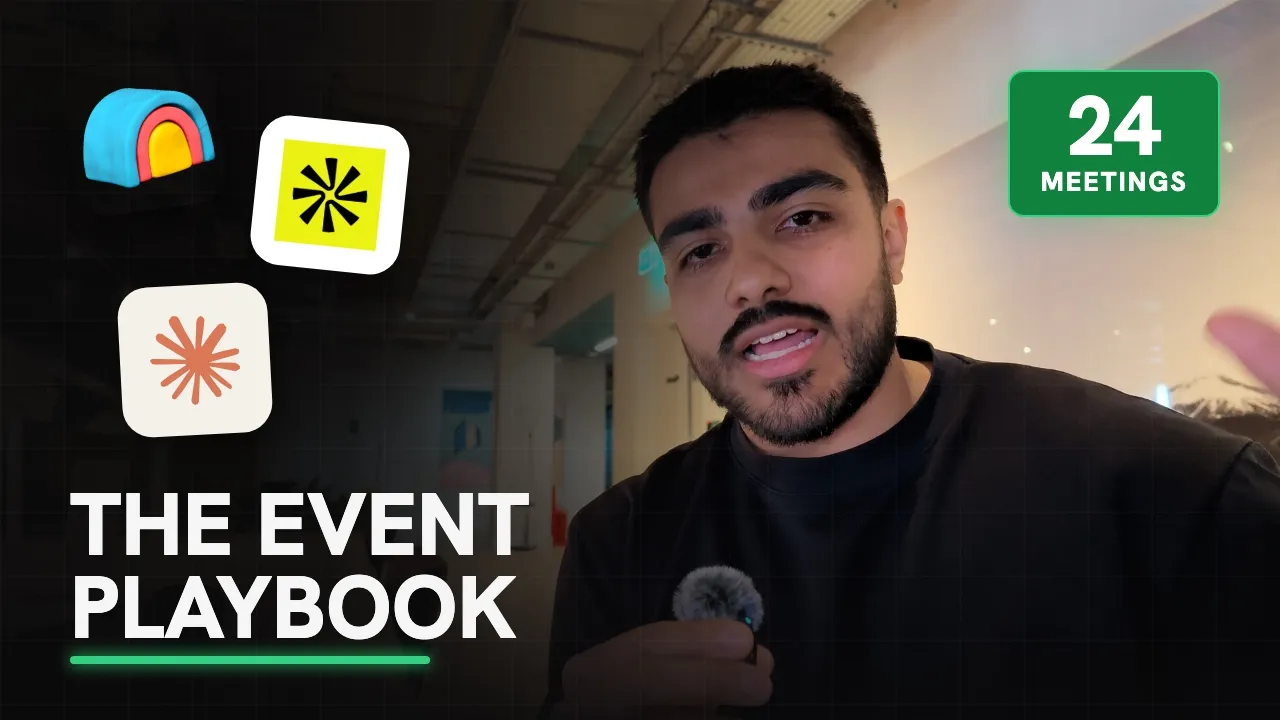





A conference is one of the most expensive things a B2B team will do all year, and one of the easiest to do badly. You can spend the budget, work the floor for two days, and come home with a stack of badge scans that never convert.
The difference between that outcome and a calendar full of qualified pipeline is rarely the event itself. It is the system you run around it.
This is a how-to for teams who are going to the conference and want to get meetings and leads from it. It is not an argument for skipping events.
If you are weighing whether the spend is worth it at all, read our take on conference alternatives for B2B pipeline and our head-to-head on events vs B2B podcasting. This post assumes you have decided to go, and you want the trip to pay for itself.
Here is the five-step playbook, then the detail for each step.
Step 1. Research and target the right attendees three to four weeks out.
Step 2. Pre-book your meetings before the event (this is the step that decides everything).
Step 3. At the event, lead with discovery, not your pitch.
Step 4. Capture context, not just a badge scan.
Step 5. Follow up fast, within 24 to 48 hours.
Step 1: How early should you start conference outreach?
Start three to four weeks before the event. That window is long enough to get the attendee or sponsor list, filter it to your ideal customers, and reach the people who matter before their calendars fill up, but late enough that the event is real to them.
The work in this step is unglamorous and it is where most of the result is won or lost. Get hold of the attendee, speaker and sponsor lists.
Many organisers publish them, share them with exhibitors, or surface them inside the event app; if not, the speaker and sponsor lists alone are public and usually full of senior people. Then filter hard.
You are not trying to meet everyone. You are trying to identify the named accounts and individual buyers who fit your ideal customer profile, the ones a real conversation could turn into a deal.
Once you have a shortlist, do the homework that makes outreach personal. LinkedIn Sales Navigator is the obvious tool here: build a list of your filtered attendees, check who has changed roles recently, who is posting about the problem you solve, and who you share a connection with.
The goal is that every person you contact gets a message that could only have been written for them, referencing the event, their role, and something specific about their world. A targeted list of forty of the right people beats a scraped list of four hundred every time.
Step 2: Should you book conference meetings in advance?
Yes, and it is the single most important step in the playbook. The meetings you book before you arrive are the ones that produce pipeline.
The conversations you hope to stumble into on the floor mostly do not happen. Walk in with a schedule, not a hope.
The standard play is to send a short, low-friction invitation to each person on your shortlist. Keep it to a sentence or two.
Offer something easy: a fifteen-minute coffee between sessions, a quick hello at your stand, a slot booked through the event app. Do not pitch.
The ask is for a brief conversation, not a demo, and the lighter the ask, the more people say yes. This works, and if you do nothing else, do this.
There is a better play, and it is the one that has worked best for us. Instead of asking for a meeting, lead with an invitation to be a guest on your podcast.
Rather than "can I grab fifteen minutes to tell you about us," the message becomes "I am recording conversations with leaders working on [their problem] and I would like to feature you." The difference in response is not small. When we led pre-event outreach with a podcast guest invitation rather than a cold meeting request, around 29% of targeted attendees booked a meeting. That is one result from our own outreach, not a guarantee, and your numbers will depend on your list and your follow-through. But the reason it works is structural, not lucky.
Three things make a guest invitation outperform a meeting request:
You are offering something, not asking for something. A meeting request asks a senior buyer to spend their time hearing about you. A guest invitation offers them a platform, an audience and a bit of recognition. One is a cost to them; the other is a gift.
It is the one invite a senior buyer actually says yes to. Decision makers decline sales meetings reflexively because they get dozens. Almost nobody is being invited to share their expertise on a show, so the invitation stands out instead of blending in.
It sets up a far warmer conversation on site. When you meet at the event, you are not meeting to sell. You are meeting to plan a recording, or to record there and then. You arrive as someone interested in their thinking, which is exactly the footing a relationship-led deal needs to start on.
If you want to go deeper on running this as a repeatable motion rather than a one-off, our guide to a B2B podcast guest strategy covers how to build and work a guest list.
Step 3: What should you do when you meet someone at the event?
Lead with discovery, not your pitch. Spend the first part of every conversation asking about their goals and challenges, and listen more than you talk.
People decide whether they trust you in the first few minutes, and nothing earns that trust faster than genuine interest in their problem.
The instinct at an event is to make the most of your few minutes by getting your message out. Resist it.
The buyer already knows roughly what you do, or can find out in seconds. What they cannot get from anyone else is the feeling of being properly understood.
Ask what they are trying to achieve this year, what is getting in the way, and what they have already tried. If you have led with a podcast invitation, this is natural: you are there to learn about their work, so the discovery happens automatically and never feels like an interrogation.
This matters commercially, not just socially. B2B buyers spend only a small fraction of their buying journey actually talking to potential suppliers, so the few minutes you get are precious.
Spending them on discovery rather than a pitch is what makes a buyer want the next conversation. The pitch can wait for a meeting they have actually agreed to.
Step 4: How do you capture leads at a conference without losing the context?
Capture context, not just a badge scan. A scan gives you a name and an email.
What you actually need is the pain they described, the solution they need, and the specific next step you agreed, while the conversation is still fresh.
The badge scan is the trap. It feels like progress, you leave with three hundred of them, and not one tells you why the person mattered or what you said you would do next.
After every real conversation, take thirty seconds to note three things: the problem they raised, what a good solution looks like for them, and the next step you both agreed to. A voice memo on your phone works fine.
These notes are what make your follow-up personal instead of generic, and personal follow-up is the only kind that converts.
Do one more thing in the moment: send the LinkedIn connection request during or right after the conversation, while you are still standing together. It is far more likely to be accepted there than as a cold request a week later, and it gives you a channel to follow up that does not get lost in an inbox.
Step 5: How quickly should you follow up after a conference?
Fast. Within 24 to 48 hours, while the conversation is still real to both of you.
Speed of follow-up is one of the most reliable predictors of whether a lead converts, and the decay is steep. Research on lead response found the odds of qualifying a lead drop more than sixfold if you wait an hour rather than responding within five minutes (Lead Response Management Study).
You will not hit five minutes after a conference, but the principle holds: the longer you leave it, the colder the lead, and the conferences where teams "get to the follow-up next week" are the ones that produce nothing.
A good follow-up has three parts. It is personalised with something specific from your conversation, so they know it is you and not a mailshot.
It references the next step you both agreed to, so there is no ambiguity about why you are writing. And it includes a direct calendar link, so booking the next conversation takes one click rather than an email thread.
If you led with a podcast invitation, the follow-up writes itself: you are confirming the recording, which is a warm, expected next step rather than a sales push.
Get those five steps right and you will outperform almost everyone else at the event, most of whom are still relying on luck and a lanyard.
How do you make conference relationships repeatable?
The honest problem with conferences is the maths. A serious B2B event runs somewhere between $3,000 and $12,000 all-in once you add the ticket, the stand, flights, hotels and the days your best people spend out of the business.
And the spend is hard to justify even when you do everything in this playbook, because events are simultaneously the biggest line in many B2B budgets and the hardest to prove. Forrester reports that events "consistently take the largest slice of the annual B2B marketing budget pie, averaging 12% of program spend," yet only 18% of event technology vendors say their clients can demonstrate measurable returns on it.
You can run a brilliant conference and still struggle to show, line by line, what it bought you.
So here is the bridge worth thinking about. The relationships you work this hard for at one event, the senior buyers, the warm conversations, the genuine interest, you can build continuously by inviting those same people to be guests on a podcast.
It is conference-grade warmth without the booth or the flights: one conversation produces a real relationship and a pipeline opportunity now, and a piece of authority content that keeps working for months afterwards. The guest invitation that gets people to your stand is the same invitation that fills your calendar all year, not just the week of the show.
That is the whole idea behind turning podcast guests into clients: the conversation is the relationship, and the recording is the asset.
Used together, the event becomes the introduction and the podcast becomes the engine that makes every introduction repeatable.
Frequently asked questions
How early should I start conference outreach?
Three to four weeks before the event. That gives you time to get the attendee, speaker and sponsor lists, filter them to your ideal customers, and reach those people before their schedules fill, without being so early that the event is not yet on their radar.
The earlier you have a shortlist, the more pre-booked meetings you walk in with.
What is a good meeting-booked rate from conference outreach?
It varies with your list quality and the strength of your offer, so treat any single number as a benchmark, not a promise. As a reference point, when we led pre-event outreach with a podcast guest invitation instead of a cold meeting request, around 29% of targeted attendees booked a meeting.
A plain meeting request to a well-targeted list typically converts lower, which is exactly why the offer you lead with matters so much.
How do you follow up after a conference without being pushy?
Make the follow-up about them, not about your pitch. Reference something specific they said, restate the next step you both agreed to, and include a calendar link so booking is one click.
Sending it within 24 to 48 hours helps too: a fast, relevant note reads as attentive, while a generic one sent a week later reads as a mass mailing. If you agreed to record a podcast conversation, confirming that is a warm next step rather than a sell.
Are conferences still worth it for B2B lead generation?
They can be, if you run them as a campaign rather than a stand to lean on for two days. Worked well, with pre-booked meetings and fast follow-up, a conference produces real pipeline.
The catch is cost and proof: events are the largest slice of many B2B budgets yet the hardest to attribute, which is why the smartest teams pair them with a channel that builds the same warm relationships continuously. See our comparison of events vs B2B podcasting for how the two work together.
If you want help turning the buyers you meet at events into a year-round pipeline of warm, recorded conversations, book a short intro call with ThePod.fm and we will map it to your buyers.
About the Author
Aqil Jannaty is the founder of ThePod.fm, where he helps B2B companies turn podcasts into predictable growth systems. With experience in outbound, GTM, and content strategy, he’s worked with teams from Nestlé, B2B SaaS, consulting firms, and infoproduct businesses to scale relationship-driven sales.