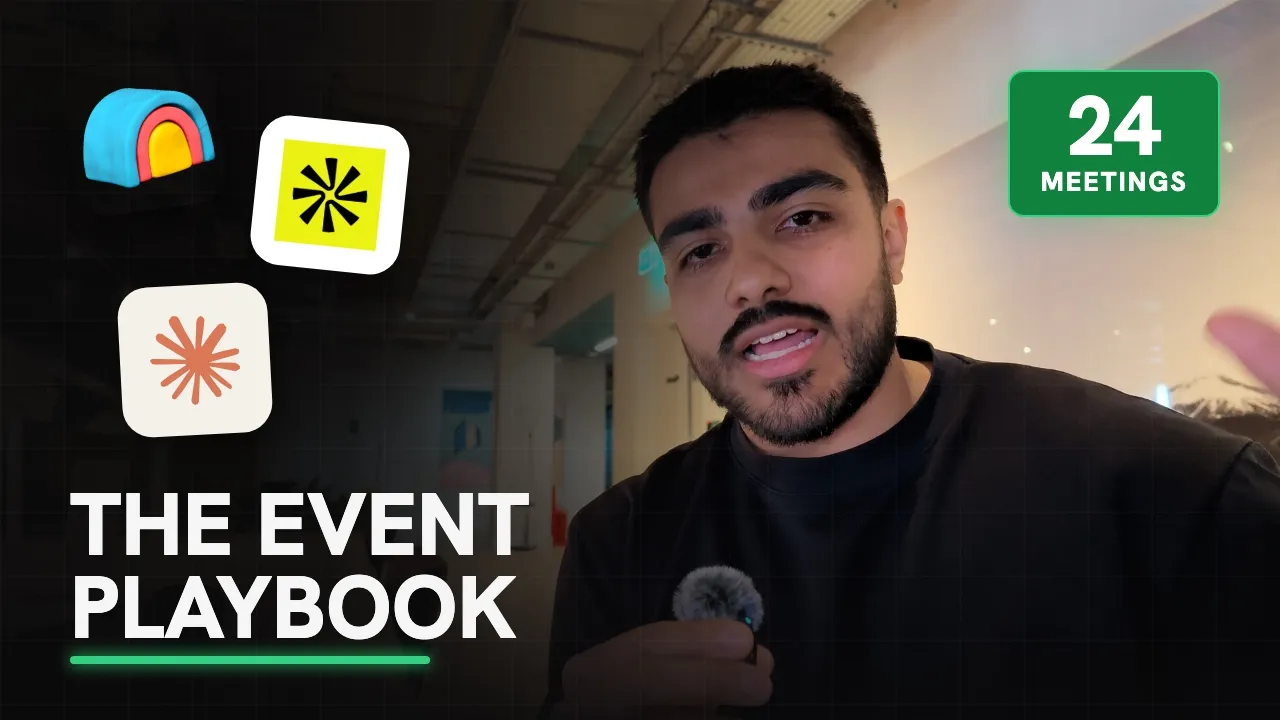





Why does a single conference cost so much for so little?
Most B2B teams know the feeling. You book a stand at a regional conference, spend the better part of a week preparing, fly out, work the floor for two days, and come home with a stack of business cards and a vague sense that "it was good to be seen." Three months later, almost none of those cards have turned into revenue.
The spreadsheet says you spent thousands. The pipeline says you gained very little.
This is not an argument that events are worthless. They are not.
But the gap between what events cost and what they reliably return is wide enough that it deserves honest scrutiny, especially for business-services and SaaS companies trying to reach a specific, named set of buyers. This post compares in-person events and B2B podcasting as pipeline channels: what each genuinely offers, what each costs, and how to decide where your time and budget should go.
What do in-person events actually offer?
Events have real, defensible value, and it is worth naming it clearly before weighing the costs.
Brand presence and category visibility
Being physically present at the right conference signals that you are a serious player in your space. Buyers, partners, and competitors all see you there.
For younger companies trying to establish credibility in a category, that presence can matter more than any single conversation.
Serendipity and face-to-face trust
Some of the best business relationships start with an unplanned hallway conversation. Events compress a lot of people into one place, and the in-person format builds trust faster than a screen ever will.
A firm handshake and a shared coffee still carry weight in B2B.
Deepening existing relationships
Events are often better at strengthening relationships you already have than at creating new ones. Dinner with an existing client or a face-to-face with a partner you usually only email can be worth the trip on its own.
What does an event really cost?
The ticket price is the part everyone sees. It is rarely the largest line item.
The visible spend
A single conference can run to around $3,000 or more just to attend, and that figure climbs sharply once you factor in everything around it. If you exhibit, a booth adds a significant cost layer on top, often several times the price of a ticket.
Across B2B marketing, in-person events are consistently the single largest line item in program budgets (Forrester).
The hidden spend
Travel and accommodation stack up quickly, particularly for a team of two or three. Then there is the cost that never appears on an invoice: time out of the business.
Days spent travelling, standing on a show floor, and recovering afterwards are days not spent on billable work or active deals.
The yield problem
Here is the uncomfortable part. After all of that, a typical outcome is a handful of business cards, most of which never convert.
You might come home with thirty contacts and turn two into conversations. The cost per genuine opportunity, once you do the maths honestly, is often far higher than it first appears.
What are you actually going to events for?
Strip away the lanyard and the swag, and the real reason teams attend events is simple: relationships and direct conversations with the people they want to reach. Nobody flies across the country for the conference Wi-Fi.
They go to sit across from a prospect, have a real exchange, and start a relationship that might lead somewhere.
That is the core value. And once you isolate it, an obvious question follows.
If the thing you actually want is a scheduled, direct conversation with a specific person you are trying to reach, do you need the flight, the booth, and the show floor to get it?
How does B2B podcasting deliver the same core value?
B2B podcasting answers that question directly. At its heart, it is a method for booking a scheduled, one-to-one conversation with a named person you want a relationship with, the exact buyer, partner, or industry voice you would have hoped to bump into at a conference, except you choose them deliberately rather than leaving it to chance.
You choose exactly who to invite
At an event, you meet whoever happens to be there. With a podcast, you build a guest list.
If your ideal customer profile is narrow and hard to advertise to, a common situation for business-services and SaaS companies, this is a meaningful advantage. Paid ads are inefficient when your audience is a few hundred named accounts; a guest invitation reaches them as a person, not an impression.
It is a more relationship-first approach than most outbound, which is partly why some teams treat it as an alternative to SDR agencies.
The conversation scales beyond one room
An event puts you in front of the few people you physically meet. A podcast conversation reaches that one guest directly and then, as content, reaches everyone who reads or listens afterwards.
You are not limited to the people who walked past your booth.
It produces a tangible asset
A conference badge is gone the moment you bin it. A recorded conversation becomes an episode, clips, a blog post, and social content, which is why B2B podcasting works as a content engine rather than a one-off touchpoint.
The relationship and the marketing asset come from the same hour of work.
What does the conversation-to-pipeline link look like in practice?
The mechanism is straightforward: a warm, substantive conversation with the right person tends to open doors that a cold pitch cannot. When the invitation is to be a guest, to share their expertise rather than sit through a sales pitch, acceptance rates and goodwill are higher.
One podcast-led programme generated $1.16M in pipeline before its first episode even aired, added $200K within 90 days, and booked more than 40 meetings off the back of guest conversations. Results like that are not guaranteed, and no channel can promise revenue.
But the underlying logic is sound: the conversation itself is the pipeline activity, and the content is a by-product that keeps working long after the call ends. You can see how this plays out across different companies in our case studies.
Events vs B2B podcasting: a side-by-side comparison
Factor | Events | B2B podcasting |
|---|---|---|
Typical cost to participate | ~$3,000+ per event, plus travel, accommodation, and a booth if exhibiting | Production and outreach cost; no travel or booth |
Who you reach | Whoever attends, largely left to chance | Named guests you choose deliberately |
Reach beyond the room | Limited to people physically present | Guest plus the wider audience for the content |
Time cost | Days of travel and floor time per event | Roughly an hour per recorded conversation |
Lasting asset | Business cards and memories | Episode, clips, blog, and social content |
Best for | Brand presence, serendipity, deepening existing ties | Reaching specific, hard-to-advertise buyers at scale |
Relationship type | Often broad and shallow, occasionally deep | Direct and one-to-one by design |
Who is each channel actually for?
When events make sense
Events earn their cost when brand presence is a genuine goal, when your category runs on in-person gatherings (some industries simply do), or when you need to deepen relationships with people you already know. If your buyers all congregate at two flagship shows a year, being absent is its own risk.
For these jobs, events are hard to replace.
When B2B podcasting makes sense
Podcasting tends to win when your ICP is specific and hard to reach through advertising, when you want predictable, repeatable conversations rather than a once-a-year scramble, and when you want each conversation to leave behind a usable asset. Business-services firms and SaaS companies selling to a defined set of accounts often find it does the relationship-building job of events without the per-event cost or the dependence on who happens to show up.
Can you use both together?
You can, and the smartest teams do. The two channels are complementary, not mutually exclusive.
The cleanest way to combine them: record podcast episodes with the people you meet at events. A hallway conversation that might otherwise fade becomes a scheduled, recorded discussion a few weeks later, turning a fleeting introduction into a real relationship and a piece of content at once.
Events become a top-of-funnel discovery mechanism, and the podcast becomes the follow-up engine that does something durable with each introduction.
Used this way, the event spend works harder, because every promising contact has a natural next step beyond "let's stay in touch." If you want help building that follow-up engine, structured podcast guest outreach turns a list of target accounts into booked conversations.
How should you decide where to put your budget?
Start with the job you are hiring the channel to do. If the goal is visibility in a category that lives on in-person events, weight your budget toward the right shows.
If the goal is direct pipeline from a specific, named set of buyers, and you want each touch to produce content as well, B2B podcasting usually returns more per pound. Most teams do not have to choose absolutely; they decide the split based on which job matters most this quarter, and let each channel do what it does best.
If you would like to talk through the right mix for your situation, you can book an intro call and we will map it to your goals, no pitch required.
Still attending events this year? See our practical guide to getting leads from a B2B conference.
Frequently asked questions
Are in-person events a waste of money for B2B?
No. Events deliver genuine value for brand presence, serendipitous meetings, and deepening existing relationships. The issue is that their cost per new opportunity is often high, so they work best when visibility or relationship-deepening, not raw new-pipeline volume, is the goal.
Is B2B podcasting cheaper than attending conferences?
Usually, yes, on a per-conversation basis. There is no travel, accommodation, or booth cost, and the time investment is roughly an hour per recorded conversation rather than days per event.
The main costs are production and outreach.
How does a podcast actually generate pipeline?
By turning a guest invitation into a warm, substantive conversation with a specific person you want a relationship with. Being invited to share expertise carries more goodwill than a cold pitch, and the relationship that forms can open commercial doors the recording was never explicitly about.
Who should choose podcasting over events?
Business-services firms and SaaS companies with a narrow, hard-to-advertise ICP tend to benefit most, because they need to reach specific named accounts rather than a broad audience, exactly where paid ads and large conferences are least efficient.
Do I have to give up events entirely?
No, and most teams should not. The strongest approach uses events for discovery and category presence, then records podcast episodes with the best contacts you meet there, so the two channels reinforce each other instead of competing for budget.
How many guests do I need before it is worth it?
There is no fixed number, but the value compounds. Each conversation is both a relationship and a reusable content asset, so even a modest, consistent cadence of the right guests tends to outperform a single expensive event over time.
Does podcasting replace in-person trust-building?
Not entirely. In-person meetings still build trust uniquely fast.
A recorded conversation gets remarkably close, though, and it scales in a way that physical attendance cannot, which is why many teams use it as their primary relationship channel and reserve events for specific, high-value moments.

About the Author
Aqil Jannaty is the founder of ThePod.fm, where he helps B2B companies turn podcasts into predictable growth systems. With experience in outbound, GTM, and content strategy, he’s worked with teams from Nestlé, B2B SaaS, consulting firms, and infoproduct businesses to scale relationship-driven sales.